
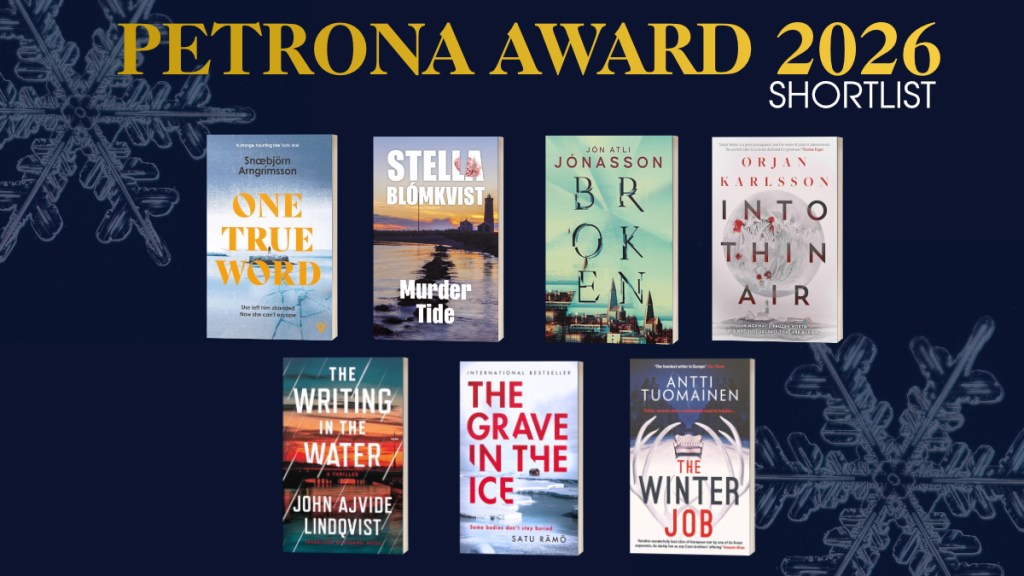
Before the announcement of the Petrona Award 2026 Winner, from the shortlist below, on 22nd October, Karen (Euro Crime), the Petrona Award administrator, decided that crime fiction cross-examination was required. Hence the introduction to three judges: Jackie, Sonja and Ewa (me), Karen’s fiendish questions, and our answers.
1. The judging panel is truly international so let’s start with where were you born / live now?
Jackie: Have always lived in the UK.
Sonja: I was born and bred in the Western Cape of South Africa. We live in a Cape Town suburb that offers the best of both worlds: vineyards on one side, and Cape Town CBD just a stone’s throw away. Even though I’ve travelled extensively, South Africa will always be my home and I’m truly lucky to live in one of the most beautiful parts of the world with the friendliest people, lots of culture and the most delicious food!
Ewa: I was born in Poland, lived for nearly thirty years in the UK, and now I’m based in a small town by a non-touristy fjord in Norway.
2. Can you remember the first Scandinavian crime novel you read (in translation) and if so do you remember when that was?
Jackie: Roseanna – Maj Sjöwall / Per Wahlöö. Picked up an old, battered copy of this in a thrift sale when I was a teenager, and then tracked down the rest of the series as quickly as I could! From there my love of Scandinavian crime fiction and fiction was born…
Sonja: Miss Smilla’s Feeling for Snow by Peter Høeg immediately comes to mind. Even though I wasn’t aware of Scandi or Nordic Noir at the time, I knew there was something in the setting, theme, or social commentary of the novel that intrigued me immediately.
Ewa: As a child I read many books by Tove Jansson and Astrid Lindgren translated into Polish. Although they were not crime I felt strong connection to Scandinavian culture and history and I later realised they presented various social topics hidden within children tales. The Redbreast, one of Jo Nesbø’s earlier books, made a huge impression on me. Apart from a gripping narration, it dealt with WWII history and its impact on Norwegian ordinary citizens, as well as Norway’s post-war national trauma tied to the Nazi collaboration. This led me to read more about Nordic / Scandinavian countries in general.
3. What attracts you to Scandinavian crime fiction?
Jackie: I really enjoy the socio-political element of the genre, giving us a window into the Nordic societies, which outwardly seem almost halcyon in some respects, but are actually pervaded by the same societal, political and criminality issues that we recognise from our own. I also like the gender balance that tends to exist where women are not so often portrayed as victims and have more agency. Obviously I love the sense of darkness that usually permeates these books both in plot and characterisation, but also the unexpected glimpses of mordant or absurd wit that some authors exhibit. It’s a smorgasbord of enjoyment!
Sonja: I think it is a combination of reading about countries and cultures far removed from my own, the mystery of crime-solving, and the strong social commentary. The latter feels particularly relevant since I live in a country where people have a strong awareness of social injustices.
Ewa: The mood, atmosphere and environment of the Cold Climate are mesmerising. The settings: distant, mysterious, known from social media and travel logs, inviting or frightening, affect the fictional characters and their actions, and their stories are told in nuanced ways. I am interested in how the stunning yet tough nature and locations shaped human lives and human perceptions of local places and wider world. The writing is often sparse yet emotive. The humour, especially dark or dry, is unexpected and welcoming. All that plus the social and political issues, including the state of Europe and how Scandinavia finds its identity there in recent years, make for truly engaging crime fiction novels.
4. Why do you think it is still so popular in the UK? Is it popular where you live?
Jackie: I think it’s still popular because of the window it gives other Europeans into Nordic life and society. Also because there are so many sub-genres of the crime genre. Where some are incredibly dark, visceral and unsettling, there are those that have cynical private investigators, maverick detectives, a touch of the Golden Age tradition, a sense of the absurd, ones that touch on the countries’ troubled historical past, or conniving families and career criminals. It’s a great mix and something for everyone!
Sonja: There are certainly avid readers of Scandi Noir in South Africa, but people tend to read what they are familiar with. Of course, Deon Meyer remains the most popular author. That being said, alongside recipe books, investigative journalism, and true crime, crime fiction remains the best-selling genre, which is reassuring!
Ewa: In Norway – absolutely! There are many small crime fiction gatherings and festivals around the country throughout the year, often arranged by an author and supported by the publishing houses, local libraries and / or local councils. For example in October readers can come to Kongsberg Krimfestival, or Thomas Engers Krimfestival in Jessheim, and in November to Kristiansand Krimfestival. Oslo has its own Krimfestivalen each March. Norwegians have the longstanding and firmly established tradition of påskekrim or Easter Crime. This is the time to enjoy all types of crime fiction, both on screens and on pages of very popular novels. It goes back to a very successful advertising campaign for Jonathan Jerv’s crime novel. The book, written by two young students Nordahl Grieg and Nils Lie, was launched spectacularly in the country’s biggest newspaper ‘Aftenposten’ on Saturday 24 March 1923, the day before Palm Sunday, with a seemingly real headline at the top of the first page. The words ‘The train to Bergen plundered last night’ were in fact a title, rather than a real news item. The rest is a history, or an incredible interpretation of the fact that reading during holidays can be so enjoyable.
5. Do you have a favourite subgenre of Scandinavian crime fiction and are you willing to say who your favourite authors and translators are?
Jackie: I am a sucker for a grizzled maverick detective, journalist or private eye and I love a bit of dark humour, so no, I don’t really have a favourite sub genre and having the privilege of reading for The Petrona Award every year, it’s always good to keep an open mind!
Sonja: I have a soft spot for police procedurals and a well-written hard-boiled crime novel, particularly one with a good dose of dark humour, will hook me every time. Generally, I am not too fond of cosy mysteries, domestic noir or historical crime.
There are so many great Scandi Noir writers beyond the well-knowns, i.e. Henning Mankell, Jo Nesbo, and Stieg Larsson. Some of my favourites are Malin Persson Giolito, Samuel Bjørk, Max Seeck, Anne Holt, Jussi Adler-Olsen, Karin Smirnoff, and Gunnar Staalesen. I also enjoyed Icelandic writer Hildur Knutsdottir’s horror thriller, The Night Guest, and I look forward to her latest, Dead Weight. One of my all-time favourites is Leif GW Persson’s ‘Story of a Crime’ series and The Dying Detective. Likewise, you can always trust translations by Don Bartlett and Victoria Cribb.
Keep an eye out for authors published by smaller, indie presses such as Orenda Books, Pushkin Press, and Corylus Books. That is where you will find the real gems. Unfortunately, the Scandi Noir market has been flooded since it became more popular, and sadly, not all of them are worthy of the label.
Ewa: I’m not fussed about a subgenre but want a great story that will make me think and reflect, hide behind a sofa, reach for a map, or forget about the world. There are too many favourite authors to list them all here. However, I will say that I have huge admiration for translators who bring these books to life in the English language. Some of them have worked with the same writers over long periods of time and become their English voices. I’m in awe of Neil Smith, Don Bartlett, Ian Giles, Anne Bruce, Kari Dickson, Victoria Cribb, Quentin Bates, Lucy Moffat, David Hackston, Charlotte Barslund. I also always look for connections within and between books. For example, Ørjan Karlsson mentions a character reading Gunnar Staalsen’s novel on a beach in Barcelona. You’ll have to find out which book it is…
6. And finally, where can we find more of your writings?
Jackie: I’m very active on social media as @ravencrime and also have a blog Raven Crime Reads.
Sonja: In the UK, I regularly review for Crime Fiction Lover and occasionally for the European Literature Network. In South Africa, I review for Afrikaans for newspapers and magazines. All my English reviews are available on my blog, West Words Reviews, and on social media under the same handle, e.g. https://www.instagram.com/westwordsreview/
Ewa: I have a blog Nordic Lighthouse and also review various genres for European Literature Network. My earlier reviews are on Crime Review and Euro Crime.

