
I am very very lucky to have some of my reviews published on the pages of European Literature Network. This particular review is available there as well but I wanted to share it on my blog, too. Here’s the link to Your Absence is Darkness. And I would absolutely recommend that you check other interesting articles written by extraordinary people who contribute #RivetingReviews.
Have you ever seen photographs of rivers and streams meandering through the rugged terrain of Iceland? The way they create their own space, take ownership of obstacles and thrive in the beautiful, unexplored countryside? As I was reading Jón Kalmann Stefánsson’s latest audacious novel Your Absence is Darkness, I was reminded of this Icelandic landscape. I fell under the spell of the storytelling, which meanders through time and locations, taking in life and death, punctuated by raw love of many kinds, and leading the reader to a perfect conclusion.
The powerful narrative, which is both stoic and emotional in equal parts, moves at a pace dictated by both the weather and the speed at which memories come to the surface. An unnamed man finds himself awake in a church in rural Iceland. He remembers nothing – he has completely lost his bearings – but he knows the presence of a stranger makes him feel uncomfortable.
This mysterious shape-shifting figure will accompany him on a journey of discovery. First a local woman helps him reunite with his sister. Then, as he listens to her stories about previous generations, he slowly submerges himself in a history that spans centuries, telling tales of the people who have loved, lost, fought, survived and died in the isolated, windswept farms and small villages on the Snæfellsnes Peninsula in western Iceland, whose stunning, unforgiving landscape has been influencing the ordinary lives of its inhabitants for centuries.
As the narrator begins to question this correlation between the natural environment and the economic situation of the inhabitants of these villages, which have changed very little over the years – ‘Blessed darkness, accursed damp – the history of Iceland?’ – we get to know the fates of the members of one particular family. Eirikur, a musician abandoned as a child by his mother, is running away from his Icelandic past, but suffers from loneliness and cannot connect with his father. A girl, chasing after the memory of one, intense blue-eyed gaze, moves from Reykjavik to the fjords. An uneducated farmer’s wife writes an essay on the earthworm, ‘the blind poet of the soil’ and unwillingly changes the course of two families’ lives. Petur, a pastor, neglects his wife, writes to a dead poet and falls in love with a stranger. An alcoholic father leaves those close to him and follows the starry night sky. We see dramatic events forcing men and women either to abandon their homes or stay firmly put, emigrate to Canada or settle for compromise, moved by love, pride or sense of duty. Just like in Iceland’s ancient sagas, the novel’s characters are bound together in a family history that spans around two hundred years.
Human tragedy links these individual stories, each of which deserves attention and patience from the reader. It seems that these characters cannot escape a brutal, often inexplicable destiny, but even as the natural world around them guides their daily existence, and even their morality, they also crave joy and a sense of belonging. Tenderness appears in the most unexpected places, humour provides some light, while Danish philosopher Søren Kierkegaard reminds the characters that they are loved: ‘Your memory is light, your absence darkness’.
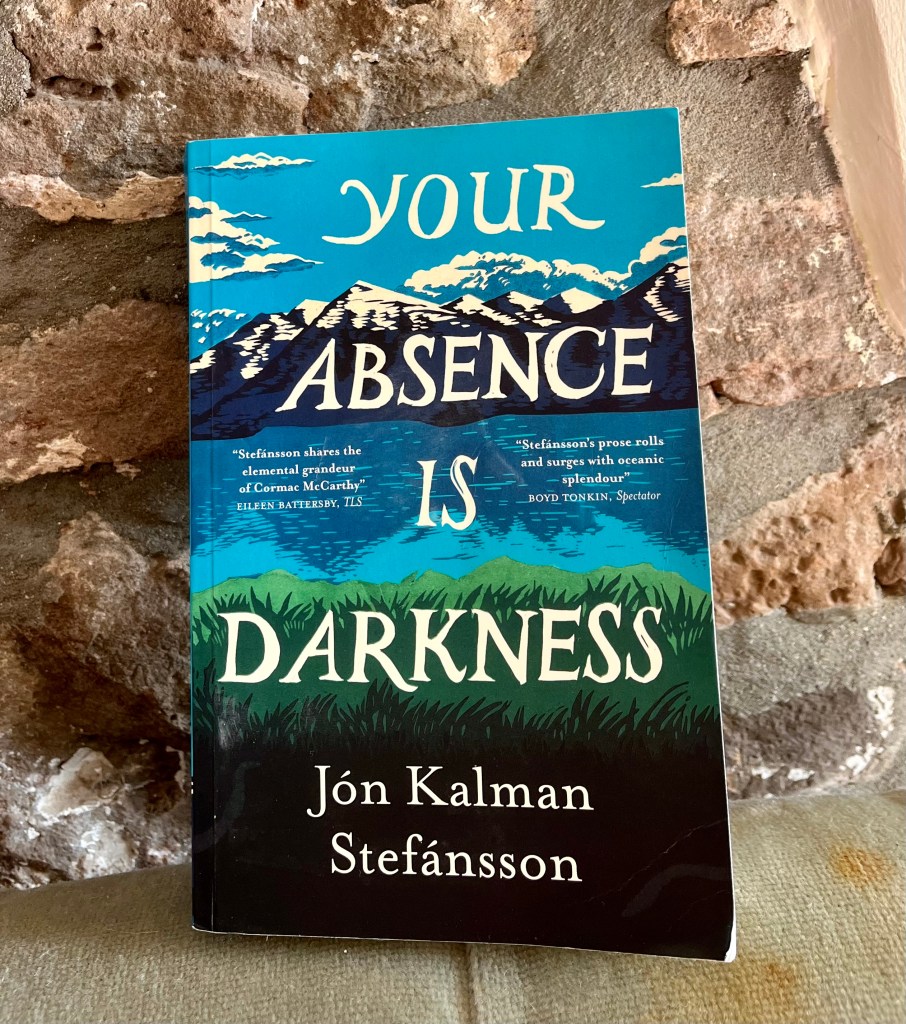
Philip Roughton’s translation is superb, with the novel’s rhythm and tempo beautifully executed, especially when it comes to the way repetitions of words and phrases add to the overall sense of uncontrollable fate and the tensions between faith and biological fact. Stefánsson’s style – complex, intriguing, nuanced – in this translation flows like those Icelandic rivers.
 Nordic Lighthouse
Great review, Ewa! I am buying this!
Michael
>
LikeLike