
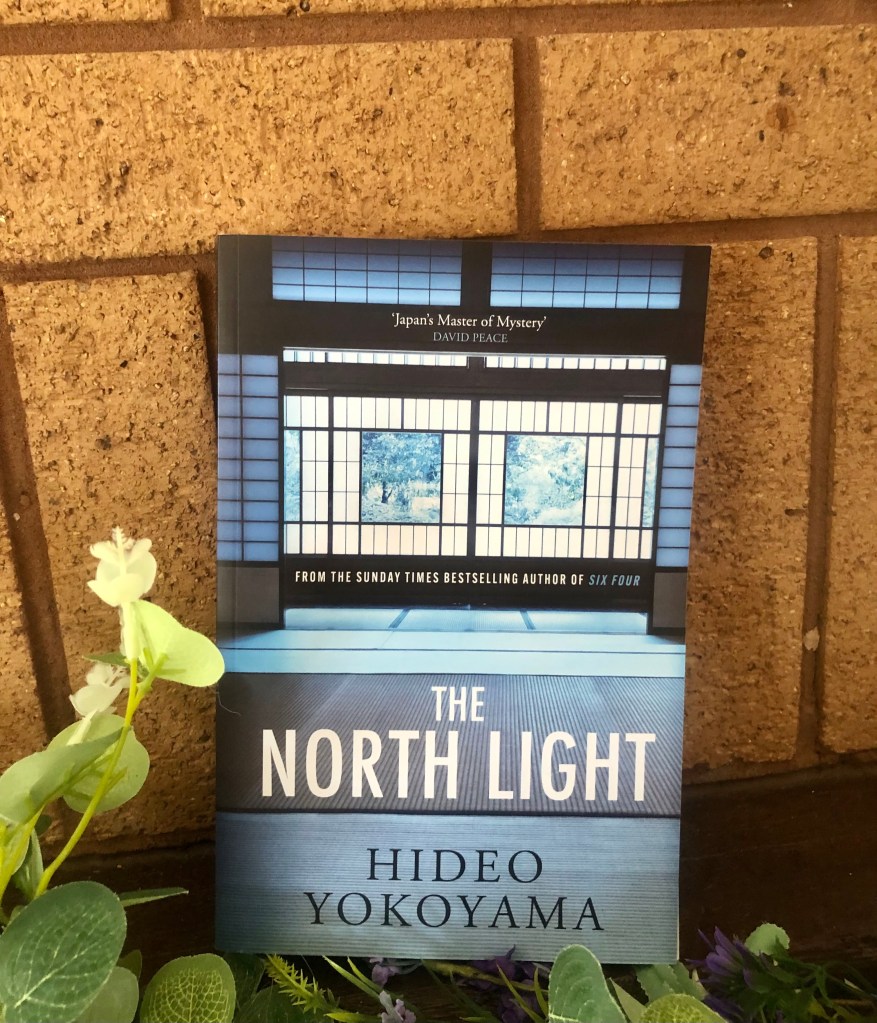
The elusive new mystery titled The North Light, by the Sunday Times bestselling author of Six Four, Hideo Yokoyama (translated by Louise Heal Kawai) was published by Riverrun on 12th October. I had an opportunity to get a copy beforehand. And I read it while house-sitting, accompanied only by two cats that had no interest in literature but were confident about the place where they belong. Being in a different space with different routines made me all the more appreciate the overwhelming sense of importance of location to Minoru Aose, the main character in the novel. As well as his professional preoccupation with utilising space and creating an amazing experience for the future inhabitants of the houses or offices, he also is completely focused on the setting that is or could have been his, embracing memories of itinerant childhood and an unfulfilled dream of building his own house.
Minoru Aose does not seem to be a happy man: in his mid-forties, fearing loneliness, lacks motivation and ambition. His divorce to Yukari eight years earlier resulted in a simplified structured life, with monthly meetings with his daughter, lots of soul searching, and a feeling of failure. After the initial period of sinking into despair and drink, he was offered some kind of salvation. His university friend Akihiko Okajima gave him a job at his own architectural firm Okajima Design Company. However, stability and routine of work does not bring much joy. One of the reasons is that Aose cannot replicate sense of exhilaration after designing and supervising construction and completion of his crowning achievement: an awe-inspiring innovative modernist private residence built in the shadow of Mount Asama. ‘Aose had believed that the Y Residence was intended as a symbol of hope – an attempt to reunite the family.’ The question remains though: whose family.
He feels insecure, and very disappointed when there is no post-design feedback and no contact at all from the owners. Then discovers that his clients and now owning the Yoshino House have never moved in. The beautiful unique property has been empty for several months, and although clean, also it is also neglected and unloved. He decides to visit the house to make sure that nothing bad has happened to the Yoshino family. His boss accompanies him, and there in the pristine building the emptiness encompasses everything. A lone single wooden chair standing in a middle of a room and facing the mountain’s north light is another mystery. Okajima recognises it as an iconic piece of furniture created by Bruno Taut, a German designer who fled his home country in the 1930s to escape Nazi persecution, and had come to Japan. By introducing a factual person into the story, Hideo Yokoyama anchors it in the fictionalised search into the disappearance of Yoshino and his family, and so pushes Aose to dig into the real history of architecture, and to ask uncomfortable personal questions. This process shakes Aose’s own fragile confidence. Yet he is drawn to the unknown situation, and must try to connect words and emotions. Very slowly he uncovers links that finally force him to acknowledge who he is, and how the sense of not belonging and being rootless has been following him since early years. Childhood spent in several places around the country as the family moved according to the national plans for building dams, and then his father’s sudden death made a huge impact: ‘Migration: staying at a place was not the same as living somewhere.’
The North Light flows slowly past the modern buildings, ancient structures, the past and the present. The novel has two contradictory motions at the same time: it’s both calm and reflective as well as intensely urgent and inquisitive. Aose’s personal story intertwines with the professional side of his life as his boss Okajima pushes the team to get shortlisted for the competition to design a memorial gallery for Haruko Fujimiya, ‘a reclusive painter who made a living selling postcards on a Paris street…Not a soul had ever set eyes on her incredible body of work, not until she had died, at the age of seventy.’ This commercial venture is marred with criminal investigation threatening honour and good name of all involved, yet somehow it also allows Aose to breathe. And so invites the readers to tune into the mood of this stunning book.
Born in 1957, Hideo Yokoyama worked for twelve years as an investigative reporter with a regional newspaper north of Tokyo, before becoming one of Japan’s most acclaimed fiction writers. The North Light is his fourth novel to be translated into the English language. His first, Six Four, was a Sunday Times bestseller in hardback and paperback, became the first Japanese novel to be shortlisted for the CWA International Dagger, was named in the Crime and Thrillers of 2016 roundups in each of The Guardian, Telegraph, Financial Times and Glasgow Herald, and has since been translated into thirteen languages worldwide. Louise Heal Kawai is from Manchester in the UK and holds an MA in Advanced Japanese Studies from the University of Sheffield. She has lived in Japan for over twenty years and been a literary translator for the past ten. Her Japanese translations include Seicho Matsumoto’s murder mystery, A Quiet Place, and Mieko Kawakami’s Ms Ice Sandwich.
 Nordic Lighthouse
Excellent, stunning review. I wish I’d said that! 🙂
LikeLike
Mary,
So kind of you to say that. Thank you very much x
LikeLike
Brilliant review Ewa. Sounds like a great read. Thanks again x
LikeLike