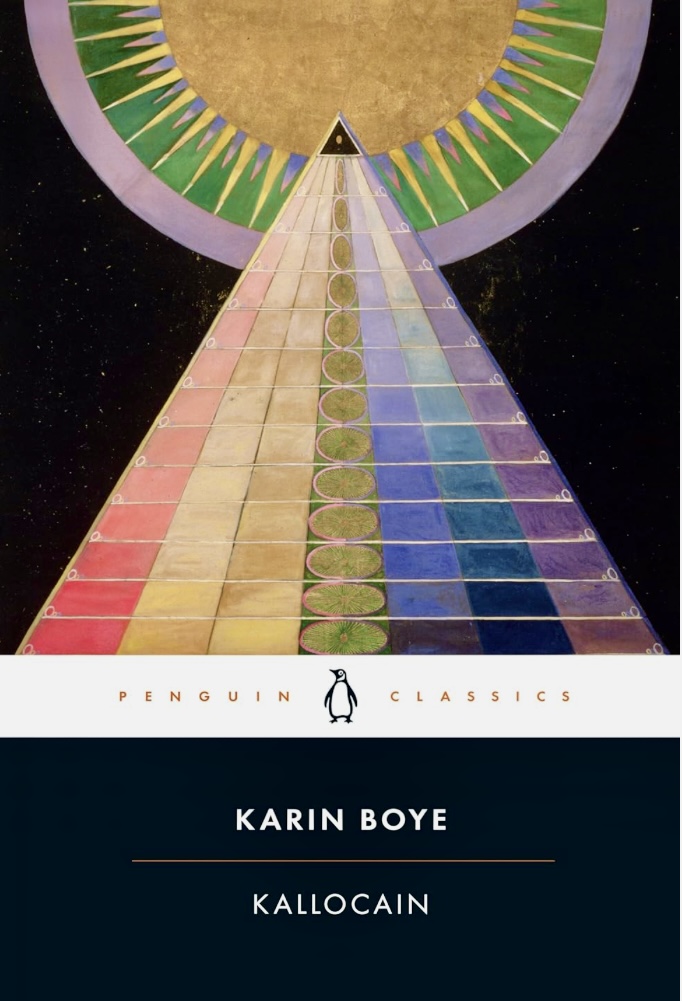
Kallocain by Karin Boye

Leo Kall, a research chemist and a very obedient citizen, has been working on a revolutionary new drug that will force everyone to share the most private and innermost personal thoughts. Police are keen to use Kallocain as a new interrogation technique to crush citizens of the totalitarian ‘World State’. Leo begins to feel alienated and terrified.

Let me start with mentioning the translator David McDuff who did an incredible job bringing this pioneering work of dystopian fiction from a Swedish author into emotive and taut precise English. He also wrote an introduction to the novel, and I would like to quote some of his words to get a better understanding of the poet, novelist and essayist Karin Boye. Her science fiction novel, written in 1940, presented a ‘vision of enslaved humanity, an allegory dream- like and grotesque, yet instantly recognizable to anyone then living through the international crisis.’ It is a novel from one of Sweden’s most acclaimed writers that we know nothing or very little of.

I was reading Kallocain with trepidation, shocked by the incredible clarity of literary vision of its author Karin Boye. It depicts a totalitarian ‘World State’ designed to crush and obliterate the individual and all private thoughts. It is also pure Nineteen Eighty-Four even though it was written eight years before George Orwell’s dystopian classic, with touches of The Handmaid’s Tale which I just couldn’t handle. Boye’s fictionalised futuristic world was influenced by the contemporary unfolding events of the Second World War and two apparently opposing systems: ‘ice-cold reasoning’ of Hitler and the ‘merciless dialectics’ of Stalin’. This chilling and totally absorbing tale follows the research chemist Leo Kall, a very obedient citizen and middle-ranking scientist. He is a Fellow Solider, just as his wife is, and as his three children will be. Their life is rigorously compartmentalised in the society divided by basic skills and needs. Leo has been working on ‘truth drug’ Kallocain which will force truth of anyone when the liquid is injected straight into the bloodstream, making people fall into a sleep-like state and saying what’s on their minds, even the most personal opinions, hidden deep down in subconsciousness. When the drug stops working, everyone is aware and often intensely ashamed of sharing everything. The authorities are excited: ‘Kallocain gives us the possibility of controlling what goes on in people’s minds’ and will replace all other methods of interrogation.

Leo and his superior start initial tests on ‘five subjects from the Voluntary Sacrifice Service’ which proved satisfactory and more ‘human material’ gets brought in to experiment on. Soon the top police get involved, production of Kallocain goes ahead, other Fellow Soldiers are trained to administer it – and Leo begins to fear for his own life. Surrounded by ‘police eyes’ and ‘police ears’ – cameras and microphones – which are in the walls of apartments and houses, and lacking any sense of security at home as Linda often vanishes without a word, he, like everyone else, is terrified of being denounced and found guilty of not denouncing others. Because this is happening as more injections are given to anyone who dares to think differently, more arrests and deaths. However, he realises that there is a seed of opposition in the society, and equally scared of being own person.

Karin Boye paints a bleak desolate landscape of underground buildings and corridors; with a need for surface permissions; dehumanised and alien, lacking colours and smells. Grim. Leo tells his story from the prison where he’s been for over twenty years, not sure how long because of the isolation and induced timelessness, and still continues as a chemist, his existence being still terrified but also a little bit brave and resigned that he must not be completely silent. Whatever happens to him afterwards is unclear; however, I believe that any reader of Kallocain by Karin Boye will be shaken to the core.

Karin Boye (1900–41) was born in Gothenburg, Sweden and studied in Stockholm and Uppsala. As a young woman she joined the international socialist and pacifist organization Clarté and published her first volume of poetry while still in her early twenties. She translated T. S. Eliot’s The Waste Land into Swedish in 1931, and wrote several novels throughout the decade. She married a fellow writer but left her husband after undergoing psychoanalysis in Berlin and formed a lifelong relationship with a German woman, Margot Hanel. Boye’s most famous book, Kallocain (1940), was partly inspired by eye-opening trips to Nazi Germany and Soviet Russia. She died from an overdose of sleeping pills the year after writing the novel.
David McDuff’s translations for Penguin Classics include Dostoyevsky’s Crime and Punishment, The Brothers Karamazov and The Idiot, and Babel’s short stories.

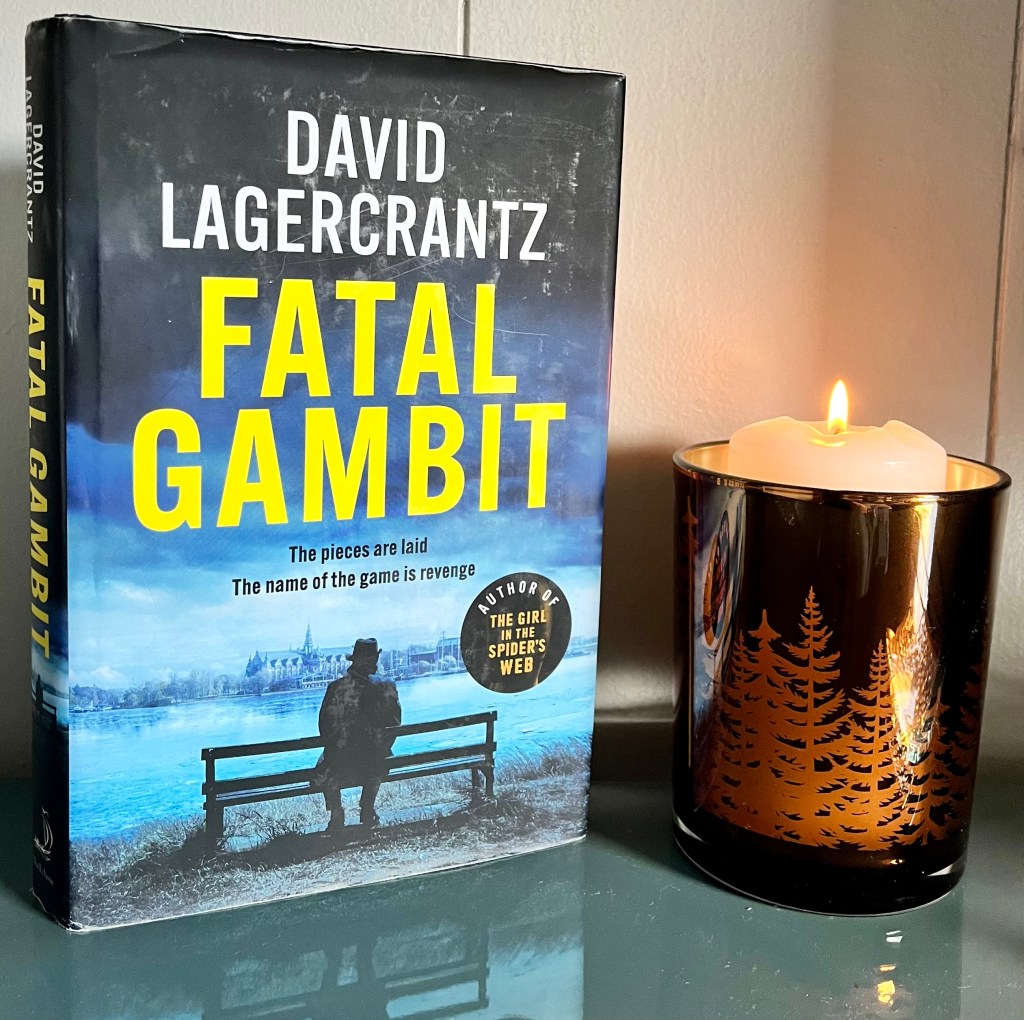
Fatal Gambit by David Lagercrantz

Brilliant academic and government consultant Hans Rekke and his unofficial work partner Detective Micaela Vargas are the latest duo following the well-established ‘method’ of the famous Sherlock and Watson partnership. However, they did not make a conscious decision to embark together on the crime-fighting journey. Beginnings of their cooperation are in Crime Review – Dark Music (2022), first novel of the new gripping series by David Lagercrantz, which is absolutely worth reading. Translation of both by Ian Giles is superb: flowing and engaging capturing the attention. I would expect that collaboration between Lagercrantz and Giles will continue as the complex threads of Fatal Gambit invite further investigations.   

As the modern take on Sherlock-Watson theme continues, it is not difficult to realise who is who here, and how that uneasy working relationship slowly embraces friendship and deeper understanding of personal motives. At times it is such a slow painful process that not only the readers might find it frustrating – the main characters as well, especially Vargas (but devil’s in the details). She had to move into Rekke’s vast apartment as a lodger because of her own private situation. Living with the professor who is both disillusioned and disgraced, and surviving on the diet of various pills and self-loathing, creates many practical and emotional challenges. Contrast between wealth and social standing, mostly going years back (to be precise) of Rekke versus down-to-earth attitude and immigrant background of Vargas amplify the difficulties within the Swedish society, too.

Main story strands focus on a missing woman Claire Lidman who was confirmed as dead in a fire fourteen years ago. Yet she suddenly appears in the background of a recent holiday photo taken in Venice. Her still-hopeful husband Samuel Lidman brings this anomaly to the pair. Scepticism seems to be the only reasonable response as the earlier investigation into Claire’s death showed no doubt. Rekke cannot deal with this cold case: he is very concerned that his daughter Julia has a secret new boyfriend and there are nuanced signs of dangerous darkness. At the same time he becomes aware of hearing a name from his past, a memory of a genius rival, a mastermind of words, deeds and manipulation. Enter Gabor Morovia, lapsed mathematician and evil player of chess and women. As a villain he is definitely outstanding, as a link in the chain holding lives of Rekke and others which will become obvious as the plot intensifies. This villainous creation takes me back to the latest book in the Millenium series: The Girl in The Eagle’s Talons where Karin Smirnoff pulled all the stops, just like Lagercrantz in his contribution to the Stig Larsson’s legacy. But back to Fatal Gambit.

Vargas tries to balance her life in the realm divided by the law-abiding profession she has chosen and the reality of criminal underworld. Her gangster brother threatens to silence her if she doesn’t get off his back, and he absolutely means that. Caught in the web of real and perceived violence, lack of support and understanding, and confusing emotions towards Rekke, she struggles with convincing others of making the right steps. When she finds out identity of Julia’s mysterious boyfriend, her fragile world collapses. However, this is not the time to stop and hide.

Perilous mystery opens avenues that nobody anticipated. Symbolic chess game is already on and Hans Rekke and Micaela Vargas are caught in the bigger game of the post iron-curtain connections, political machinations, big money and fear. Conclusion of the Claire case and exploration of various small elements in this picture affected them in deeply personal ways, and a as result brought their professional lives closer. And I loved the tension, drama and moral questions along the way.

Fatal Gambit by David Lagercrantz is out now, published by MacLehose Press.  

Outstanding crime fiction from the Kingdom of Denmark, Iceland, Norway and Sweden shortlisted for the 2024 Petrona Award

Six impressive crime novels from the Kingdom of Denmark, Iceland, Norway and Sweden have been shortlisted for the 2024 Petrona Award for the Best Scandinavian Crime Novel of the Year. The shortlist is announced today, Thursday 10th October and is as follows:


·       Anne Mette Hancock – The Collector tr. Tara F Chace (Denmark, Swift Press)

·       Jørn Lier Horst – Snow Fall tr. Anne Bruce (Norway, Michael Joseph)

·       Arnaldur Indriðason – The Girl by the Bridge tr. Philip Roughton (Iceland, Harvill Secker)

·       Jógvan Isaksen – Dead Men Dancing tr. Marita Thomsen (Faroe Islands (Kingdom of Denmark), Norvik Press)

·       Ã…sa Larsson – The Sins of our Fathers tr. Frank Perry (Sweden, MacLehose Press)

·       Yrsa Sigurðardottir – The Prey tr. Victoria Cribb (Iceland, Hodder & Stoughton)

The winning title will be announced on 14 November 2024.

The Petrona Award is open to crime fiction in translation, either written by a Scandinavian author or set in Scandinavia, and published in the UK in the previous calendar year. The Petrona team would like to thank our sponsor, David Hicks, for his continued generous support of the Award.

The judges’ comments on the shortlist:

There were 31 entries for the 2024 Petrona Award from six countries (Kingdom of Denmark, Finland, France, Iceland, Norway, and Sweden). This year’s shortlist sees both the Kingdom of Denmark and Iceland represented with two novels each and Sweden and Norway with one novel each. The judges selected the shortlist from a strong pool of candidates with the shortlisted authors including Petrona Award winners Jørn Lier Horst and Yrsa Sigurðardottir. As ever, we are extremely grateful to the six translators whose expertise and skill have allowed readers to access these outstanding examples of Scandinavian crime fiction, and to the publishers who continue to champion and support translated fiction.

The judges’ comments on each of the shortlisted titles:

Anne Mette Hancock – THE COLLECTOR translated by Tara F Chace (Denmark, Swift Press)

When ten-year-old Lukas disappears from his Copenhagen school, police investigators discover that the boy had a peculiar obsession with pareidolia: a phenomenon that makes him see faces in random things. A photo on his phone, posted just hours before his disappearance, shows an old barn door that resembles a face. Journalist Heloise Kaldan thinks she recognises the barn – but from where? When Lukas’s blood-flecked jacket is found, DNA evidence points to Thomas Strand, a former soldier suffering from severe PTSD, but then Strand turns up dead in his apartment. 

This is a complex thriller of buried secrets, that beautifully wrong-foots the reader from beginning to end.

Jørn Lier Horst – SNOW FALL translated by Anne Bruce (Norway, Michael Joseph)

The discovery of an Australian backpacker’s body in Spain prompts a group of amateur true crime detectives into action. They are scattered online around the world, attempting to solve the mystery of her death. Astri, a young Norwegian woman whose intense pursuit takes her closer than anyone else to solving the case, prepares to reveal her findings and then goes offline. When William Wisting reluctantly gets involved in the investigation, he is faced with the unusual, unorthodox investigators of varied skills and intentions, and puzzling connections.

A slow methodological approach gathers pace and pulls readers into a complex web of low-key international ties. As always Lier Horst delves deep into the psychology and motives of the characters, creating a slow-burning police procedural of empathy and human interest, firmly rooted in Norwegian society.  

Arnaldur Indriðason – THE GIRL BY THE BRIDGE translated by Philip Roughton (Iceland, Harvill Secker)

When a young woman known for drug smuggling goes missing, her elderly grandparents have no choice but to call friend of the family, retired detective Konrád. Still looking for his own father’s murderer, Konrád agrees to investigate the case, but digging into the past reveals more than he set out to discover, and a strange connection to a little girl who drowned in the Reykjavík city pond decades ago recaptures everyone’s attention.

One of Iceland’s most established authors, Indriðason skilfully interweaves different timelines along with assured characterisation, in this second book to feature Konrád.

Jógvan Isaksen – DEAD MEN DANCING translated by Marita Thomsen (Faroe Islands (Kingdom of Denmark), Norvik Press)

Similar to the story of the ancient god Prometheus, a man has been shackled to rocks and left to drown on the beach. But this time it happens on the Faroe Islands. The discovery of his body throws the local community into an unsettling chaos. As the journalist Hannis Martinsson investigates, he comes across evidence of similar deaths. He realises they are linked to the events in Klaksvik in the 1950s, and a local revolt which tore the community apart. As Martinsson digs into the past, he learns about his country’s history, and the reader has a chance to discover what makes the Faroes intriguing and spellbinding.

This is only Isaksen’s second novel to be translated into English. The contemporary Faroese crime fiction writer places his characters in the wild, beautiful, and unforgiving environment and allows them to search for truth. Dogged and uncompromising, Martinsson is a superb creation.

Ã…sa Larsson – THE SINS OF OUR FATHERS translated by Frank Perry (Sweden, MacLehose Press)

Rebecka Martinsson, disillusioned with her challenging job as a prosecutor, initially has no intention of looking into a fifty-year-old case involving the missing father of Swedish Olympic boxing champion, Börje Ström. Agreeing, however, to the dying wish of her forensic pathologist friend she begins to follow links when a body is found in a freezer at the house of a deceased alcoholic. The grim realities of life in the area years ago, and the current influx of criminals attracted by developments in Kiruna make for a tough investigation and difficult soul-searching, coupled with Rebecka’s own history in a foster family.

Larsson remains a wise observant social commentator and creator of a gripping, suspenseful and utterly moving series, with her eye to the past and the future, and emotive style. Delicate and  relevant humour adds hope to the fragile lives of the main characters.

Yrsa Sigurðardottir – THE PREY translated by Victoria Cribb (Iceland, Hodder & Stoughton)

Kolbeinn has been called to his old home as the new owners have uncovered some photos, and a muddied child’s shoe bearing the name ‘Salvor’. A name Kolbeinn doesn’t recognise. Soon after, his mother’s carers say that she has been asking for her daughter, Salvor.

Jóhanna is working with the search and rescue team in Höfn to find two couples from Reykjavik. Their phones’ last location, the road leading up into the highlands. In a harsh winter, the journey is treacherous, and they soon find the first body.

Hjörvar works at the Stokksnes Radar Station in the highlands. He’s alone when the phone connected to the gate rings: the first time it’s ever done so. Above the interference he can hear a child’s voice asking for her mother.

How are these events connected?

Sigurðardottir balances these three storylines, each with her trademark creeping sense of unease, in this dark and disturbing standalone.

The judges

Jackie Farrant – creator of RAVEN CRIME READS and a bookseller/ Area Commercial Support for a major book chain in the UK. Ewa Sherman – translator and writer, and blogger at NORDIC LIGHTHOUSE. The Award administrator is Karen Meek – owner of the EURO CRIME blog and website.

Further information on the history of the Award and the previous winners can be found on the Petrona Award website.