The Sea Cemetery by Aslak Nore

What an incredible novel! From the very first pages I knew that The Sea Cemetery / Havets kirkegård, a literary thriller and family saga combined in one huge tome, would take me on an unforgettable voyage through the recent history of Norway and its connections with the Europe, and questions about individual choices made by the main characters. The universal human issues are hidden just below the surface of the dramatic story about legacy and control, and consequences of hidden secrets in the thriller set among the harsh Norwegian natural beauty.
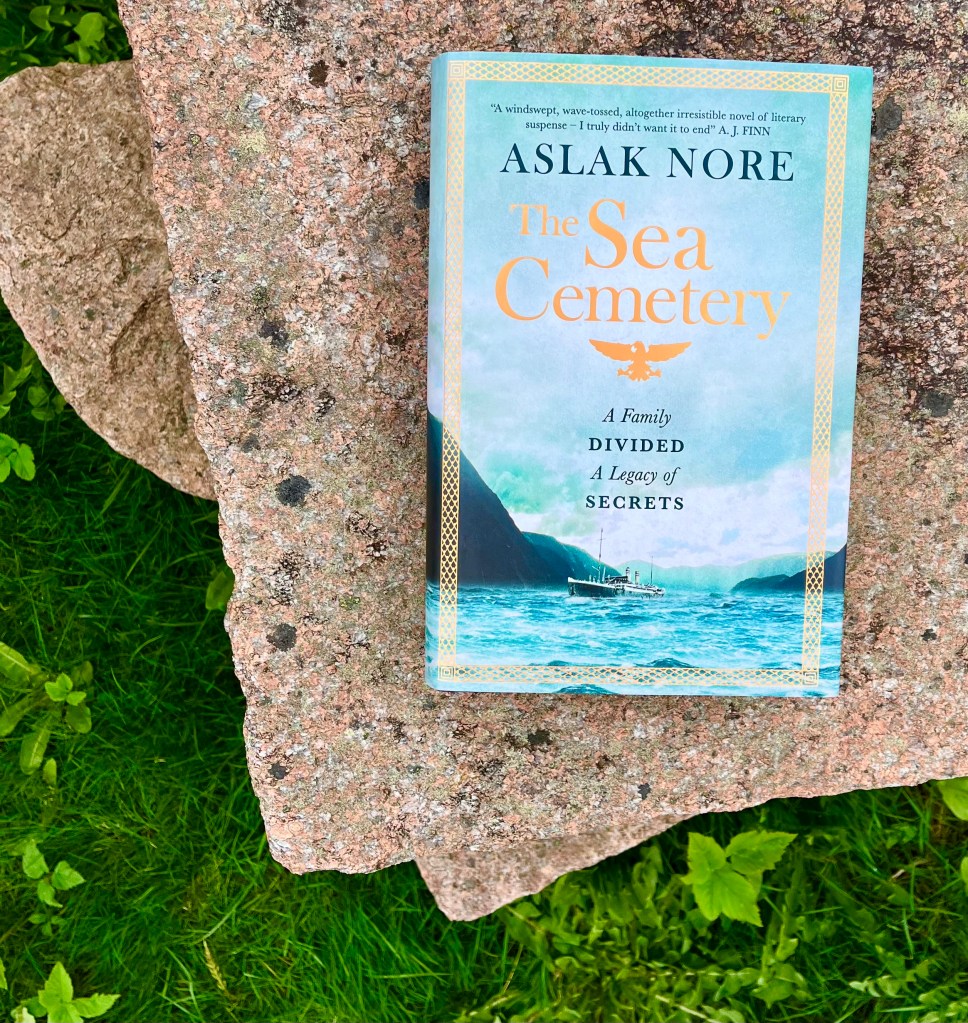
Aslak Nore’s inspiration came from the authentic sea disaster during the WWII when Norway was under German occupation. Sinking of the Norwegian passenger ship DS Prinsesse Ragnhild in 1940 was the worst wartime tragedy. The ship struck a mine and disappeared under the water between Bodø and Lofoten in the North, with loss of many lives.

Vera Lind, writer and matriarch of a rich and powerful dynasty, commits suicide on the family stunning estate near Oslo. She has been writing memoirs while trying to deal with her own and family’s trauma, going back to the times of wartime shipping disaster in October 1940 that had killed her husband and hundreds of other passengers and German soldiers. However, her earlier attempts to publish the novel were met with fierce opposition by Olav, her son and heir to the fortune. Forty years later in 1970 the manuscript vanished and Vera was placed under a Guardianship Order. Something strange has taken place.  

Not everyone wants to dig into the past to uncover shocking truth but her granddaughter Sasha (Alexandra) is determined to find out what has happened to Vera. Her husband Mads and siblings Sverre and Andrea don’t want to rock the boat, so to speak, and so she does it alone, although Johnny Berg, a journalist and discredited Norwegian secret service agent, decides to help her along the way. This semi-professional relationship is tricky. Sasha is torn between loyalty to her strong-willed father Olav and the family, and the need to ‘avenge’ her grandmother. Berg, apart from his personal motives to search for the manuscript, has also signed the contract to write biography of Hans Falck, a charismatic doctor and an adventurer, notorious for his personal life and famous for his humanitarian work in the Middle East. Sasha’s cousin Hans is from Bergen and convinced that Vera bequeathed the fortune to him and his children. There is no love lost between two branches of the Falck family: in Bergen on the beautiful Norwegian coast and in Oslo, close to the country’s financial centre.  

So far so complex regarding the family ties. However, the power struggles and different sentiments become much more evident as the novel unravels. I enjoyed the occasionally uneven tempo of this epic tale. Hunt for Vera’s missing testament and manuscript was shown through eyes of main players and as a novel-in-novel process, and my view of various people shifted. It’s right to say that ‘History is power. Control the narrative, and you wield the power.’ Chapters exploring conflict in Kurdistan and Afghanistan added both clarity and some confusion necessary to paint a picture of intertwined connections within the family, known only to those who make the decisions. The geopolitical context is relevant as the author also took on the most sacred Norwegian values, such as patriotism and trust, and explored them in the view of family secrets.

The Sea Cemetery, in superb translation by Deborah Dawkin, culminates in a brilliant and completely unexpected twist that paves the way for the second part of this trilogy. It was published by MacLehose Press in 2024. Now I am really looking forward to reading The Heirs of the Arctic / Ingen skal drukne.
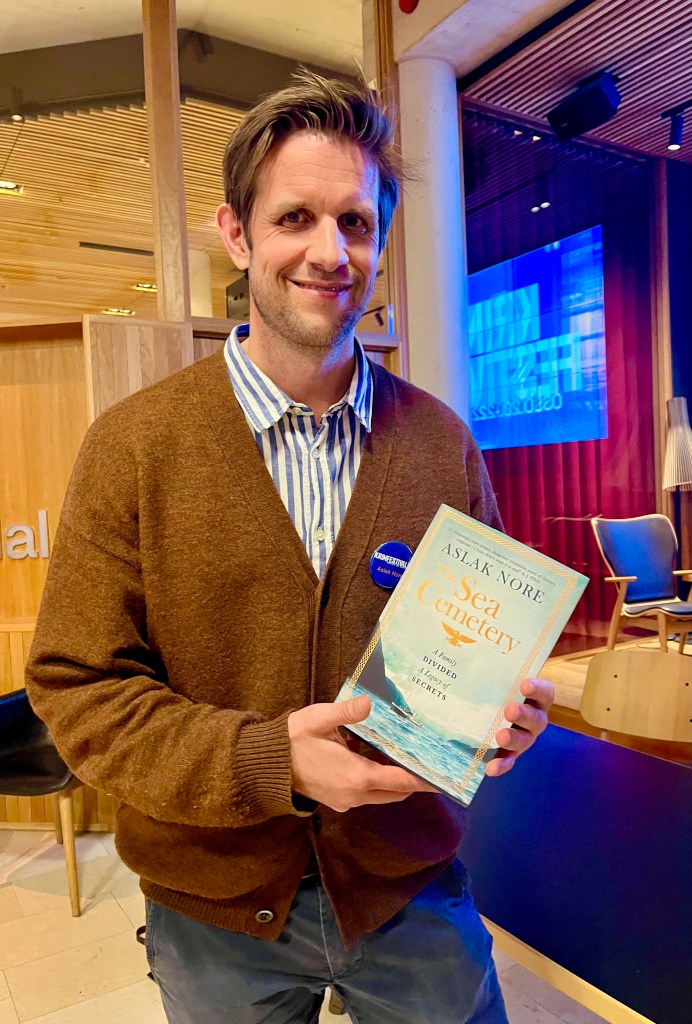
Aslak Nore with The Sea Cemetery during Krimfestivalen 2025

Aslak Nore (b. 1978) grew up in Oslo. He was educated at the University of Oslo and the New School for Social Research in New York and has served in Norway’s elite Telemark Battalion in Bosnia. A modern-day adventurer, Nore has lived in Latin America and worked as a journalist in the Middle East and Afghanistan. He has published several non-fiction books and four novels. Wolfsangel (2017) was a national bestseller and won the Riverton Prize for best crime novel in Norway in 2018. The Cemetery of the Sea (2021) is the first novel in an epic literary thriller series and a huge international success and bestseller. Nore lives in Provence, France. © Winje Agency
Outstanding crime fiction from the Kingdom of Denmark, Iceland, Norway and Sweden shortlisted for the 2024 Petrona Award

Six impressive crime novels from the Kingdom of Denmark, Iceland, Norway and Sweden have been shortlisted for the 2024 Petrona Award for the Best Scandinavian Crime Novel of the Year. The shortlist is announced today, Thursday 10th October and is as follows:


·       Anne Mette Hancock – The Collector tr. Tara F Chace (Denmark, Swift Press)

·       Jørn Lier Horst – Snow Fall tr. Anne Bruce (Norway, Michael Joseph)

·       Arnaldur Indriðason – The Girl by the Bridge tr. Philip Roughton (Iceland, Harvill Secker)

·       Jógvan Isaksen – Dead Men Dancing tr. Marita Thomsen (Faroe Islands (Kingdom of Denmark), Norvik Press)

·       Ã…sa Larsson – The Sins of our Fathers tr. Frank Perry (Sweden, MacLehose Press)

·       Yrsa Sigurðardottir – The Prey tr. Victoria Cribb (Iceland, Hodder & Stoughton)

The winning title will be announced on 14 November 2024.

The Petrona Award is open to crime fiction in translation, either written by a Scandinavian author or set in Scandinavia, and published in the UK in the previous calendar year. The Petrona team would like to thank our sponsor, David Hicks, for his continued generous support of the Award.

The judges’ comments on the shortlist:

There were 31 entries for the 2024 Petrona Award from six countries (Kingdom of Denmark, Finland, France, Iceland, Norway, and Sweden). This year’s shortlist sees both the Kingdom of Denmark and Iceland represented with two novels each and Sweden and Norway with one novel each. The judges selected the shortlist from a strong pool of candidates with the shortlisted authors including Petrona Award winners Jørn Lier Horst and Yrsa Sigurðardottir. As ever, we are extremely grateful to the six translators whose expertise and skill have allowed readers to access these outstanding examples of Scandinavian crime fiction, and to the publishers who continue to champion and support translated fiction.

The judges’ comments on each of the shortlisted titles:

Anne Mette Hancock – THE COLLECTOR translated by Tara F Chace (Denmark, Swift Press)

When ten-year-old Lukas disappears from his Copenhagen school, police investigators discover that the boy had a peculiar obsession with pareidolia: a phenomenon that makes him see faces in random things. A photo on his phone, posted just hours before his disappearance, shows an old barn door that resembles a face. Journalist Heloise Kaldan thinks she recognises the barn – but from where? When Lukas’s blood-flecked jacket is found, DNA evidence points to Thomas Strand, a former soldier suffering from severe PTSD, but then Strand turns up dead in his apartment. 

This is a complex thriller of buried secrets, that beautifully wrong-foots the reader from beginning to end.

Jørn Lier Horst – SNOW FALL translated by Anne Bruce (Norway, Michael Joseph)

The discovery of an Australian backpacker’s body in Spain prompts a group of amateur true crime detectives into action. They are scattered online around the world, attempting to solve the mystery of her death. Astri, a young Norwegian woman whose intense pursuit takes her closer than anyone else to solving the case, prepares to reveal her findings and then goes offline. When William Wisting reluctantly gets involved in the investigation, he is faced with the unusual, unorthodox investigators of varied skills and intentions, and puzzling connections.

A slow methodological approach gathers pace and pulls readers into a complex web of low-key international ties. As always Lier Horst delves deep into the psychology and motives of the characters, creating a slow-burning police procedural of empathy and human interest, firmly rooted in Norwegian society.  

Arnaldur Indriðason – THE GIRL BY THE BRIDGE translated by Philip Roughton (Iceland, Harvill Secker)

When a young woman known for drug smuggling goes missing, her elderly grandparents have no choice but to call friend of the family, retired detective Konrád. Still looking for his own father’s murderer, Konrád agrees to investigate the case, but digging into the past reveals more than he set out to discover, and a strange connection to a little girl who drowned in the Reykjavík city pond decades ago recaptures everyone’s attention.

One of Iceland’s most established authors, Indriðason skilfully interweaves different timelines along with assured characterisation, in this second book to feature Konrád.

Jógvan Isaksen – DEAD MEN DANCING translated by Marita Thomsen (Faroe Islands (Kingdom of Denmark), Norvik Press)

Similar to the story of the ancient god Prometheus, a man has been shackled to rocks and left to drown on the beach. But this time it happens on the Faroe Islands. The discovery of his body throws the local community into an unsettling chaos. As the journalist Hannis Martinsson investigates, he comes across evidence of similar deaths. He realises they are linked to the events in Klaksvik in the 1950s, and a local revolt which tore the community apart. As Martinsson digs into the past, he learns about his country’s history, and the reader has a chance to discover what makes the Faroes intriguing and spellbinding.

This is only Isaksen’s second novel to be translated into English. The contemporary Faroese crime fiction writer places his characters in the wild, beautiful, and unforgiving environment and allows them to search for truth. Dogged and uncompromising, Martinsson is a superb creation.

Ã…sa Larsson – THE SINS OF OUR FATHERS translated by Frank Perry (Sweden, MacLehose Press)

Rebecka Martinsson, disillusioned with her challenging job as a prosecutor, initially has no intention of looking into a fifty-year-old case involving the missing father of Swedish Olympic boxing champion, Börje Ström. Agreeing, however, to the dying wish of her forensic pathologist friend she begins to follow links when a body is found in a freezer at the house of a deceased alcoholic. The grim realities of life in the area years ago, and the current influx of criminals attracted by developments in Kiruna make for a tough investigation and difficult soul-searching, coupled with Rebecka’s own history in a foster family.

Larsson remains a wise observant social commentator and creator of a gripping, suspenseful and utterly moving series, with her eye to the past and the future, and emotive style. Delicate and  relevant humour adds hope to the fragile lives of the main characters.

Yrsa Sigurðardottir – THE PREY translated by Victoria Cribb (Iceland, Hodder & Stoughton)

Kolbeinn has been called to his old home as the new owners have uncovered some photos, and a muddied child’s shoe bearing the name ‘Salvor’. A name Kolbeinn doesn’t recognise. Soon after, his mother’s carers say that she has been asking for her daughter, Salvor.

Jóhanna is working with the search and rescue team in Höfn to find two couples from Reykjavik. Their phones’ last location, the road leading up into the highlands. In a harsh winter, the journey is treacherous, and they soon find the first body.

Hjörvar works at the Stokksnes Radar Station in the highlands. He’s alone when the phone connected to the gate rings: the first time it’s ever done so. Above the interference he can hear a child’s voice asking for her mother.

How are these events connected?

Sigurðardottir balances these three storylines, each with her trademark creeping sense of unease, in this dark and disturbing standalone.

The judges

Jackie Farrant – creator of RAVEN CRIME READS and a bookseller/ Area Commercial Support for a major book chain in the UK. Ewa Sherman – translator and writer, and blogger at NORDIC LIGHTHOUSE. The Award administrator is Karen Meek – owner of the EURO CRIME blog and website.

Further information on the history of the Award and the previous winners can be found on the Petrona Award website.