How is the first week of January treating you? Is it snowing where you are? Have you been reading much over Christmas? And the most important question: did Santa bring any good books for you? I got new and second-hand books but must admit that I had no headspace to focus on reading much nor writing for a while hence my blog has been hibernating since autumn.
However, now that the days are tiny bit longer even if bitterly cold, and everything is covered in the snow and the whiteness creates more light at night, and I also have a new cat introducing new routines at home and supervising everything I do, I decided to ease myself gently into the fiction reading. First on the list: Historical Value by Quentin Bates. At 29 pages the short story was indeed very short, and ‘sweet’ in the way that all cool writing is: setting up an interesting background to what could have happened in the past, shaping believable characters and even if a conclusion comes quickly and nicely packaged, it makes you want more. Introduction of the quick-thinking detective who needs to navigate the official crime scene outside his jurisdiction while on holidays could really develop into much bigger / shocking story. Maybe it will be the case.
I might have mentioned Quentin Bates once or ten times before: my favourite translator from the Icelandic, journalist, publisher (Corylus Books) and writer (Summerchill – 2015, Cold Breath – 2019, Cold Steel – 2019, Cold Malice – 2020) that could probably use more hours in a day to just write. That’s what he says about this standalone continuation of the Gunnhildur books: ‘Old bones come to light on a remote farm in the north of Iceland. Detective Helgi Svavarsson is reluctant to get involved with what looks like something he feels calls for an archaeologist rather than a policeman. In any case, he’s off duty and has family business to attend to. But he can’t help but be intrigued as suspicion falls on the now elderly woman who farmed at Fagrabrekka for so many years – and what became of the man who caught the bus south one winter afternoon, forty-two years ago?
Historical Value is cheaper than chips (or coffee) and will definitely stay with(in) you for much longer. Get it now.
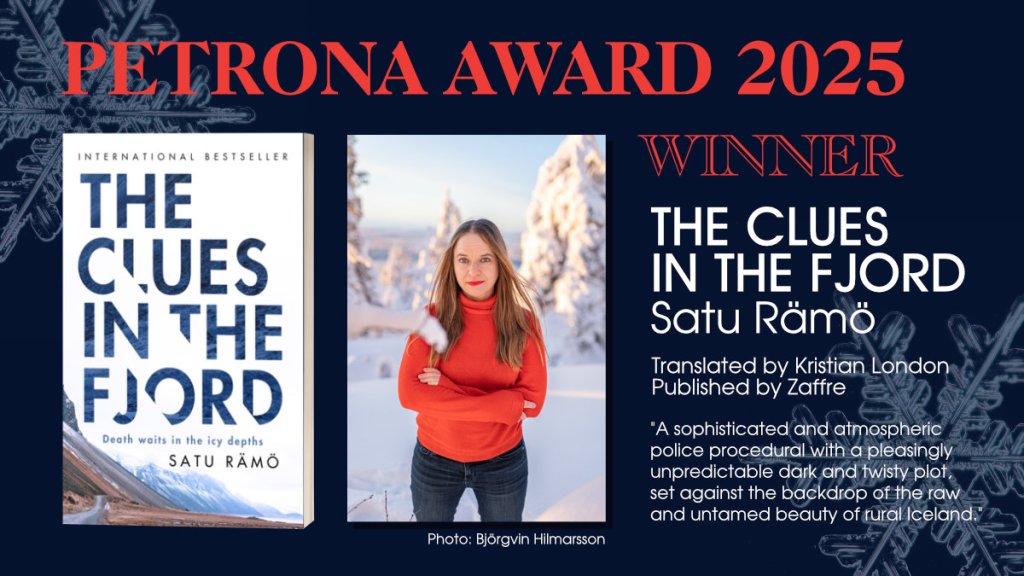
It is so exciting to annonce the winner of the Petrona Award 2025 for the Best Scandinavian Crime Novel of the Year:
THE CLUES IN THE FJORD by Satu Rämö translated from the Finnish by Kristian London and published by Zaffre. Satu Rämö will receive a trophy, and both the author and translator will receive a cash prize. The Petrona team would like to thank David Hicks for his sponsorship of the Petrona Award.
The judges’ statement on THE CLUES IN THE FJORD:
THE CLUES IN THE FJORD is a sophisticated and atmospheric police procedural with a pleasingly unpredictable dark and twisty plot, set against the backdrop of the raw and untamed beauty of rural Iceland.
Providing the local detective with a Finnish side-kick allows the author to contrast Icelandic and Finnish traits, adding authenticity to an original story. The intriguing back-stories of both characters leave the reader anticipating the next instalments.
In the ever-increasing Icelandic crime fiction scene, Satu Rämö has carved out a unique position between traditional mysteries and the darker end of crime fiction.
Statements from the winning author, translator and publisher:
Satu Rämö:
I am deeply honoured to receive this award, and I want to thank the jury and the organizers of the Petrona Award. I also want to acknowledge the incredible writers nominated alongside me. To be included among such talented writers is a reward in itself. Your words have inspired me a lot!
This award reminds me of a conversation I had with a reader, a ninety-five-year-old woman, who shared how the book, the first part in the Hildur crime book series, THE CLUES IN THE FJORD, made her feel. She told me that she knows she is getting very old but after reading this book, she hoped she would live long enough to read the sequel, to know what happened to the two little girls who got lost on their way from school. When the sequel came out, I sent it to her and called her after a few weeks. She was still as happy and joyful as last time, waiting for the next book in the series to come out…
It is the readers who keep stories alive. Thank you for reading. I want to thank you also, my British publisher Zaffre and my translator Kristian London. Great teamwork! Thank you jury from the bottom of my heart, this award means so much to me.
Kristian London:
When I first took on translating Satu Rämö’s THE CLUES IN THE FJORD, the book’s incredible success in Finland suggested it had a high chance of connecting with audiences abroad as well. I’m gratified to see this is the case. It has been a privilege to act as an intermediary between Rämö’s imagination and those of her English-speaking readers as they enter Hildur’s world of human quirks and foibles, familial traumas and inheritances. For me, the work’s slow power springs from its true protagonist: that isolated land in the North Atlantic that serves as the setting, and the terrain and culture and people we’re introduced to through an outsider’s keen eyes. Many thanks to the Petrona Award jury for this honor.
Kasim Mohammed (editor at Zaffre):
Being Satu’s English-language publisher is a real honour. She has such an eye for crafting stories about real people, and a real heart to her writing that is hard to find these days. Bringing authors’ dreams to life is a privilege and moments like this are wonderful to experience. To know Satu’s work is resonating with so many readers, worldwide, brings the team here at Bonnier so much pride. Thank you to the Petrona Award jury for this honour – we will treasure this as we continue to publish Satu!
The judges
Jackie Farrant – creator of RAVEN CRIME READS and a bookseller for a major book chain in the UK.
Ewa Sherman – translator and writer, and blogger at NORDIC LIGHTHOUSE.
Sonja van der Westhuizen – book critic for print and online publications in the UK and South Africa, as well as a blogger at WEST WORDS REVIEWS.
Award administrator
Karen Meek – owner of the EURO CRIME blog and website.
Petrona Award 2025 shortlist in full is here and further information can be found on The Petrona Award website.
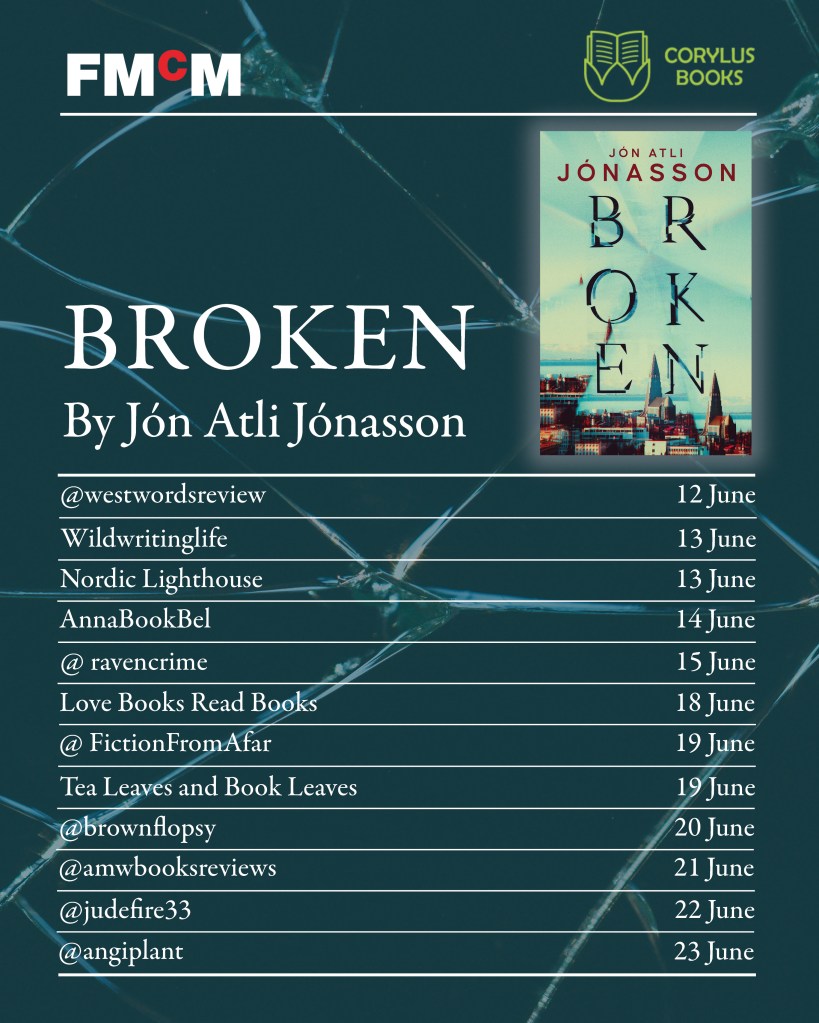
Jón Atli Jónasson is a new name among the crime writers from Iceland appearing in translation, and his English-language debut Broken definitely pushes this genre in a new direction.
The pair of two cops who probably shouldn’t be on the force, let alone working together, isn’t a new idea, but the supremely damaged Dóra and second-generation immigrant Rado as the cop duo is brilliantly done. They fit together, but at the same time they don’t. Then there’s the cast of characters Jón Atli has woven into this story who give it such bright colours. There’s chain-smoking Elliði, Dóra’s boss and former patrol partner who was present when she was so badly injured, and the cast of other cops who don’t hide their suspicion and dislike of the foreign guy in their ranks.
Rado’s family and his shady in-laws, also immigrants, are sharply drawn, highlighting the rootlessness and the conflictedness of people finding a foothold in a new, strange country, and how their children cope (or fail to cope) with this double identity. It doesn’t help that in this new home they’ve rebuilt the criminal empire they were forced to abandon back in the old country… Jón Atli shows us an Iceland that’s so far removed from the version visitors see that it’s barely recognisable, but at the same time scarily familiar.
Then the criminals, both the old-school homegrown variety with their clunky methods, and a new generation of villains who don’t sample their own merchandise and look up to business figure, seeing themselves as entrepreneurs who have the unfortunate disadvantage of operating on the wrong side of the law. And then there’s the sinister and mysterious Groke, the consummate professional who takes no prisoners, and who comes with a backstory of his own that hits so painfully close to home.
Jón Atli Jónasson is an acclaimed screenwriter and playwright. Broken is his first novel to appear in English, translated by Quentin Bates and published by Corylus Books. A TV adaptation is already in the works, and shooting is scheduled to start next year.
Here’s a short sample of Jón Atli Jónasson’s writing:
The fishing lodge couldn’t be seen from the road, and hardly even from the rutted track that led down to it. If he hadn’t got the jeep stuck in the soft ground then he wouldn’t be standing here in a pair of rubber boots and a shovel in his hands, trying to fill in the deep tyre tracks. It was as well there was nobody about. There was a farmhouse on the far side of the ravine, but he was fairly sure it had been long abandoned.
Shovelling was tiring, but he didn’t mind that. The cool air was invigorating. It was April and the snow was melting, freeing water to stream down from the highlands. It was difficult to see where the meltwater was going, until you put a foot on the ground and the gravel gave way into the slush beneath. This aroused his interest more than anything else. It didn’t trouble the Groke in the least. He had never seen any point in letting himself be angered by nature or its laws. In fact, he lived closer to nature than most people – close to the border with death and decomposition. He was a ferryman of a kind, leading all sorts of people, understandably not always willing, to that border and across it.
The two corpses he had conscientiously buried behind the fishing lodge were prime examples. This couple lived in Reykjavík, in one of the new districts that had sprouted up over the last decade. In these sprawling, soulless boxes where vast flat screens cast their blue glare on the walls and the big picture windows. The couple had stolen money. This was an amount that would have been worth negotiating, if only they’d showed a little inclination. But they hadn’t. They thought they would get away with it. They hadn’t realised that this was too much money to simply shrug off. Their attitude had been such that threats, beatings and even torture hadn’t done the trick. Some people had to have their hands held to the border between life and death, while others failed to understand that their own behaviour brought the border to them. Their deaths would serve as a warning to others. He knew that wasn’t true. Man as a species is too cross-grained for that to be the case.
Neither of them had been able to say a word before they died. The man had been coming out of the bathroom. The Groke sank the needle deep into his neck, and he sank down against the wall of this house that looked as if it had been cut from the pages of a piece of property porn. They had great taste, which perhaps was the reason for their downfall. In the end it had all been too costly, all the beautiful art on the walls, the expensive furniture and wardrobes crammed with designer goods.
Just moments after the man slipped to the floor, his wife parked her new electric car in front of the house and wondered who owned the jeep with tinted windows standing in the drive, and which she didn’t recall having seen before. She went indoors, called out, but didn’t get a response.
The Groke waited patiently in the corridor upstairs. He heard her potter around the kitchen, putting groceries away and calling her husband. The low hum from the man’s phone carried from the bedroom. He eventually heard her come up the stairs. When she appeared in the corridor and saw her husband lying there, she was about to scream. But the blow he gave her to the solar plexus punched all the breath out of her. He didn’t like this. It felt amateurish. But there was no other option. Then he grabbed her by the back of the neck and sank the needle deep into it. A few seconds later she lay on the floor beside her husband. If anyone were to wonder about them, then border control would inform them that the couple had left the country on a charter flight to Portugal. Their social media accounts had been hacked into. There would be a few pictures posted of landscapes and Southern European cuisine before their trails would disappear for good.
The Groke descended the stairs and went into the kitchen, where he opened the fridge and checked out the contents. The same luxury was on offer there. He glanced at the clock, and sent a Signal message from his phone. 2-0.
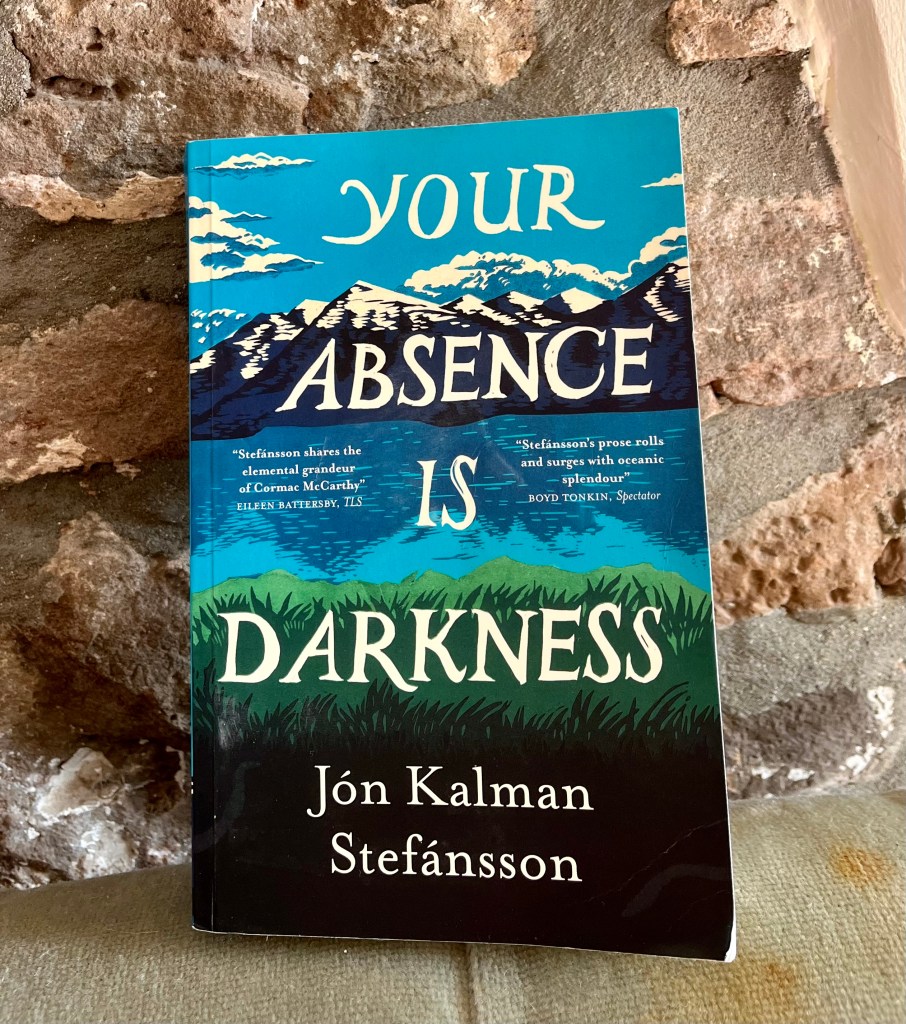
I am very very lucky to have some of my reviews published on the pages of European Literature Network. This particular review is available there as well but I wanted to share it on my blog, too. Here’s the link to Your Absence is Darkness. And I would absolutely recommend that you check other interesting articles written by extraordinary people who contribute #RivetingReviews.
Have you ever seen photographs of rivers and streams meandering through the rugged terrain of Iceland? The way they create their own space, take ownership of obstacles and thrive in the beautiful, unexplored countryside? As I was reading Jón Kalmann Stefánsson’s latest audacious novel Your Absence is Darkness, I was reminded of this Icelandic landscape. I fell under the spell of the storytelling, which meanders through time and locations, taking in life and death, punctuated by raw love of many kinds, and leading the reader to a perfect conclusion.
The powerful narrative, which is both stoic and emotional in equal parts, moves at a pace dictated by both the weather and the speed at which memories come to the surface. An unnamed man finds himself awake in a church in rural Iceland. He remembers nothing – he has completely lost his bearings – but he knows the presence of a stranger makes him feel uncomfortable.
This mysterious shape-shifting figure will accompany him on a journey of discovery. First a local woman helps him reunite with his sister. Then, as he listens to her stories about previous generations, he slowly submerges himself in a history that spans centuries, telling tales of the people who have loved, lost, fought, survived and died in the isolated, windswept farms and small villages on the Snæfellsnes Peninsula in western Iceland, whose stunning, unforgiving landscape has been influencing the ordinary lives of its inhabitants for centuries.
As the narrator begins to question this correlation between the natural environment and the economic situation of the inhabitants of these villages, which have changed very little over the years – ‘Blessed darkness, accursed damp – the history of Iceland?’ – we get to know the fates of the members of one particular family. Eirikur, a musician abandoned as a child by his mother, is running away from his Icelandic past, but suffers from loneliness and cannot connect with his father. A girl, chasing after the memory of one, intense blue-eyed gaze, moves from Reykjavik to the fjords. An uneducated farmer’s wife writes an essay on the earthworm, ‘the blind poet of the soil’ and unwillingly changes the course of two families’ lives. Petur, a pastor, neglects his wife, writes to a dead poet and falls in love with a stranger. An alcoholic father leaves those close to him and follows the starry night sky. We see dramatic events forcing men and women either to abandon their homes or stay firmly put, emigrate to Canada or settle for compromise, moved by love, pride or sense of duty. Just like in Iceland’s ancient sagas, the novel’s characters are bound together in a family history that spans around two hundred years.
Human tragedy links these individual stories, each of which deserves attention and patience from the reader. It seems that these characters cannot escape a brutal, often inexplicable destiny, but even as the natural world around them guides their daily existence, and even their morality, they also crave joy and a sense of belonging. Tenderness appears in the most unexpected places, humour provides some light, while Danish philosopher Søren Kierkegaard reminds the characters that they are loved: ‘Your memory is light, your absence darkness’.
Philip Roughton’s translation is superb, with the novel’s rhythm and tempo beautifully executed, especially when it comes to the way repetitions of words and phrases add to the overall sense of uncontrollable fate and the tensions between faith and biological fact. Stefánsson’s style – complex, intriguing, nuanced – in this translation flows like those Icelandic rivers.
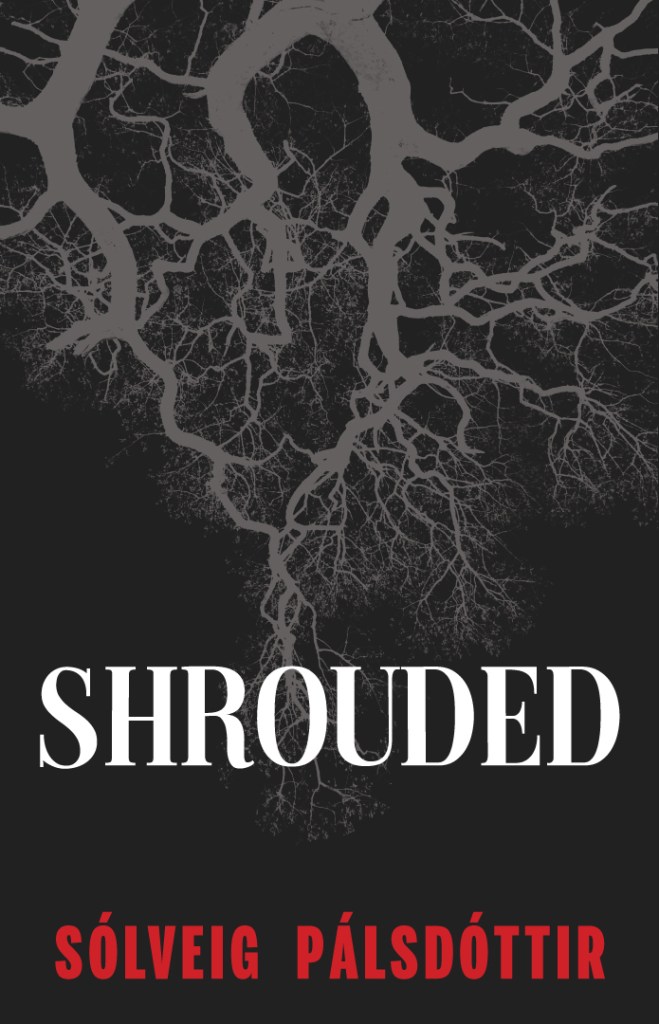
A retired, reclusive woman is found on a bitter winter morning, clubbed to death in Reykjavik’s old graveyard. Detectives Guðgeir and Elsa Guðrún face one of their toughest cases yet, as they try to piece together the details of Arnhildur’s austere life in her Red House in the oldest part of the city.Why was this solitary, private woman attending séances, and why was she determined to keep her severe financial difficulties so secret? Could the truth be buried deep in her past and a long history of family enmity, or could there be something more? Now a stranger keeps a watchful eye on the graveyard and Arnhildur’s house.With the detectives running out of leads, could the Medium, blessed and cursed with uncanny abilities, shed any light on Arnhildur’s lonely death?
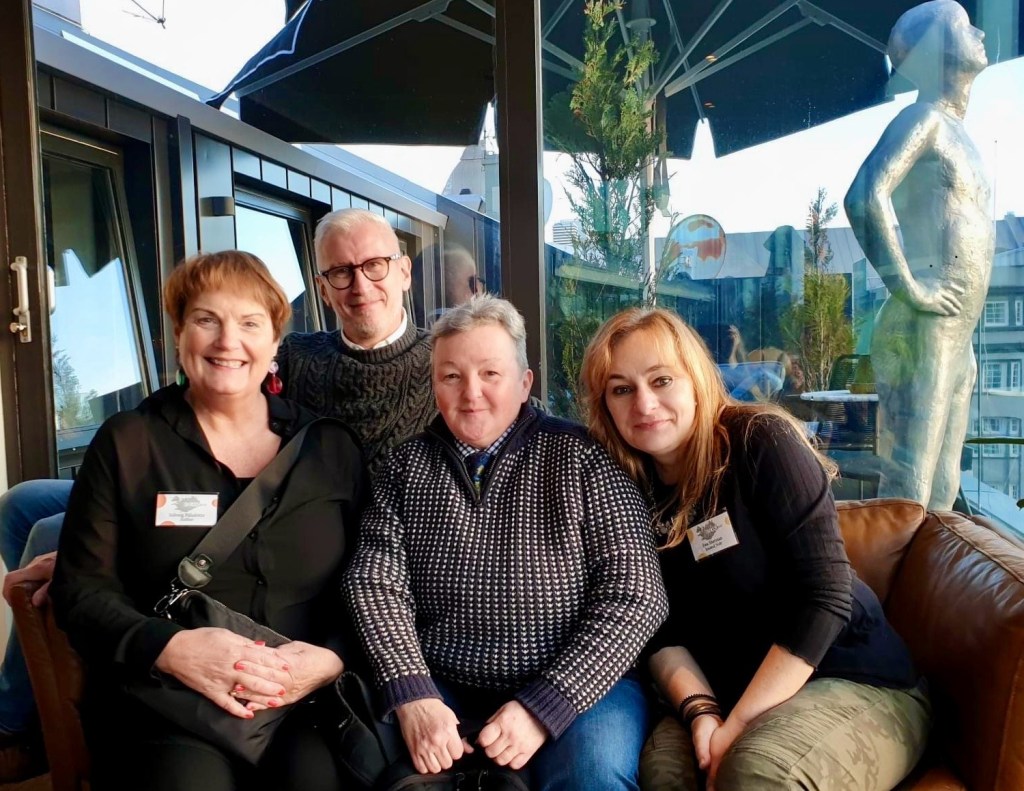
Sólveig Pálsdóttir and her fellow Icelandic author Óskar Guðmundsson, and two of her biggest fans: Jacky Collins and Ewa Sherman. Iceland Noir 2021.
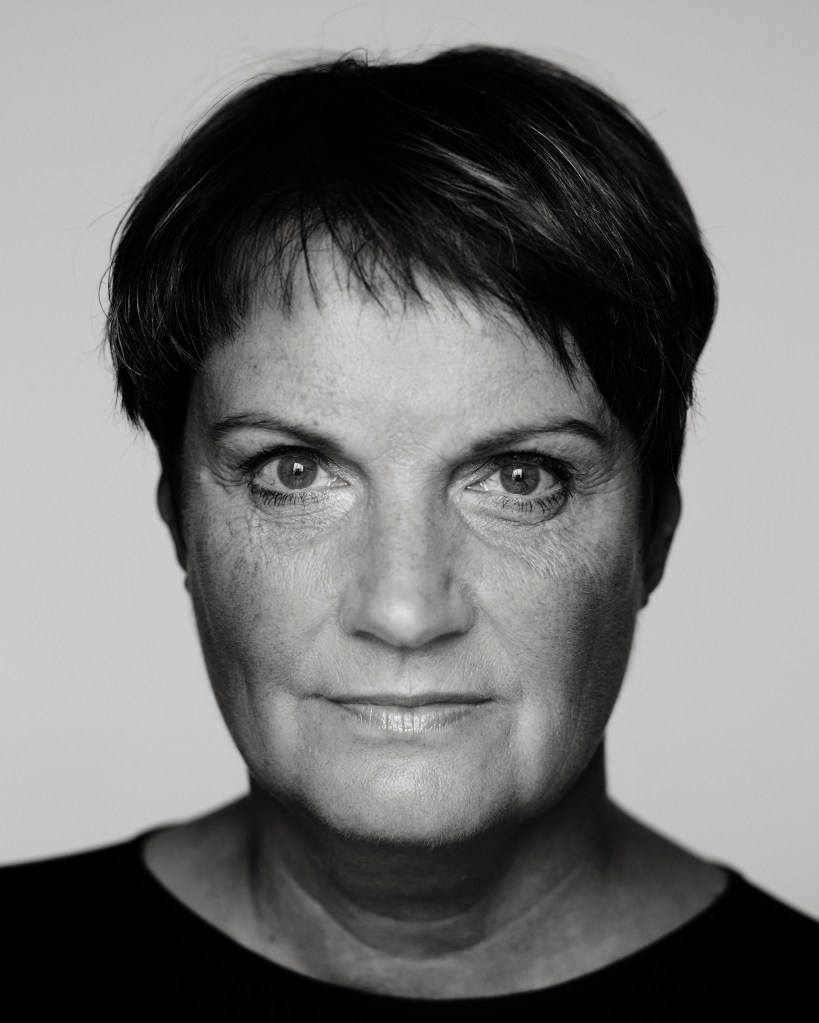
Sólveig Pálsdóttir’s latest gripping intriguing novel Shrouded in Quentin Bates’ translation from Icelandic has been published by Corylus Books last month, and received some excellent reviews from the readers. Here she talks about books that have made impression on her, over the years and quite recently.
‘I have always been a big reader, with an interest in literature of many kinds. My choice of reading depends on how I am feeling, as well as what I’m working on. I was a voracious reader of crime fiction before I started writing it myself. Swedish author Henning Mankell is my absolute favourite, a great stylist with strong social awareness and a highly versatile writer, as in addition to his crime fiction (featuring his most famous creation, Kurt Wallander) he wrote children’s books, plays, novels and powerful works based on his own life. Then I became a strong admirer of Stieg Larsson and his Millennium books. The Icelandic novelist Arnaldur Indriðason’s first books caught me in their grip, and as a student I naturally read Edgar Allan Poe and Umberto Eco, both of whom have been strong influences.
Since writing my own crime fiction, this is a genre I read less and find myself choosing other varieties of literature. I probably read half a dozen crime novels a year, just enough to keep up, and more of other books such as poetry, biographies and other fiction. I’m sure the reason for this is the concern that my work could be influenced by other authors’ crime stories and I want to avoid that happening. So I mustn’t read crime when I’m working on a book of my own.
There are more books than I can count that have been a strong influence on me, and many are by Icelandic authors who are mostly little known elsewhere. I have to include Iceland’s Bell by Nobel Prize winner Halldór Laxness.
I played a part in a dramatisation of Crime andPunishment by Fyodor Dostoevsky which was highly thought-provoking in a way that has stayed with me ever since.
Other authors who moved me deeply in my younger years and shaped my thinking were Margaret Atwood and Doris Lessing. I was captivated by The Grass is Singing and A Diary of a Good Neighbour. I haven’t read this again, but the feeling remains strong of what a curse restraint can be and how important it is to allow oneself fondness for others.
I can’t fail to mention Íslenskar þjóðsögur og dulrænar frásagnir / Icelandic Tolk Tales and Accounts of the Uncanny. I used to devour books like this well into adulthood, and listened carefully to people’s accounts of folk tales, the hidden people and ghosts. This can be clearly seen in The Fox and Shrouded, and probably in other books.
Of the more recent memorable books, I would like to mention The End of Loneliness by Benedict Wells. This seductive, low-key narrative technique has stayed in my mind. I read the book again recently and wasn’t disappointed. Now I mean to track down his latest book Hard Land. I recently read two novellas by Claire Keegan that I would wholeheartedly recommend, Small Things LikeThese and Foster. I have also been reading La Place by French Nobel Prize winner Annie Ernaux, which has recently been translated into Icelandic. This taut, almost cold, text was almost repelling, but it somehow stays with you, and I find myself again and again thinking about this book. Educated by Tara Westover also sticks in the mind. Her parents belonged to an isolated Mormon sect which believes the end of the world is imminent, living completely isolated from the outside world. It is an astonishing autobiography in every way. It’s shot through with the author’s powerful will to live, independence and belief in better things to come.’
Sólveig Pálsdóttir trained as an actor and has a background in the theatre, television and radio. In a second career she studied for degrees in literature and education, and has taught literature and linguistics, drama and public speaking; she has also produced both radio programmes and managed cultural events. Her first novel appeared in Iceland in 2012 and went straight to the country’s bestseller list. Her memoir Klettaborgin was a 2020 hit in Iceland. Sólveig Pálsdóttir has written seven novels featuring Reykjavík detectives Guðgeir Fransson and Elsa Guðrún in the series called Ice and Crime. Silenced received the 2020 Drop of Blood award for the best Icelandic novel of the year and was Iceland’s nomination for the 2021 Glass key award for the best Nordic crime novel of the year. Shrouded is the series’ fourth book to appear in English. Sólveig lives in Reykjavík.
Quentin Bates has personal and professional roots in Iceland that go very deep. He is an author of series of nine crime novels and novellas featuring the Reykjavik detective Gunnhildur (Gunna) Gísladóttir. In addition to his own fiction, he has translated many works of Iceland’s coolest writers into English, including books by Lilja Sigurðardóttir, Guðlaugur Arason, Einar Kárason, Óskar Guðmundsson, Sólveig Pálsdóttir, Jónína Leosdottir, Ragnar Jónasson and elusive Stella Blomkvist. Quentin was instrumental in launching Iceland Noir in 2013, the crime fiction festival in Reykjavik.


 Nordic Lighthouse