1947: When Now Begins by Elisabeth Åsbrink

My first ever review for European Literature Network – 1947: When Now Begins by Elisabeth Åsbrink was published eight years ago. I’m feeling a touch nostalgic as I look through old reviews but I must also admit that Elisabeth Åsbrink‘s book has been on my mind for the last two years. Hence I would like to recommend it again. The world is changing rapidly and we must learn from the past – to do good.
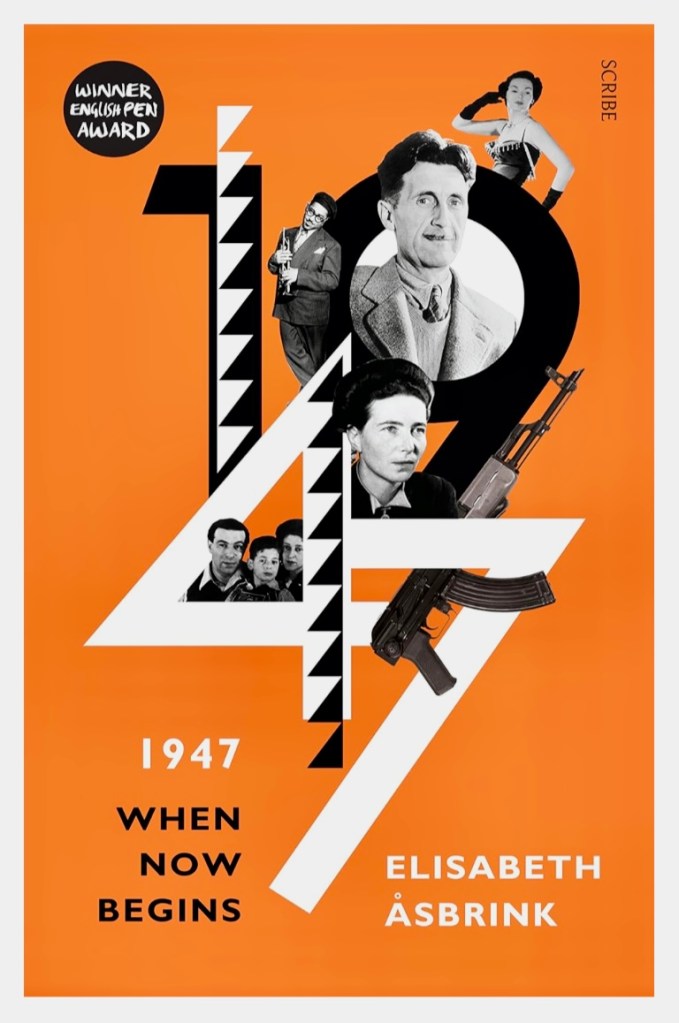
In 1947, everything is changing. The world is set to become a very different place …

Christian Dior is designing his fabulous, sumptuous New Look dresses. Thelonius Monk is playing his ground-breaking jazz compositions and Billie Holliday is singing the blues. Grace Hopper, appointed as a mathematician in the US Navy, finds an actual computer bug: a moth stuck in a massive mainframe. Simone de Beauvoir longs for her American lover and writes The Second Sex, later hailed as feminist bible. Eric Arthur Blair, better known as George Orwell, is coughing his guts out as he works on 1984 on the Scottish island of Jura.

On the other side of the still invisible East – West border, Mikhail Kalashnikov finally gets the go-ahead to mass produce his deadly invention: a gas-operated machine gun. The Cold War map is reduced to black and white … nuances of grey: non-existent. British and American powers decide the fate of thousands of Jews and fight against communist influence. The Soviet Union hardens its ideology.

While the world tries to heal itself and for the most part cries ‘never again, never again’, the Nuremberg Trials are in full swing and finally there is a chance that a new crime of genocide will be recognised. Other opinions and thoughts allow the continuing flight of old Nazis to Argentina, thanks to their new sympathisers, who often gather in the Swedish town of Malmö, and spread the written Fascist credo like fire. Anxiety, cynicism, cold legal calculations, power games and deeply-rooted convictions provoke the creation of the CIA and underlie the origins of the Muslim Brotherhood and ISIS, based on Hassan Al-Banna’s ideology. The UN Committee has only four months to decide future of Palestine and in these tumultuous times must consider diametrically conflicting wishes and demands.

Amid the post war chaos and pain, amongst thousands of refugees, liberated prisoners and emaciated Jews, a ten-year-old Hungarian boy, Joszef, once called György, is in Ansbach in southern Germany, in the American zone. In a camp for children whose parents have been killed by Nazis, he needs to decide whether to travel to Palestine and start a new ‘Zionist’ life, or to return to Budapest, the city that was his home as well as the source of his persecution. His is also the personal story of the author: Joszef will eventually escape to Sweden where his daughter Elisabeth will be born.

The story moves through a devastated Europe, to the mighty US, which is launching the Marshall Plan, to a fragile Middle East, a torn-apart Indian subcontinent with millions of hurting Muslims, Hindus and Sikhs; it carries us seamlessly along. It’s a fascinating piece of non-fiction that reads like a vivid novel: the evolution of the world on a huge scale reveals small fissures through which we observe tiny moments in private lives.

Swedish author and journalist Elisabeth Åsbrink has written four books which have, between them, won the August Prize, the Danish-Swedish Cultural Fund Prize, and Poland’s Kapuscinski Prize. 1947: When Now Begins is her first book to appear in English, superbly translated by Fiona Graham, a winner of the English Pen Award. Åsbrink has created an exceptional and gripping chronicle of this one momentous post-Second World War year; it combines major events with small, individual histories of the people affected by what had happened only a few years previously, and what would continue to affect future generations. Åsbrink uses both snapshots and longer musings to ask important questions; yet she keeps her own emotions in check, barely allowing them to surface in the sea of pain, despair, unspeakable crimes and the occasional hope. She admits to attempting to define herself and her own authenticity through her detailed survey of the events of 1947: Grief over violence, shame over violence, grief over fame. In this 70th anniversary year, the book is in no way just a historical record: instead its themes are contemporary, valid, and urgent.

1947: When Now Begins is an extraordinary book, based on an incredible amount of research, presented in a very sober, sensitive way. It invites us to go in search of even more information. A highly recommended must-read.
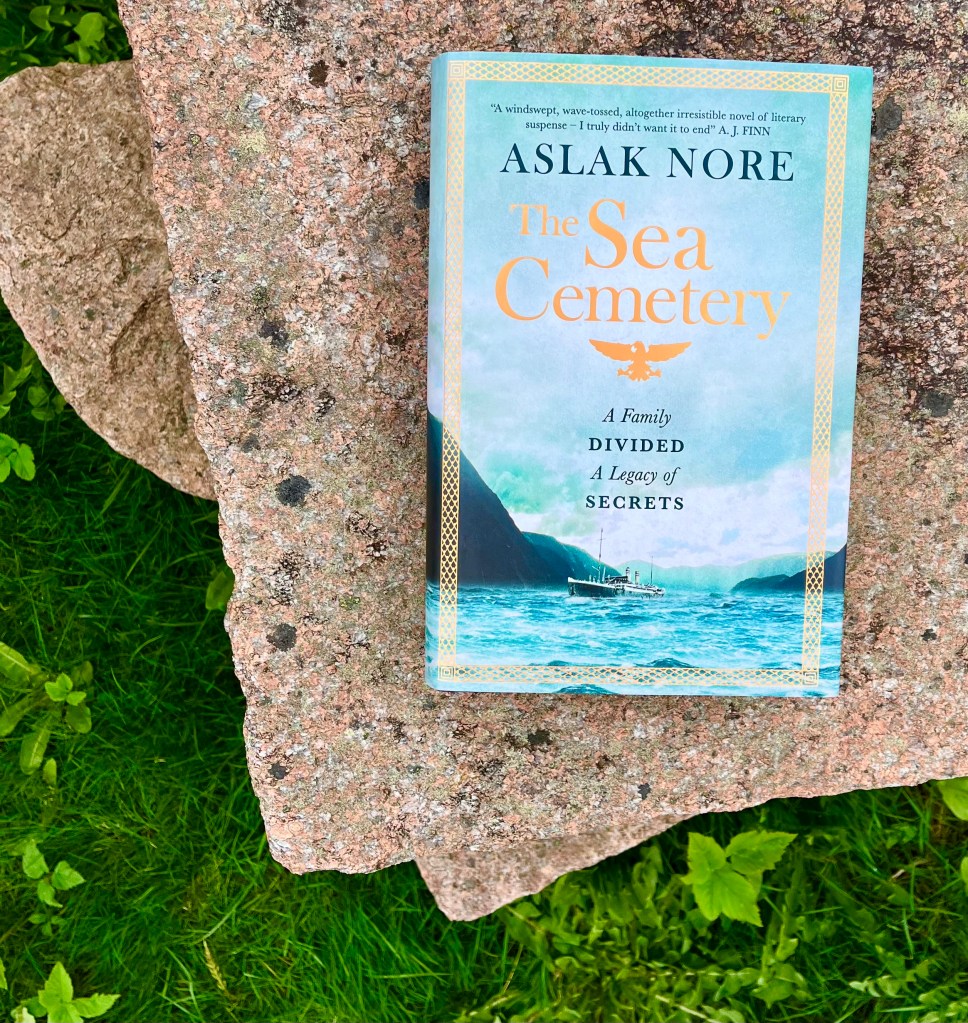
The Sea Cemetery by Aslak Nore

What an incredible novel! From the very first pages I knew that The Sea Cemetery / Havets kirkegård, a literary thriller and family saga combined in one huge tome, would take me on an unforgettable voyage through the recent history of Norway and its connections with the Europe, and questions about individual choices made by the main characters. The universal human issues are hidden just below the surface of the dramatic story about legacy and control, and consequences of hidden secrets in the thriller set among the harsh Norwegian natural beauty.

Aslak Nore’s inspiration came from the authentic sea disaster during the WWII when Norway was under German occupation. Sinking of the Norwegian passenger ship DS Prinsesse Ragnhild in 1940 was the worst wartime tragedy. The ship struck a mine and disappeared under the water between Bodø and Lofoten in the North, with loss of many lives.

Vera Lind, writer and matriarch of a rich and powerful dynasty, commits suicide on the family stunning estate near Oslo. She has been writing memoirs while trying to deal with her own and family’s trauma, going back to the times of wartime shipping disaster in October 1940 that had killed her husband and hundreds of other passengers and German soldiers. However, her earlier attempts to publish the novel were met with fierce opposition by Olav, her son and heir to the fortune. Forty years later in 1970 the manuscript vanished and Vera was placed under a Guardianship Order. Something strange has taken place.  

Not everyone wants to dig into the past to uncover shocking truth but her granddaughter Sasha (Alexandra) is determined to find out what has happened to Vera. Her husband Mads and siblings Sverre and Andrea don’t want to rock the boat, so to speak, and so she does it alone, although Johnny Berg, a journalist and discredited Norwegian secret service agent, decides to help her along the way. This semi-professional relationship is tricky. Sasha is torn between loyalty to her strong-willed father Olav and the family, and the need to ‘avenge’ her grandmother. Berg, apart from his personal motives to search for the manuscript, has also signed the contract to write biography of Hans Falck, a charismatic doctor and an adventurer, notorious for his personal life and famous for his humanitarian work in the Middle East. Sasha’s cousin Hans is from Bergen and convinced that Vera bequeathed the fortune to him and his children. There is no love lost between two branches of the Falck family: in Bergen on the beautiful Norwegian coast and in Oslo, close to the country’s financial centre.  

So far so complex regarding the family ties. However, the power struggles and different sentiments become much more evident as the novel unravels. I enjoyed the occasionally uneven tempo of this epic tale. Hunt for Vera’s missing testament and manuscript was shown through eyes of main players and as a novel-in-novel process, and my view of various people shifted. It’s right to say that ‘History is power. Control the narrative, and you wield the power.’ Chapters exploring conflict in Kurdistan and Afghanistan added both clarity and some confusion necessary to paint a picture of intertwined connections within the family, known only to those who make the decisions. The geopolitical context is relevant as the author also took on the most sacred Norwegian values, such as patriotism and trust, and explored them in the view of family secrets.

The Sea Cemetery, in superb translation by Deborah Dawkin, culminates in a brilliant and completely unexpected twist that paves the way for the second part of this trilogy. It was published by MacLehose Press in 2024. Now I am really looking forward to reading The Heirs of the Arctic / Ingen skal drukne.

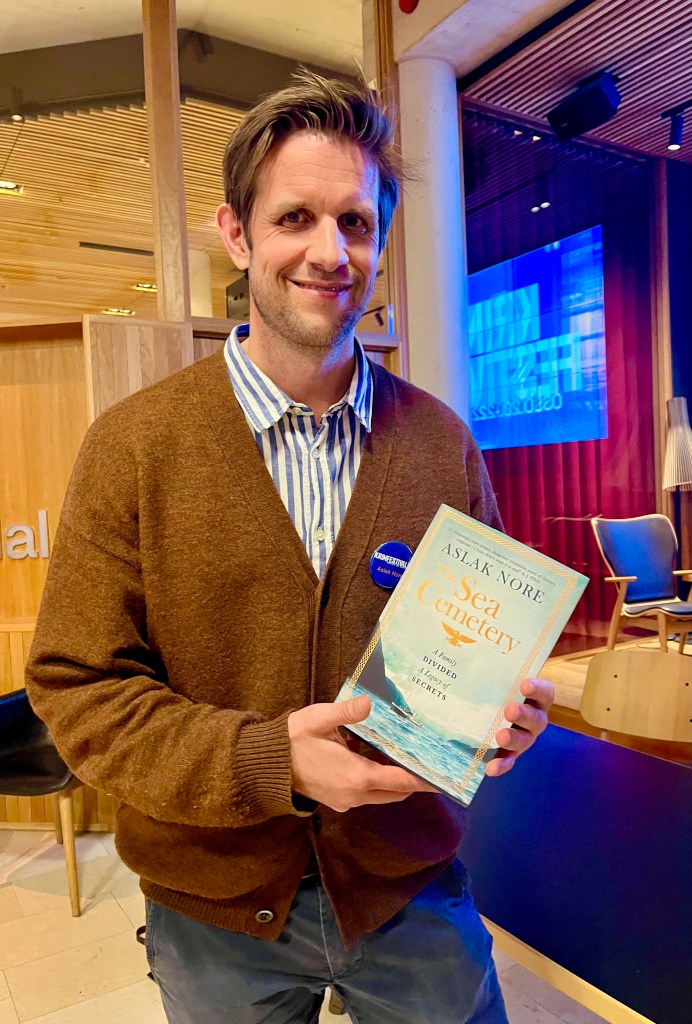
Aslak Nore with The Sea Cemetery during Krimfestivalen 2025

Aslak Nore (b. 1978) grew up in Oslo. He was educated at the University of Oslo and the New School for Social Research in New York and has served in Norway’s elite Telemark Battalion in Bosnia. A modern-day adventurer, Nore has lived in Latin America and worked as a journalist in the Middle East and Afghanistan. He has published several non-fiction books and four novels. Wolfsangel (2017) was a national bestseller and won the Riverton Prize for best crime novel in Norway in 2018. The Cemetery of the Sea (2021) is the first novel in an epic literary thriller series and a huge international success and bestseller. Nore lives in Provence, France. © Winje Agency

My Blue Peninsula by Maureen Freely

In Maureen Freely’s own words: ‘It’s about an old Istanbul family that derives its prestige from the patriotic ancestor who served next to Mustafa Kemal in Turkey’s War of Independence. His wildly bohemian descendants have been in the news ever since, often for less noble reasons. But no one ever speaks about how they came into their money – until Dora, Pasha’s granddaughter, takes it upon herself to investigate her family’s past. Whereupon her world unravels.’

There is so much I still don’t know about history in this region, about the culture and the people, even though I did pay attention at school, especially in relation to the Polish situation, as we learnt the King Jan III Sobieski of Poland had saved the rest of Europe from the Ottoman Empire’s influence. Battle of Vienna in 1683 was the defining moment for the combined forces of the Holy Roman Empire, led by the Habsburg monarchy, and the Polish-Lithuanian Commonwealth. The Ottoman Empire, founded around the year 1299, controlled much of Southeast Europe, West Asia and North Africa. It was the largest political entity in this part of the world until its demise and eventual the dissolution by treaties after the end of WWI. The modern Turkish Republic was established. But I digress a bit.

My Blue Peninsula by Maureen Freely, published by Linen Press, is her fourth novel set in Istanbul which she knows very well after spending childhood there while her father taught physics at an American University in the city. Curious about the author and academic Maureen Freely, I began searching for information about her work as an acclaimed writer and a translator of books from Turkish, including five written by Orhan Pamuk who was awarded Nobel Prize in Literature in 2006. That led me to read about other Turkish authors whose books Maureen Freely brought into English, and about the fairly recent tragic history of the country. For more than a century the Turkish state refused to acknowledge the Armenian genocide in 1915. Even mentioning the word could have led to prosecutions, and it did. However, history cannot be ignored and forgotten as it still affects generations of people whose own personal history needs its own voice. The geopolitical context, ‘moving’ borders and dealing with the shameful past gives My Blue Peninsula a truly epic feel, especially as various characters come from different countries. Yet personal drama makes it intimate and heartbreaking. This vivid powerful book focuses on Dora Giraud’s search for truth, as her extended family is just one of thousands that experienced the shameful and tragic past.

The novel’s strong precise prose of seven notebooks, akin to confessions, chart life of Dora from her upbringing and childhood in America into late middle age, taking in numerous locations and the enormously complex legacy. This personal journal is meant for her adult daughters Maude and Clementine; an exploration of the turbulent past and explanation of her decision to remain in Istanbul and risk her life to continue campaign to record and acknowledge the Greek, Armenian and Assyrian genocides. In the capital city she has survived an extremist attack which killed Tallis, her American ex-husband, and yet she is unable to leave the past behind.

That process is difficult. Dora uncovers strands of family heritage linked to the past and constantly influencing her choices. She is part-Ottoman, part-Armenian, part-American, and a descendant of the genocide, having both the victims and the perpetrators in the genealogical line. At first she is curious and confused when suddenly her quiet life in New York turns into an international adventure across the ocean. Bohemian and mysterious spy drama awaits when her beautiful secretive mother Delphine decides to move to Istanbul in the 1960s and then the realisation that she has two passports hits her. Getting to know relatives and making friends while embracing free artistic atmosphere in her grandmother Hermine’s city apartment, she begins to discover the reality of conflicts, although she is often unaware of real events, decisions, reasons. And as she learns more, she also grows more determined to untangle strands and to understand what’s happening in the Cold War context, its aftermath, and the rise of Islamic fundamentalism.

Although the search for identity, belonging and comprehension proves to be a painful emotional journey, Dora must do that, and she seeks love and assurance, too. She needs her family, her people. Her story is rich, complicated, violate and engrossing. It cannot exist in limbo as relationships between various members of her huge family are so entwined and dependent on the actions of previous generations. There are many white lies, and unspoken secrets, hidden issues. Cousins are not always who they seem and might not be related by blood. Generations do not follow a standard pattern. Betrayal and confusing connections are everywhere. But this is her cultural and historical inheritance:

‘I’d try to imagine what I could say. That my mother was a spy, and my father the son of a Pasha? That my grandmother, a brilliant but scandal-prone artist, had only learned to love her husband after shooting him in the neck?’ ‘How was I to explain that tangled roots like these had not been unusual in the ruling classes of this vanished empire that my lovely new friends had probably never heard of? Or that I nevertheless felt disappointment on discovering these roots, because it meant that my father could not therefore be a Soviet spy of whom I was so very fond? How could I convey how jarring it had been [..] to realise that my cousin Sinan was in actual fact my nephew?’