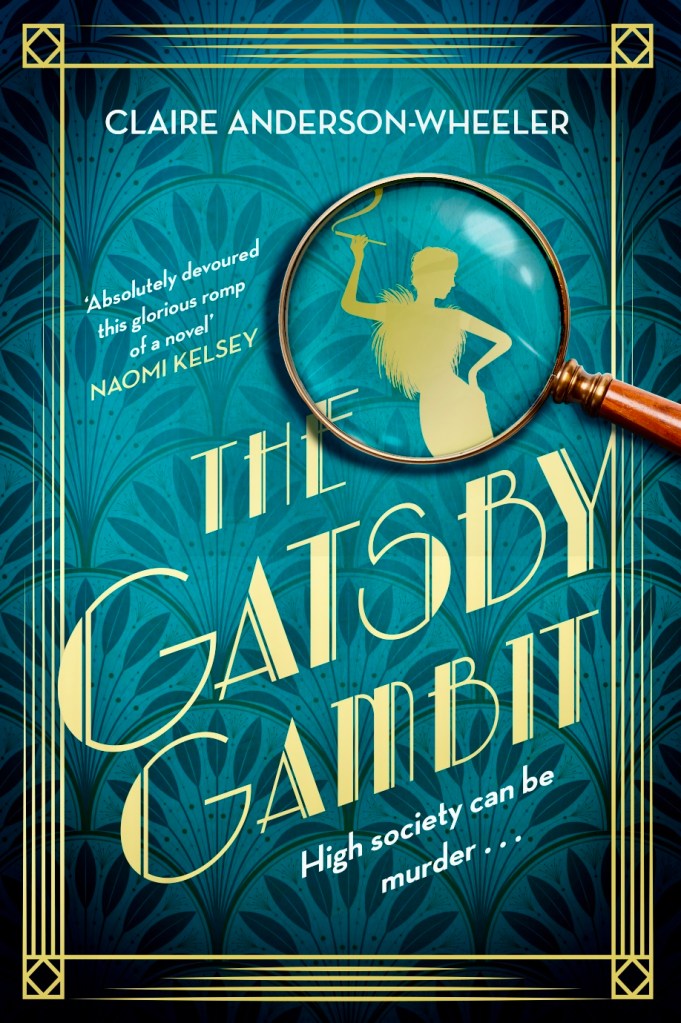
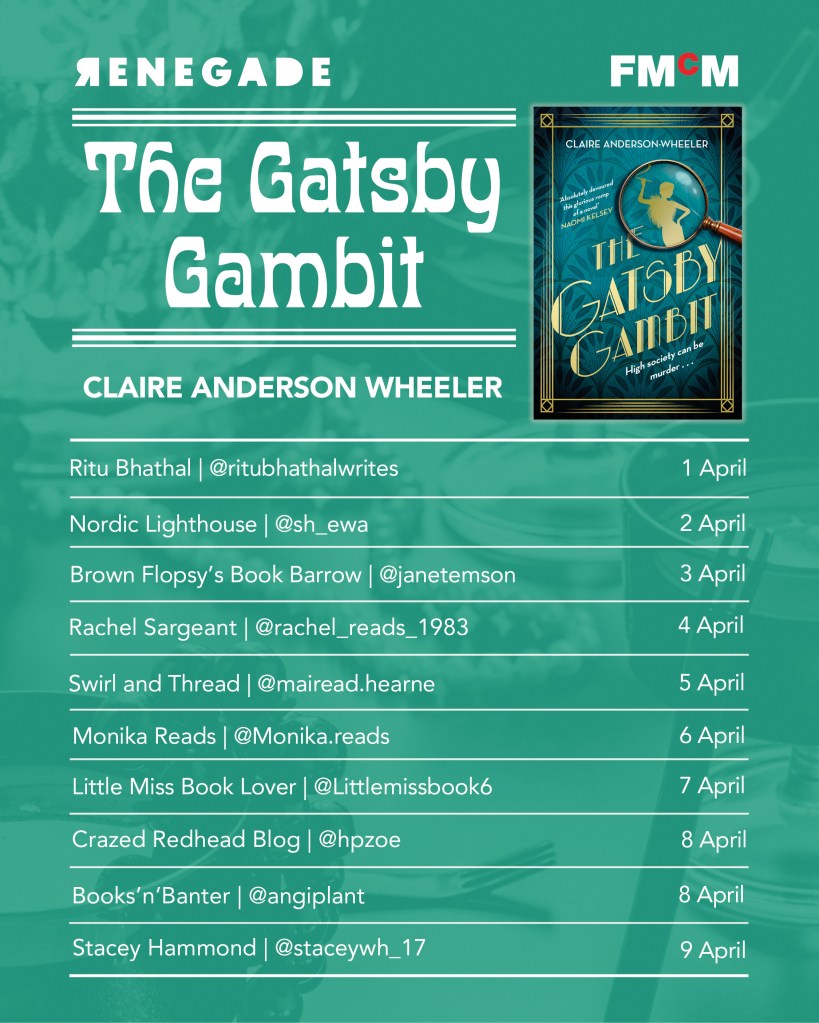
The Gatsby Gambit by Claire Anderson-Wheeler

Freshly twenty-one and sporting a daring new bob, Greta Gatsby – younger sister to the infamous Jay – is finally free of finishing school. An idyllic summer stretches ahead of her at the Gatsby Mansion, the jewel of West Egg. But when Greta arrives at the secluded white-stone estate bathed in the late-afternoon light, she finds she isn’t the only visitor. Jay is hosting an intimate gathering of New York’s fashionable set: Daisy and Tom Buchanan, along with his brother Edgar, Nick Carraway and Jordan Baker.

That evening, the guests enjoy a candelabra-lit dinner party. That night, they dance to the lilt of the gramophone. The next morning, one of them is missing. Murder has come to West Egg, the warm breeze tainted by scandal, betrayal and secrets. Turning sleuth isn’t how Greta meant to spend her summer – but what choice does she have when one of them could be next?

Many of us fell in love with Jay Gatsby and the opulent crazy world he represented, with the social issues bubbling under the surface of Jazz Age fun and apparent freedom. While reading The Gatsby Gambit it will be impossible not to refer to the original classic which was published exactly a hundred years ago in April1925. Francis Scott Fitzgerald’s The Great Gatsby had romance, unattained love, sharp look at social class, conflict between inherited and self-made wealth. And most of all drama and inspiration. However, the novel by Claire Anderson-Wheeler is a beauty of storytelling in its own right.

Here, this environment, seen from Greta’s perspective, acquires more depth and clarity away from the music, illegal drinking, dancing and flapper dresses which were reserved mostly for the rich at the time. Of course the glitz is not far away. She discovers how divided the society is by its norms, racial attitudes and money, mostly by people convinced of their own greatness, for example Tom Buchanan who was above rules and laws, and a fan of: ‘the American Protective League […] a self-appointed group of vigilantes who had organized “slacker raids” during the war, rounding up other civilians they suspected of draftdodging.’

Greta Gatsby’s existence has been quite sad, secure and privileged, and lacking in deep meaningful relationships, apart from the one with her brother Jay, seven years older than her: ’Greta had lived under Jay’s guardianship since their parents had died fifteen years ago.’ Completing her formal education and returning to Gatsby home, a fabulous mansion at West Egg brings contrasting emotions: joy of returning to her brother, a thrilling possibility of freedom and fearing ‘for a new set of restrictions – the world Jay had bought them entry into had already shown itself to be heavy with codes and rules.’ Her concern is the possible boring future as a trophy wife, married into the family with strict rules, just like Daisy Buchanan’s existence.

Rich, charming and inscrutable Jay has always been in love with Daisy and now it’s the time that Greta realises how strong his devotion is. In the hours and days following a discovery of a dead body on his yacht, she learns of secrets and scandals, and of intricacies of his relationships with his friends and people around him, mostly those who take advantage of his wealth: spectacular parties and the influence. Death of person in Jay’s close circle sends shock waves. Initially everyone, including the police, assumes it was suicide. Greta feels that something is not quite right, begins to think of all tiny details that don’t fit and follows her intuition to try and explain what has happened. Her ‘investigation’ makes her experience some dangerous situations but that doesn’t stop her. Her parents brought her up to believe that ‘mind was a terrible thing to waste’ and she is also convinced that life shouldn’t be wasted either. She also remembers that her ‘ mother had been a keenly intelligent woman, and one of those lucky, all-too-rare ones whose intelligence had been welcomed – cherished, even – by her spouse. But she had never failed to remind her daughter that the world wasn’t always so accommodating. A woman’s mind is her sword, she’d say to Greta […] Keep it sharp, she’d add, and keep it hidden.’

Claire Anderson-Wheeler’s take on the dazzling and dangerous era and revisiting a famous location where the iconic hero played with his life is a fantastic example of passion and knowledge. I loved the strong determined heroine who wanted to find the truth and create a purpose for herself. In a process she also learnt of the way the less privileged people had to ascertain their place in the society, and fight for basic existence. This mix of historical context and fun jazzy murder investigation, plus clever twisted plotting sparkled with Agatha Christie’s comments from the men in the story, makes The Gatsby Gambit a very interesting homage to the classic masterpiece, and a joy to read.   

Thank you to Hannah Born of FMcM for the invitation to join the blog tour.

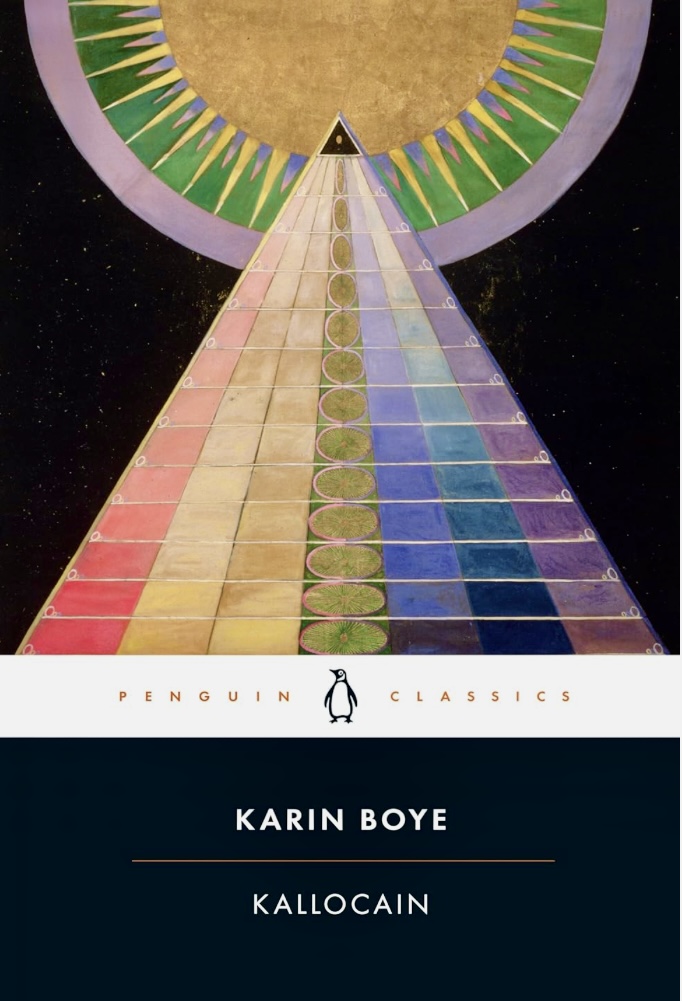
Kallocain by Karin Boye

Leo Kall, a research chemist and a very obedient citizen, has been working on a revolutionary new drug that will force everyone to share the most private and innermost personal thoughts. Police are keen to use Kallocain as a new interrogation technique to crush citizens of the totalitarian ‘World State’. Leo begins to feel alienated and terrified.

Let me start with mentioning the translator David McDuff who did an incredible job bringing this pioneering work of dystopian fiction from a Swedish author into emotive and taut precise English. He also wrote an introduction to the novel, and I would like to quote some of his words to get a better understanding of the poet, novelist and essayist Karin Boye. Her science fiction novel, written in 1940, presented a ‘vision of enslaved humanity, an allegory dream- like and grotesque, yet instantly recognizable to anyone then living through the international crisis.’ It is a novel from one of Sweden’s most acclaimed writers that we know nothing or very little of.

I was reading Kallocain with trepidation, shocked by the incredible clarity of literary vision of its author Karin Boye. It depicts a totalitarian ‘World State’ designed to crush and obliterate the individual and all private thoughts. It is also pure Nineteen Eighty-Four even though it was written eight years before George Orwell’s dystopian classic, with touches of The Handmaid’s Tale which I just couldn’t handle. Boye’s fictionalised futuristic world was influenced by the contemporary unfolding events of the Second World War and two apparently opposing systems: ‘ice-cold reasoning’ of Hitler and the ‘merciless dialectics’ of Stalin’. This chilling and totally absorbing tale follows the research chemist Leo Kall, a very obedient citizen and middle-ranking scientist. He is a Fellow Solider, just as his wife is, and as his three children will be. Their life is rigorously compartmentalised in the society divided by basic skills and needs. Leo has been working on ‘truth drug’ Kallocain which will force truth of anyone when the liquid is injected straight into the bloodstream, making people fall into a sleep-like state and saying what’s on their minds, even the most personal opinions, hidden deep down in subconsciousness. When the drug stops working, everyone is aware and often intensely ashamed of sharing everything. The authorities are excited: ‘Kallocain gives us the possibility of controlling what goes on in people’s minds’ and will replace all other methods of interrogation.

Leo and his superior start initial tests on ‘five subjects from the Voluntary Sacrifice Service’ which proved satisfactory and more ‘human material’ gets brought in to experiment on. Soon the top police get involved, production of Kallocain goes ahead, other Fellow Soldiers are trained to administer it – and Leo begins to fear for his own life. Surrounded by ‘police eyes’ and ‘police ears’ – cameras and microphones – which are in the walls of apartments and houses, and lacking any sense of security at home as Linda often vanishes without a word, he, like everyone else, is terrified of being denounced and found guilty of not denouncing others. Because this is happening as more injections are given to anyone who dares to think differently, more arrests and deaths. However, he realises that there is a seed of opposition in the society, and equally scared of being own person.

Karin Boye paints a bleak desolate landscape of underground buildings and corridors; with a need for surface permissions; dehumanised and alien, lacking colours and smells. Grim. Leo tells his story from the prison where he’s been for over twenty years, not sure how long because of the isolation and induced timelessness, and still continues as a chemist, his existence being still terrified but also a little bit brave and resigned that he must not be completely silent. Whatever happens to him afterwards is unclear; however, I believe that any reader of Kallocain by Karin Boye will be shaken to the core.

Karin Boye (1900–41) was born in Gothenburg, Sweden and studied in Stockholm and Uppsala. As a young woman she joined the international socialist and pacifist organization Clarté and published her first volume of poetry while still in her early twenties. She translated T. S. Eliot’s The Waste Land into Swedish in 1931, and wrote several novels throughout the decade. She married a fellow writer but left her husband after undergoing psychoanalysis in Berlin and formed a lifelong relationship with a German woman, Margot Hanel. Boye’s most famous book, Kallocain (1940), was partly inspired by eye-opening trips to Nazi Germany and Soviet Russia. She died from an overdose of sleeping pills the year after writing the novel.
David McDuff’s translations for Penguin Classics include Dostoyevsky’s Crime and Punishment, The Brothers Karamazov and The Idiot, and Babel’s short stories.

Remembering Miriam, always and for ever

My dear friend Miriam V Owen died suddenly last month; today was her funeral which I joined online. It was a beautiful touching but heart-breaking occasion. I can’t even imagine how her family must feel… All her friends are deeply sad but want to cherish the moments spent together. I don’t feel I can express well anything that goes through my mind as I think of Miriam, one of the #ScandiGang’s original members. So just this short post for now… We met in London in 2013, and clicked straight away, and shared love of Scandinavian and Nordic things: literature, food, landscapes mood. We talked about bringing up boys, about work and life, about crime fiction, travel, writing. She sent recipes. She was always there… We’ve been together at different book events and festivals in Iceland and the UK but haven’t managed to meet in Bergen in Norway. The plan was to follow in the footsteps of Varg Veum, the fictional PI created by Gunnar Staalesen, whom Miriam adored. Her passion for #NordicNoir was shown in her informative views as my fellow judge for Petrona Award and on the pages of the fascinating blog from which I copy the words below.

Nordic Noir blog – Iceland Noir 2014 ‘This film is all about experience at a crime writing festival in Reykjavik, Iceland. It contains interviews with authors, fans and one of the festival organisers as well as images, music and some text. It was made as piece of academic work in 2014 to allow me to explore videography as a tool for research. I loved the experience of making a film, editing it and working with a musician on some of the soundtrack. The piece has been well received at two conferences. One around the theme of Community Memory at the University of Stirling and also at the Academy of Marketing Arts and Heritage Colloquium 2016 held at Royal Holloway in London. The Icelandic Ambassador in London has also viewed it. When I made this I did not have any really fancy tools […] This piece would not have been such positive experience without the support of the crime fiction community as well as the academic community that has supported me. Thank you all.’

I will write more but not today. We miss you, Miriam.

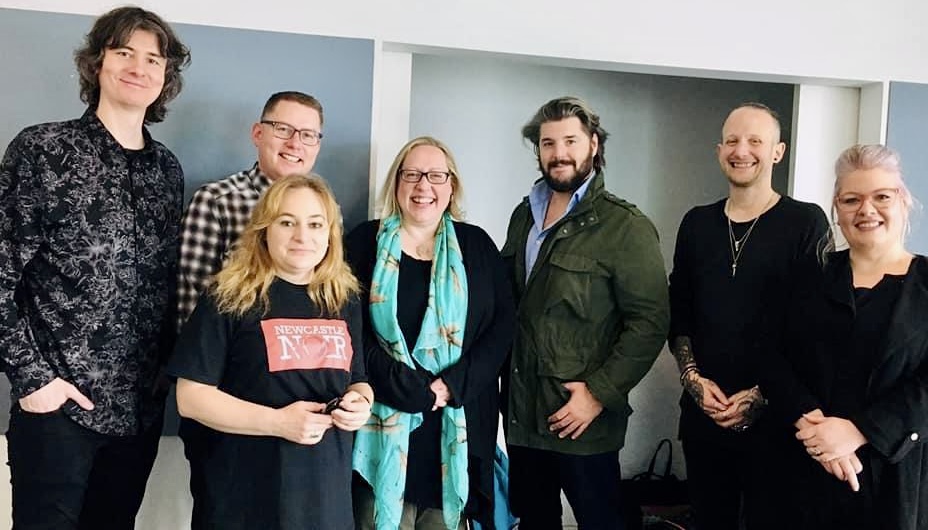
ScandiGang underground. 13 October 2013