
Twenty-three years ago, a young woman was murdered on the Swedish island of Lidingö. The island has kept its silence. Until now.
As autumn deepens into darkness in Lidingö, on the Stockholm archipelago, the island is plunged into chaos: in the space of a week, two teenaged boys are murdered. Their bodies are left deep in the forest, dressed in white tunics and wearing crowns of candles on their heads, like offerings to Saint Lucia.
Maïa Rehn has fled Paris for Lidingö after a family tragedy. But when the murders shake the island community, the former police commissioner is drawn into the heart of the investigation, joining Commissioner Aleksander Storm to unravel a mystery with a shockingly dark heart and as chilling as the Nordic winter.
As they dig deeper, it becomes clear that a wind of vengeance is blowing through the archipelago, unearthing secrets that are as scandalous as they are inhuman.
But what if the victims weren’t who they seemed? What if those long silenced have finally found a way to strike back? How far would they go to make their tormentors pay? And you – how far would you go?
I admit that Scars of Silence really shook me. The sequel to Johana Gustawsson’s chilling gothic thriller Yule Island is also set in the same location, relatively close to Stockholm, yet far away from capital’s bustle and hustle, and explores various relationships existing within a local community. The story also gives space to the process of grieving, allows it to take its own course – if that is possible at all. These two issues – mourning and connections – permeate through memories of the past and the urgency and tension of present events, following the police investigation into two murders.
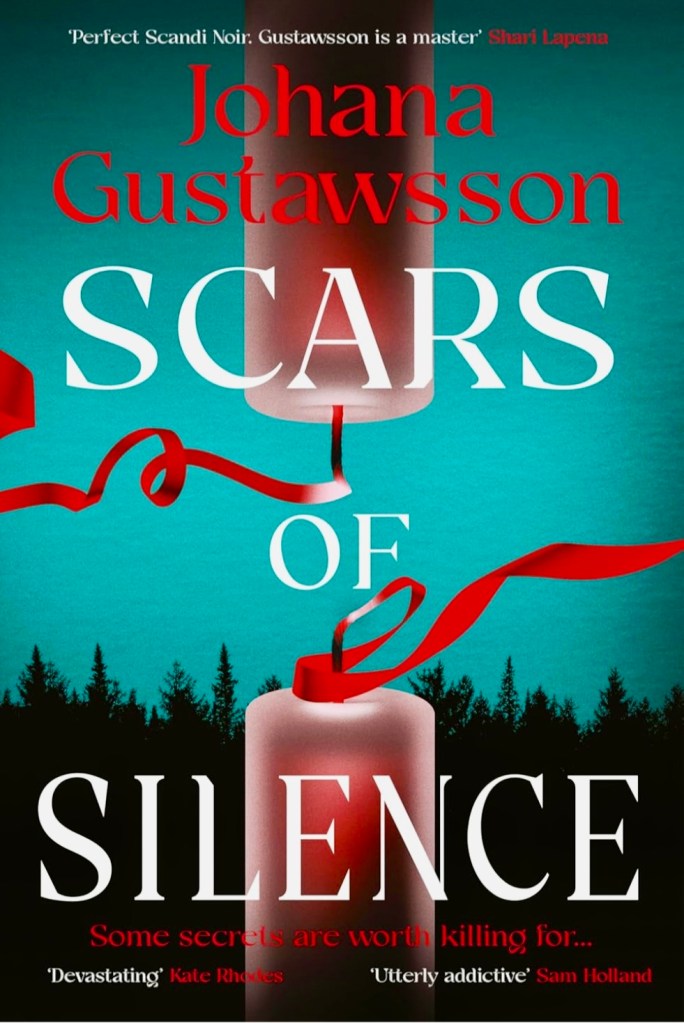
Johana Gustawsson creates unique tales that combine strong emotions, sober look at the society and masterful storytelling. Her eloquent and engaging writing style keeps the reader fully immersed in the world of fictional characters who nonetheless have their own roots in what has happened in reality before, or what could have happen in any community. Superb translation by David Warriner brings the nuances and subtleties of Swedish environment via French language into the English sphere. The flowing strong narration and attention to minute details helps to navigate the unknown and to decipher new emotions, never losing sight of the consequences of earlier crimes.
From the very first pages of Scars of Silence I felt that, both as a writer and as the main protagonist Maïa, the author learns of the new location, new country, habits and norms. Sweden’s attitudes in a nutshell appear as Gustawsson / Maïa discover beauty of the local customs, calm and wonder of unforgiving nature, and rigid, or very slowly changing, outlook at what should be hidden, not spoken about, forgotten.
However, the author and her heroine are two different persons: she does not become her distraught and devastated French detective trying to cope with the death of her daughter, and the absence of her husband Ebbe.
Tragedies cannot be ignored, even after a long passage of time. The silence, or the paralysis of horrendous aftermath, that follows can become overwhelming and extremely painful and takes over every single action. It needs some direction, maybe distraction. Therefore Maïa, in a way, welcomes the opportunity to bury herself in the old files of quickly solved rape and murder of Jenny Dalenius on Saint Lucia’s Day on 13th December 1999.The only suspect Gustav Hellström was Jenny’s ex-boyfriend, a rich young man from a prominent family. He served nearly all his time but had committed suicide just weeks before release from prison. For over twenty years his mother Anna fought to prove his innocence until suddenly, seven days later, she had killed herself in the most shocking way at the local school, while live-streaming it on social media. Sophia Akerman, Anna’s mother and Gustav’s grandmother, asks Maïa to help her find the truth of what has happened and to quiet her own doubts and suspicions. This task bonds them in grief of losing a child. ‘There’s no word in Swedish, or in English for that matter, to describe a parent who’s been widowed – or orphaned – from their child.’ ‘There’s a word for it in Sanskrit: vilomah. It means “against the natural order”.’
Maïa focuses on dealing with Sophie’s request while assisting Commissioner Aleksander ‘Aleks’ Storm with search for the killer(s) of Daniel Brink and Roland Lind, and their professional relationship grows from respect and empathy. They struggle to understand motives for copy-cat like killings, especially as a body of another victim is found in Stockholm: ‘We’ve gone from two teenagers, basically the same age, who went to the same high school, lived in Lidingö and played football at the same club, to an adult surgeon in the city.’
One more thing that Maïa and Aleks have in common is that both of them respect the need for quiet: ’Then, we share a necessary silence. A silence which, if spent in solitude, would be filled with infinite sadness. Together, we can carry it differently.’ These thoughts and words had a huge impact on me, too.
The final revenge isn’t sweet, the despair and sadness are huge, and there are no winners. Additionally, the outsider’s take on the lovely winter traditions that should bring peace and calm to the community unravel tensions and shame. Celebration of light and bravery turns to a brutal memory. However, they ‘clear the air’, for a lack of better expression, and seem necessary for the main characters to deal with and acknowledge own pain, maybe to atone, maybe just to breathe a tiny bit easier.

 Nordic Lighthouse