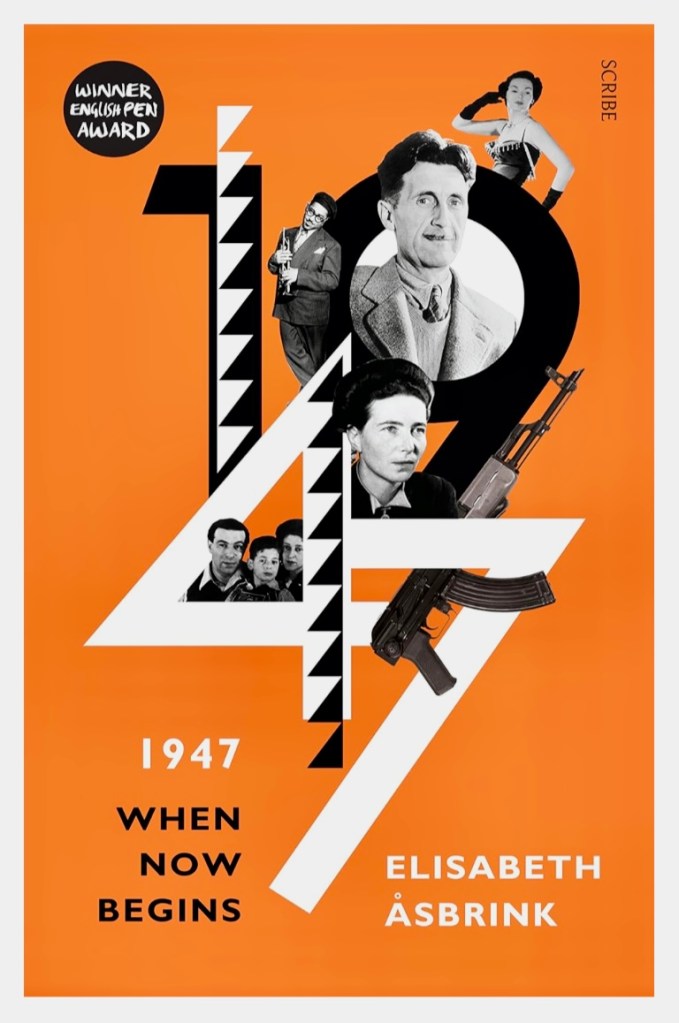
1947: When Now Begins by Elisabeth Åsbrink

My first ever review for European Literature Network – 1947: When Now Begins by Elisabeth Åsbrink was published eight years ago. I’m feeling a touch nostalgic as I look through old reviews but I must also admit that Elisabeth Åsbrink‘s book has been on my mind for the last two years. Hence I would like to recommend it again. The world is changing rapidly and we must learn from the past – to do good.

In 1947, everything is changing. The world is set to become a very different place …

Christian Dior is designing his fabulous, sumptuous New Look dresses. Thelonius Monk is playing his ground-breaking jazz compositions and Billie Holliday is singing the blues. Grace Hopper, appointed as a mathematician in the US Navy, finds an actual computer bug: a moth stuck in a massive mainframe. Simone de Beauvoir longs for her American lover and writes The Second Sex, later hailed as feminist bible. Eric Arthur Blair, better known as George Orwell, is coughing his guts out as he works on 1984 on the Scottish island of Jura.

On the other side of the still invisible East – West border, Mikhail Kalashnikov finally gets the go-ahead to mass produce his deadly invention: a gas-operated machine gun. The Cold War map is reduced to black and white … nuances of grey: non-existent. British and American powers decide the fate of thousands of Jews and fight against communist influence. The Soviet Union hardens its ideology.

While the world tries to heal itself and for the most part cries ‘never again, never again’, the Nuremberg Trials are in full swing and finally there is a chance that a new crime of genocide will be recognised. Other opinions and thoughts allow the continuing flight of old Nazis to Argentina, thanks to their new sympathisers, who often gather in the Swedish town of Malmö, and spread the written Fascist credo like fire. Anxiety, cynicism, cold legal calculations, power games and deeply-rooted convictions provoke the creation of the CIA and underlie the origins of the Muslim Brotherhood and ISIS, based on Hassan Al-Banna’s ideology. The UN Committee has only four months to decide future of Palestine and in these tumultuous times must consider diametrically conflicting wishes and demands.

Amid the post war chaos and pain, amongst thousands of refugees, liberated prisoners and emaciated Jews, a ten-year-old Hungarian boy, Joszef, once called György, is in Ansbach in southern Germany, in the American zone. In a camp for children whose parents have been killed by Nazis, he needs to decide whether to travel to Palestine and start a new ‘Zionist’ life, or to return to Budapest, the city that was his home as well as the source of his persecution. His is also the personal story of the author: Joszef will eventually escape to Sweden where his daughter Elisabeth will be born.

The story moves through a devastated Europe, to the mighty US, which is launching the Marshall Plan, to a fragile Middle East, a torn-apart Indian subcontinent with millions of hurting Muslims, Hindus and Sikhs; it carries us seamlessly along. It’s a fascinating piece of non-fiction that reads like a vivid novel: the evolution of the world on a huge scale reveals small fissures through which we observe tiny moments in private lives.

Swedish author and journalist Elisabeth Åsbrink has written four books which have, between them, won the August Prize, the Danish-Swedish Cultural Fund Prize, and Poland’s Kapuscinski Prize. 1947: When Now Begins is her first book to appear in English, superbly translated by Fiona Graham, a winner of the English Pen Award. Åsbrink has created an exceptional and gripping chronicle of this one momentous post-Second World War year; it combines major events with small, individual histories of the people affected by what had happened only a few years previously, and what would continue to affect future generations. Åsbrink uses both snapshots and longer musings to ask important questions; yet she keeps her own emotions in check, barely allowing them to surface in the sea of pain, despair, unspeakable crimes and the occasional hope. She admits to attempting to define herself and her own authenticity through her detailed survey of the events of 1947: Grief over violence, shame over violence, grief over fame. In this 70th anniversary year, the book is in no way just a historical record: instead its themes are contemporary, valid, and urgent.

1947: When Now Begins is an extraordinary book, based on an incredible amount of research, presented in a very sober, sensitive way. It invites us to go in search of even more information. A highly recommended must-read.

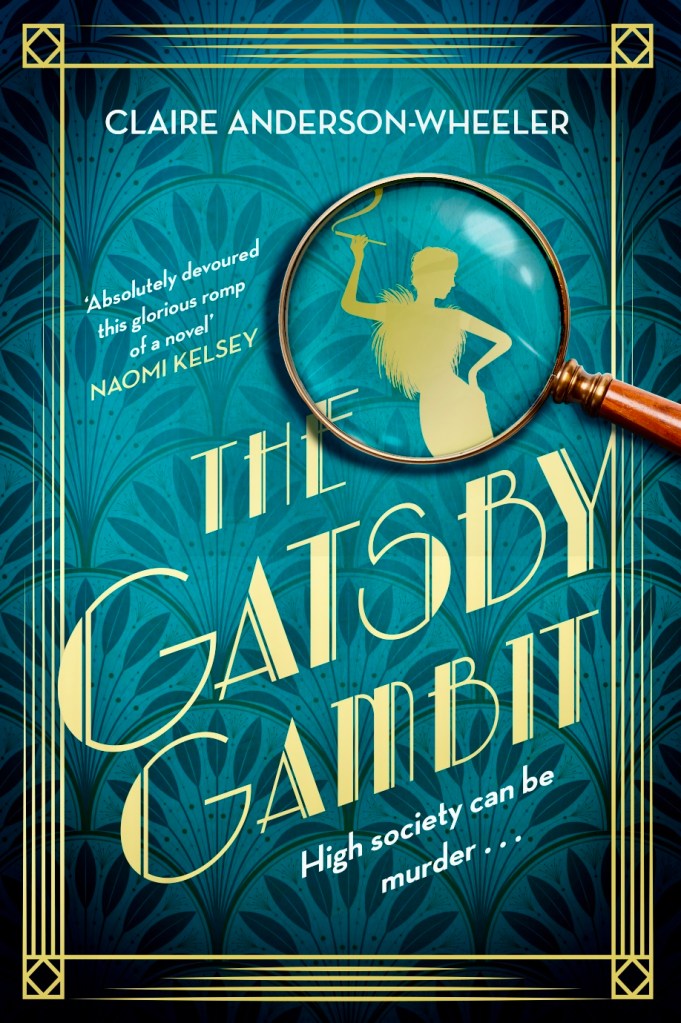
The Gatsby Gambit by Claire Anderson-Wheeler

Freshly twenty-one and sporting a daring new bob, Greta Gatsby – younger sister to the infamous Jay – is finally free of finishing school. An idyllic summer stretches ahead of her at the Gatsby Mansion, the jewel of West Egg. But when Greta arrives at the secluded white-stone estate bathed in the late-afternoon light, she finds she isn’t the only visitor. Jay is hosting an intimate gathering of New York’s fashionable set: Daisy and Tom Buchanan, along with his brother Edgar, Nick Carraway and Jordan Baker.

That evening, the guests enjoy a candelabra-lit dinner party. That night, they dance to the lilt of the gramophone. The next morning, one of them is missing. Murder has come to West Egg, the warm breeze tainted by scandal, betrayal and secrets. Turning sleuth isn’t how Greta meant to spend her summer – but what choice does she have when one of them could be next?

Many of us fell in love with Jay Gatsby and the opulent crazy world he represented, with the social issues bubbling under the surface of Jazz Age fun and apparent freedom. While reading The Gatsby Gambit it will be impossible not to refer to the original classic which was published exactly a hundred years ago in April1925. Francis Scott Fitzgerald’s The Great Gatsby had romance, unattained love, sharp look at social class, conflict between inherited and self-made wealth. And most of all drama and inspiration. However, the novel by Claire Anderson-Wheeler is a beauty of storytelling in its own right.

Here, this environment, seen from Greta’s perspective, acquires more depth and clarity away from the music, illegal drinking, dancing and flapper dresses which were reserved mostly for the rich at the time. Of course the glitz is not far away. She discovers how divided the society is by its norms, racial attitudes and money, mostly by people convinced of their own greatness, for example Tom Buchanan who was above rules and laws, and a fan of: ‘the American Protective League […] a self-appointed group of vigilantes who had organized “slacker raids” during the war, rounding up other civilians they suspected of draftdodging.’

Greta Gatsby’s existence has been quite sad, secure and privileged, and lacking in deep meaningful relationships, apart from the one with her brother Jay, seven years older than her: ’Greta had lived under Jay’s guardianship since their parents had died fifteen years ago.’ Completing her formal education and returning to Gatsby home, a fabulous mansion at West Egg brings contrasting emotions: joy of returning to her brother, a thrilling possibility of freedom and fearing ‘for a new set of restrictions – the world Jay had bought them entry into had already shown itself to be heavy with codes and rules.’ Her concern is the possible boring future as a trophy wife, married into the family with strict rules, just like Daisy Buchanan’s existence.

Rich, charming and inscrutable Jay has always been in love with Daisy and now it’s the time that Greta realises how strong his devotion is. In the hours and days following a discovery of a dead body on his yacht, she learns of secrets and scandals, and of intricacies of his relationships with his friends and people around him, mostly those who take advantage of his wealth: spectacular parties and the influence. Death of person in Jay’s close circle sends shock waves. Initially everyone, including the police, assumes it was suicide. Greta feels that something is not quite right, begins to think of all tiny details that don’t fit and follows her intuition to try and explain what has happened. Her ‘investigation’ makes her experience some dangerous situations but that doesn’t stop her. Her parents brought her up to believe that ‘mind was a terrible thing to waste’ and she is also convinced that life shouldn’t be wasted either. She also remembers that her ‘ mother had been a keenly intelligent woman, and one of those lucky, all-too-rare ones whose intelligence had been welcomed – cherished, even – by her spouse. But she had never failed to remind her daughter that the world wasn’t always so accommodating. A woman’s mind is her sword, she’d say to Greta […] Keep it sharp, she’d add, and keep it hidden.’

Claire Anderson-Wheeler’s take on the dazzling and dangerous era and revisiting a famous location where the iconic hero played with his life is a fantastic example of passion and knowledge. I loved the strong determined heroine who wanted to find the truth and create a purpose for herself. In a process she also learnt of the way the less privileged people had to ascertain their place in the society, and fight for basic existence. This mix of historical context and fun jazzy murder investigation, plus clever twisted plotting sparkled with Agatha Christie’s comments from the men in the story, makes The Gatsby Gambit a very interesting homage to the classic masterpiece, and a joy to read.   

Thank you to Hannah Born of FMcM for the invitation to join the blog tour.