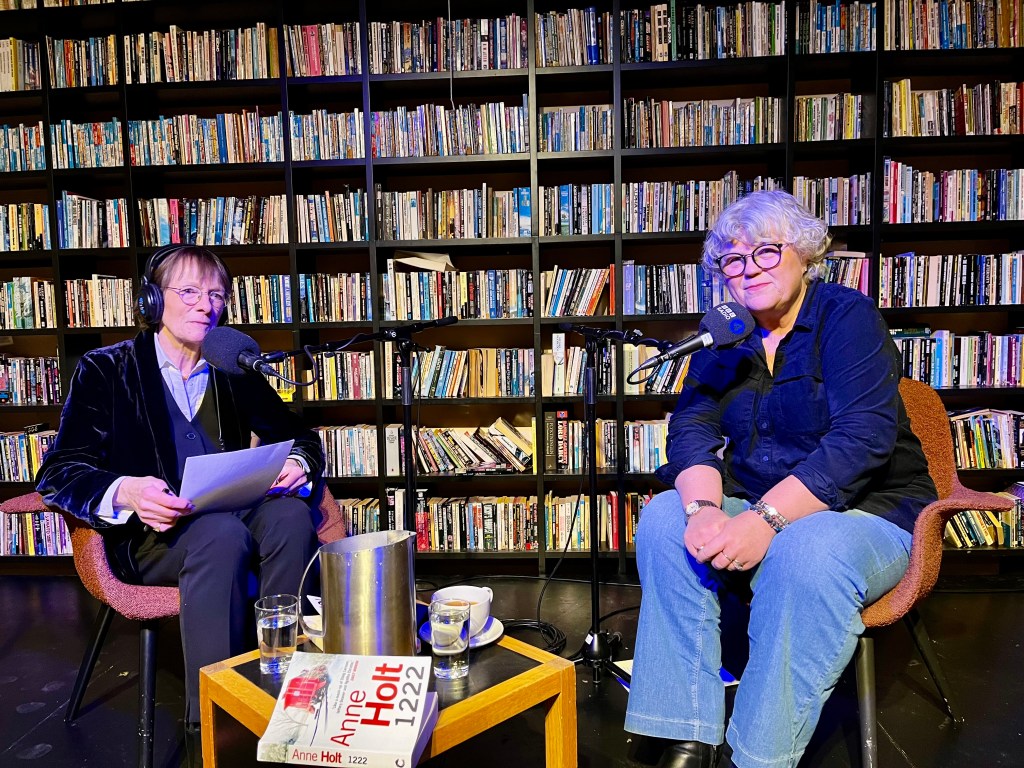
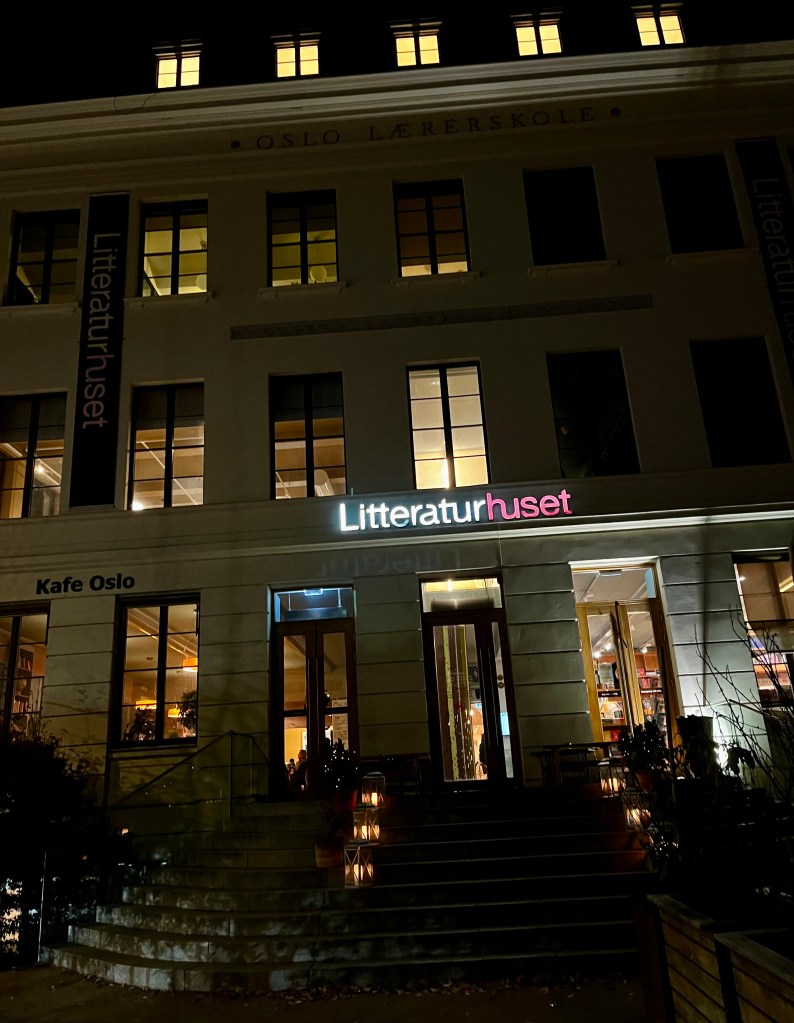
Whatever you do this weekend you must also find time to listen to a fantastic BBC World Book Club programme. Last November I was very lucky to sit in the audience during the recording of conversation between BBC’s Harriett Gilbert and the Norwegian writer Anne Holt about Anne’s book 1222. I even asked a question. Harriett Gilbert is a writer, journalist and literary editor and presents also A Good Read on Radio 4. I think Anne Holt, known for her sensible and brave political and social views, doesn’t need introductions: her writing career has been absolutely amazing, rich in interesting characters and story plots, showing the darkness of Scandinavia at various levels. She used to work as a lawyer and was a Minister of Justice, and is a truly engaged person, interested in what’s going on in the world. I’ve been a huge fan of her work, novels including A Grave for Two (2019) and A Memory For Murder (2022).
Harriett Gilbert and Anne Holt
When published in 2007 the book 1222 was not embraced warmly by the critics in Norway. However, since then it became one of the most significant and loved by readers around the world. I read it ages ago on the train (where else?) from Oslo to Bergen, and loved translation to English by Marlaine Delargy.
Good evening to you all… Hope 1st January has been a good relaxing day. I went for a long walk in the forest with my son, we fell down several times on the icy paths covered by new not-snowman-type snow, then we helped our best friends with snow shovelling and had hot dogs by a fire in the cold white garden. Feeling lazy and content I want to recommend links to the pages that you should or could follow, pages by wonderful bloggers who enjoyed the novel below…
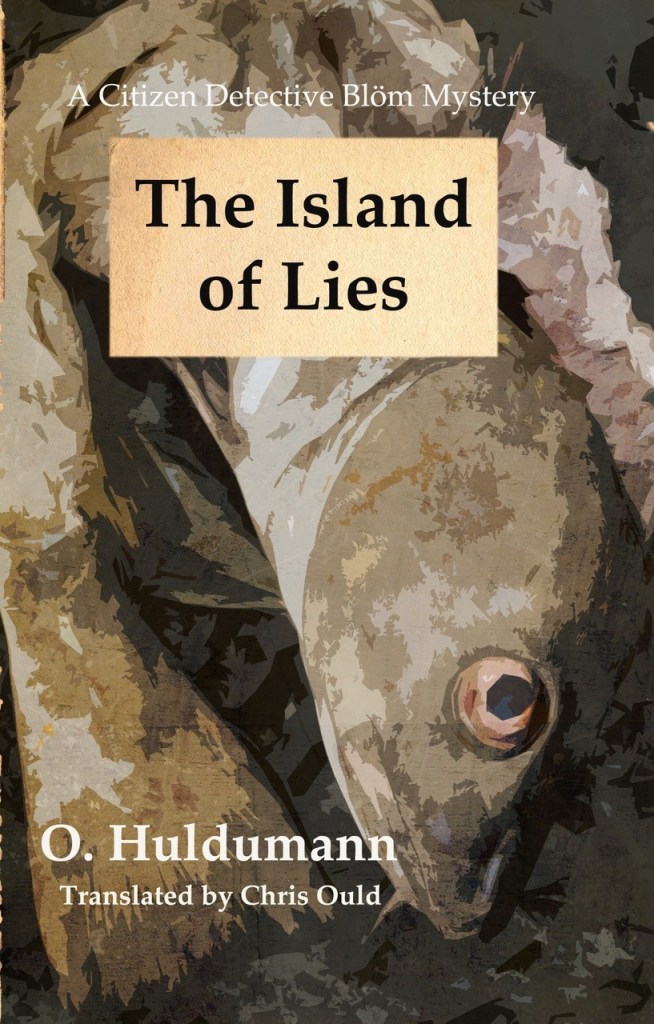
The new year 2025 is very young and full of promises for all of us as we look into the future and want the goodness of the world to win. Again and again. Just like it often happens in the books of various types, and especially in the crime fiction genre. And right now I want to go back to the recent past for long enough to enjoy the strange marvellous beauty of Chris Ould’s latest translation: The Island of Liesby the mysterious O. Huldumann, published a couple of months ago. I organised a blogtour for this Nordic Noir book and so did not write a review for my own blog. However, if I may I would love to share what our favourite Scandi Brit / Icelander Quentin Bates wrote here: The Huldumann Enigma.
The Island of Lies follows Citizen Detective / Citizen Detective, also translated by Chris Ould who is much better known among crime fiction fans as the author of the fantstic Faroese Trilogy, set, yes, in the Faroe Islands and seen from the perspective of a semi-ousider. Details and reviews can be found in the links.
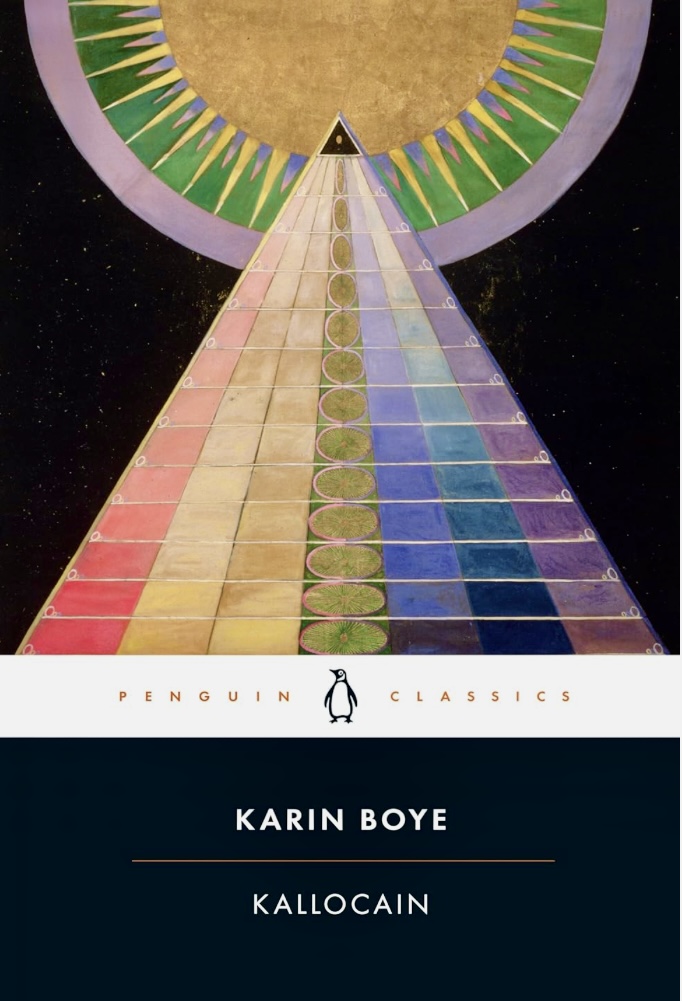
Leo Kall, a research chemist and a very obedient citizen, has been working on a revolutionary new drug that will force everyone to share the most private and innermost personal thoughts. Police are keen to use Kallocain as a new interrogation technique to crush citizens of the totalitarian ‘World State’. Leo begins to feel alienated and terrified.
Let me start with mentioning the translator David McDuff who did an incredible job bringing this pioneering work of dystopian fiction from a Swedish author into emotive and taut precise English. He also wrote an introduction to the novel, and I would like to quote some of his words to get a better understanding of the poet, novelist and essayist Karin Boye. Her science fiction novel, written in 1940, presented a ‘vision of enslaved humanity, an allegory dream- like and grotesque, yet instantly recognizable to anyone then living through the international crisis.’ It is a novel from one of Sweden’s most acclaimed writers that we know nothing or very little of.
I was reading Kallocain with trepidation, shocked by the incredible clarity of literary vision of its author Karin Boye. It depicts a totalitarian ‘World State’ designed to crush and obliterate the individual and all private thoughts. It is also pure Nineteen Eighty-Four even though it was written eight years before George Orwell’s dystopian classic, with touches of The Handmaid’s Tale which I just couldn’t handle. Boye’s fictionalised futuristic world was influenced by the contemporary unfolding events of the Second World War and two apparently opposing systems: ‘ice-cold reasoning’ of Hitler and the ‘merciless dialectics’ of Stalin’. This chilling and totally absorbing tale follows the research chemist Leo Kall, a very obedient citizen and middle-ranking scientist. He is a Fellow Solider, just as his wife is, and as his three children will be. Their life is rigorously compartmentalised in the society divided by basic skills and needs. Leo has been working on ‘truth drug’ Kallocain which will force truth of anyone when the liquid is injected straight into the bloodstream, making people fall into a sleep-like state and saying what’s on their minds, even the most personal opinions, hidden deep down in subconsciousness. When the drug stops working, everyone is aware and often intensely ashamed of sharing everything. The authorities are excited: ‘Kallocain gives us the possibility of controlling what goes on in people’s minds’ and will replace all other methods of interrogation.
Leo and his superior start initial tests on ‘five subjects from the Voluntary Sacrifice Service’ which proved satisfactory and more ‘human material’ gets brought in to experiment on. Soon the top police get involved, production of Kallocain goes ahead, other Fellow Soldiers are trained to administer it – and Leo begins to fear for his own life. Surrounded by ‘police eyes’ and ‘police ears’ – cameras and microphones – which are in the walls of apartments and houses, and lacking any sense of security at home as Linda often vanishes without a word, he, like everyone else, is terrified of being denounced and found guilty of not denouncing others. Because this is happening as more injections are given to anyone who dares to think differently, more arrests and deaths. However, he realises that there is a seed of opposition in the society, and equally scared of being own person.
Karin Boye paints a bleak desolate landscape of underground buildings and corridors; with a need for surface permissions; dehumanised and alien, lacking colours and smells. Grim. Leo tells his story from the prison where he’s been for over twenty years, not sure how long because of the isolation and induced timelessness, and still continues as a chemist, his existence being still terrified but also a little bit brave and resigned that he must not be completely silent. Whatever happens to him afterwards is unclear; however, I believe that any reader of Kallocain by Karin Boye will be shaken to the core.
Karin Boye (1900–41) was born in Gothenburg, Sweden and studied in Stockholm and Uppsala. As a young woman she joined the international socialist and pacifist organization Clarté and published her first volume of poetry while still in her early twenties. She translated T. S. Eliot’s The Waste Land into Swedish in 1931, and wrote several novels throughout the decade. She married a fellow writer but left her husband after undergoing psychoanalysis in Berlin and formed a lifelong relationship with a German woman, Margot Hanel. Boye’s most famous book, Kallocain (1940), was partly inspired by eye-opening trips to Nazi Germany and Soviet Russia. She died from an overdose of sleeping pills the year after writing the novel. David McDuff’s translations for Penguin Classics include Dostoyevsky’s Crime and Punishment, The Brothers Karamazov and The Idiot, and Babel’s short stories.
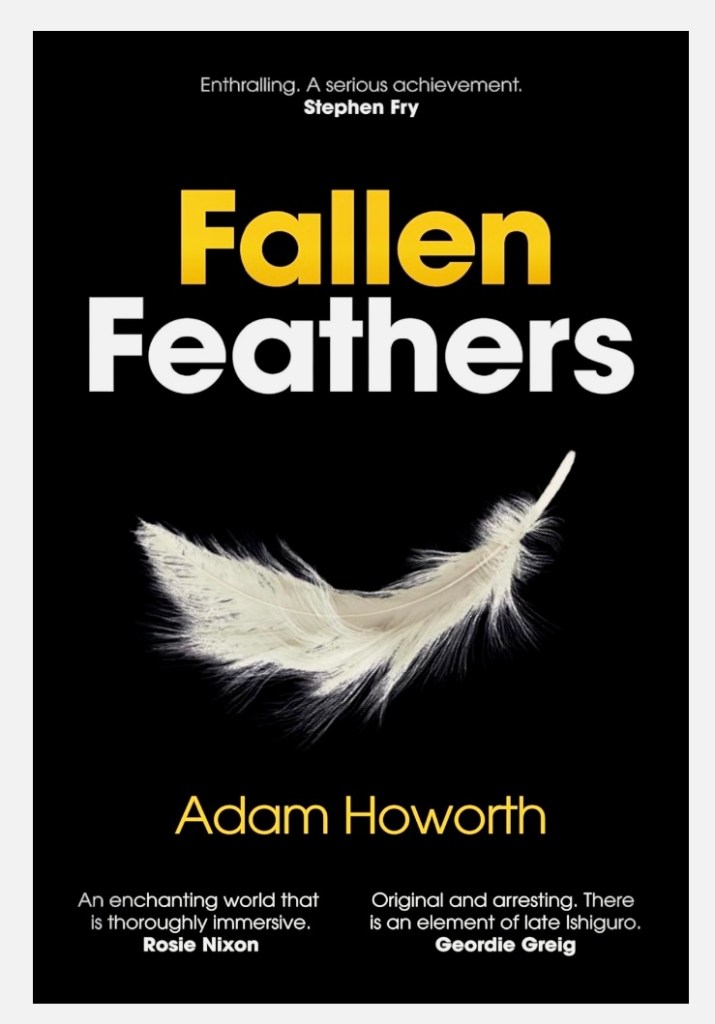
Fallen Feathers is a debut novel by Adam Howorth who took inspiration from his surroundings and existing landmarks, and created a mysterious world, both enchanting and dangerous. That world invites us to enter in and discover new stories, and appeals to both children and adults but in a different way.
Premise of this fantastical tale is about the nature of belief and truth, faith and existence in the modern world which is marked by scepticism and cynicism. Luckily not everyone feels like that and so the story can move easily between timelines and perspectives. We get to see and embrace this new reality through the eyes of innocent children and of parents aware of potential risks.
All her life Elizabeth Fairchild has been fascinated by the moon, and had the unique ability to know its movements in the sky. Living with her parents in a quiet London suburb by a river, she felt safe and secure but also curious like all kids her age. On sudden impulse she decided to sneakfrom home at night and follow the moon reflection leading her to the river. There she met a ferryman Lucas Mann who might be a figment of imagination. The stranger offered to take her across the river to a party in the mansion on the other side. The sudden encounter scared her for but not for long. Another chance to visit the unknown place appeared and so Elizabeth began her nightly adventures, risky and exciting as she also became friends with a boy called Tobias Mallory. The pair played in the woods, and Tobias couldn’t wait to introduce her to his family and other adults in the mansion. Apparently they were awaiting her eagerly. Elizabeth couldn’t quite understand the whole situation but kept going. The enchanted forest and the mysteries slowly began to be more threatening until one night when a super blood moon appeared in the sky and Elizabeth vanished. That we found and seen through the eyes of her parents who grew increasingly worried, especially as unsettling stories begin to surface.
Her father Tom was told about another blond girl who went missing in similar circumstances in the same location years ago. She looked just like Elizabeth and was never found. Then a stranger visited the local church and talked about a prophecy in an ancient book found ages ago in the middle of the forest. The prophecy states that Elizabeth is a new messiah, a golden girl who must die to save generations of people waiting for her. The existence of the book and its contents puts the story into yet another perspective which takes us back centuries ago. Here, the narrator provides a good background to the life in the monastery where monks were first to read the writings.
The collision of modern life, with the ordinary days and activities, and tales and superstitions from the past create tension, and it seems that the author AdamHoworth puts a spell on readers as he pulls together strands of complex thoughts. The old book’s power to make people believe in unexplained message transcends between then and now, and shines a tricky light on what’s most valuable in life: family love or a demanding god. Excellent read!
Fallen by Feathers was published on 28 October 2024 by Troubador Publishing Ltd. Thank you to Antara Patel of FMcM Associates for the early copy of the book and the invitation to join the blog tour.
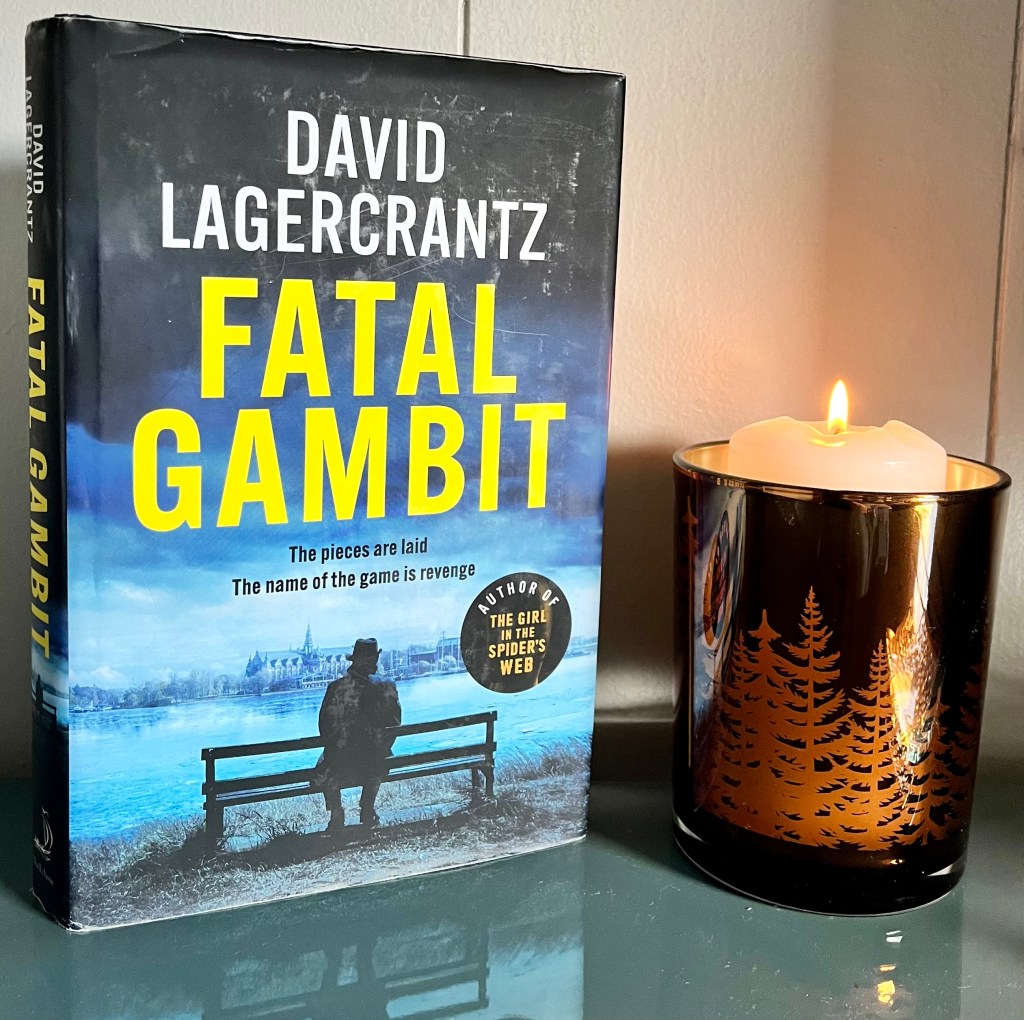
Brilliant academic and government consultant Hans Rekke and his unofficial work partner Detective Micaela Vargas are the latest duo following the well-established ‘method’ of the famous Sherlock and Watson partnership. However, they did not make a conscious decision to embark together on the crime-fighting journey. Beginnings of their cooperation are in Crime Review – Dark Music (2022), first novel of the new gripping series by David Lagercrantz, which is absolutely worth reading. Translation of both by Ian Giles is superb: flowing and engaging capturing the attention. I would expect that collaboration between Lagercrantz and Giles will continue as the complex threads of Fatal Gambit invite further investigations.
As the modern take on Sherlock-Watson theme continues, it is not difficult to realise who is who here, and how that uneasy working relationship slowly embraces friendship and deeper understanding of personal motives. At times it is such a slow painful process that not only the readers might find it frustrating – the main characters as well, especially Vargas (but devil’s in the details). She had to move into Rekke’s vast apartment as a lodger because of her own private situation. Living with the professor who is both disillusioned and disgraced, and surviving on the diet of various pills and self-loathing, creates many practical and emotional challenges. Contrast between wealth and social standing, mostly going years back (to be precise) of Rekke versus down-to-earth attitude and immigrant background of Vargas amplify the difficulties within the Swedish society, too.
Main story strands focus on a missing woman Claire Lidman who was confirmed as dead in a fire fourteen years ago. Yet she suddenly appears in the background of a recent holiday photo taken in Venice. Her still-hopeful husband Samuel Lidman brings this anomaly to the pair. Scepticism seems to be the only reasonable response as the earlier investigation into Claire’s death showed no doubt. Rekke cannot deal with this cold case: he is very concerned that his daughter Julia has a secret new boyfriend and there are nuanced signs of dangerous darkness. At the same time he becomes aware of hearing a name from his past, a memory of a genius rival, a mastermind of words, deeds and manipulation. Enter Gabor Morovia, lapsed mathematician and evil player of chess and women. As a villain he is definitely outstanding, as a link in the chain holding lives of Rekke and others which will become obvious as the plot intensifies. This villainous creation takes me back to the latest book in the Millenium series: The Girl in The Eagle’s Talons where Karin Smirnoff pulled all the stops, just like Lagercrantz in his contribution to the Stig Larsson’s legacy. But back to Fatal Gambit.
Vargas tries to balance her life in the realm divided by the law-abiding profession she has chosen and the reality of criminal underworld. Her gangster brother threatens to silence her if she doesn’t get off his back, and he absolutely means that. Caught in the web of real and perceived violence, lack of support and understanding, and confusing emotions towards Rekke, she struggles with convincing others of making the right steps. When she finds out identity of Julia’s mysterious boyfriend, her fragile world collapses. However, this is not the time to stop and hide.
Perilous mystery opens avenues that nobody anticipated. Symbolic chess game is already on and Hans Rekke and Micaela Vargas are caught in the bigger game of the post iron-curtain connections, political machinations, big money and fear. Conclusion of the Claire case and exploration of various small elements in this picture affected them in deeply personal ways, and a as result brought their professional lives closer. And I loved the tension, drama and moral questions along the way.
Six impressive crime novels from the Kingdom of Denmark, Iceland, Norway and Sweden have been shortlisted for the 2024 Petrona Award for the Best Scandinavian Crime Novel of the Year. The shortlist is announced today, Thursday 10th October and is as follows:
· Anne Mette Hancock – The Collector tr. Tara F Chace (Denmark, Swift Press)
· Jørn Lier Horst – Snow Fall tr. Anne Bruce (Norway, Michael Joseph)
· Arnaldur Indriðason – The Girl by the Bridge tr. Philip Roughton (Iceland, Harvill Secker)
· Jógvan Isaksen – Dead Men Dancing tr. Marita Thomsen (Faroe Islands (Kingdom of Denmark), Norvik Press)
· Åsa Larsson – The Sins of our Fathers tr. Frank Perry (Sweden, MacLehose Press)
· Yrsa Sigurðardottir – The Prey tr. Victoria Cribb (Iceland, Hodder & Stoughton)
The winning title will be announced on 14 November 2024.
The Petrona Award is open to crime fiction in translation, either written by a Scandinavian author or set in Scandinavia, and published in the UK in the previous calendar year. The Petrona team would like to thank our sponsor, David Hicks, for his continued generous support of the Award.
The judges’ comments on the shortlist:
There were 31 entries for the 2024 Petrona Award from six countries (Kingdom of Denmark, Finland, France, Iceland, Norway, and Sweden). This year’s shortlist sees both the Kingdom of Denmark and Iceland represented with two novels each and Sweden and Norway with one novel each. The judges selected the shortlist from a strong pool of candidates with the shortlisted authors including Petrona Award winners Jørn Lier Horst and Yrsa Sigurðardottir. As ever, we are extremely grateful to the six translators whose expertise and skill have allowed readers to access these outstanding examples of Scandinavian crime fiction, and to the publishers who continue to champion and support translated fiction.
The judges’ comments on each of the shortlisted titles:
Anne Mette Hancock – THE COLLECTOR translated by Tara F Chace (Denmark, Swift Press)
When ten-year-old Lukas disappears from his Copenhagen school, police investigators discover that the boy had a peculiar obsession with pareidolia: a phenomenon that makes him see faces in random things. A photo on his phone, posted just hours before his disappearance, shows an old barn door that resembles a face. Journalist Heloise Kaldan thinks she recognises the barn – but from where? When Lukas’s blood-flecked jacket is found, DNA evidence points to Thomas Strand, a former soldier suffering from severe PTSD, but then Strand turns up dead in his apartment.
This is a complex thriller of buried secrets, that beautifully wrong-foots the reader from beginning to end.
Jørn Lier Horst – SNOW FALL translated by Anne Bruce (Norway, Michael Joseph)
The discovery of an Australian backpacker’s body in Spain prompts a group of amateur true crime detectives into action. They are scattered online around the world, attempting to solve the mystery of her death. Astri, a young Norwegian woman whose intense pursuit takes her closer than anyone else to solving the case, prepares to reveal her findings and then goes offline. When William Wisting reluctantly gets involved in the investigation, he is faced with the unusual, unorthodox investigators of varied skills and intentions, and puzzling connections.
A slow methodological approach gathers pace and pulls readers into a complex web of low-key international ties. As always Lier Horst delves deep into the psychology and motives of the characters, creating a slow-burning police procedural of empathy and human interest, firmly rooted in Norwegian society.
Arnaldur Indriðason – THE GIRL BY THE BRIDGE translated by Philip Roughton (Iceland, Harvill Secker)
When a young woman known for drug smuggling goes missing, her elderly grandparents have no choice but to call friend of the family, retired detective Konrád. Still looking for his own father’s murderer, Konrád agrees to investigate the case, but digging into the past reveals more than he set out to discover, and a strange connection to a little girl who drowned in the Reykjavík city pond decades ago recaptures everyone’s attention.
One of Iceland’s most established authors, Indriðasonskilfully interweaves different timelines along with assured characterisation, in this second book to feature Konrád.
Jógvan Isaksen – DEAD MEN DANCING translated by Marita Thomsen (Faroe Islands (Kingdom of Denmark), Norvik Press)
Similar to the story of the ancient god Prometheus, a man has been shackled to rocks and left to drown on the beach. But this time it happens on the Faroe Islands. The discovery of his body throws the local community into an unsettling chaos. As the journalist Hannis Martinsson investigates, he comes across evidence of similar deaths. He realises they are linked to the events in Klaksvik in the 1950s, and a local revolt which tore the community apart. As Martinsson digs into the past, he learns about his country’s history, and the reader has a chance to discover what makes the Faroes intriguing and spellbinding.
This is only Isaksen’s second novel to be translated into English. The contemporary Faroese crime fiction writer places his characters in the wild, beautiful, and unforgiving environment and allows them to search for truth. Dogged and uncompromising, Martinsson is a superb creation.
Åsa Larsson – THE SINS OF OUR FATHERS translated by Frank Perry (Sweden, MacLehose Press)
Rebecka Martinsson, disillusioned with her challenging job as a prosecutor, initially has no intention of looking into a fifty-year-old case involving the missing father of Swedish Olympic boxing champion, Börje Ström. Agreeing, however, to the dying wish of her forensic pathologist friend she begins to follow links when a body is found in a freezer at the house of a deceased alcoholic. The grim realities of life in the area years ago, and the current influx of criminals attracted by developments in Kiruna make for a tough investigation and difficult soul-searching, coupled with Rebecka’s own history in a foster family.
Larsson remains a wise observant social commentator and creator of a gripping, suspenseful and utterly moving series, with her eye to the past and the future, and emotive style. Delicate and relevant humour adds hope to the fragile lives of the main characters.
Yrsa Sigurðardottir – THE PREY translated by Victoria Cribb (Iceland, Hodder & Stoughton)
Kolbeinn has been called to his old home as the new owners have uncovered some photos, and a muddied child’s shoe bearing the name ‘Salvor’. A name Kolbeinn doesn’t recognise. Soon after, his mother’s carers say that she has been asking for her daughter, Salvor.
Jóhanna is working with the search and rescue team in Höfn to find two couples from Reykjavik. Their phones’ last location, the road leading up into the highlands. In a harsh winter, the journey is treacherous, and they soon find the first body.
Hjörvar works at the Stokksnes Radar Station in the highlands. He’s alone when the phone connected to the gate rings: the first time it’s ever done so. Above the interference he can hear a child’s voice asking for her mother.
How are these events connected?
Sigurðardottir balances these three storylines, each with her trademark creeping sense of unease, in this dark and disturbing standalone.
The judges
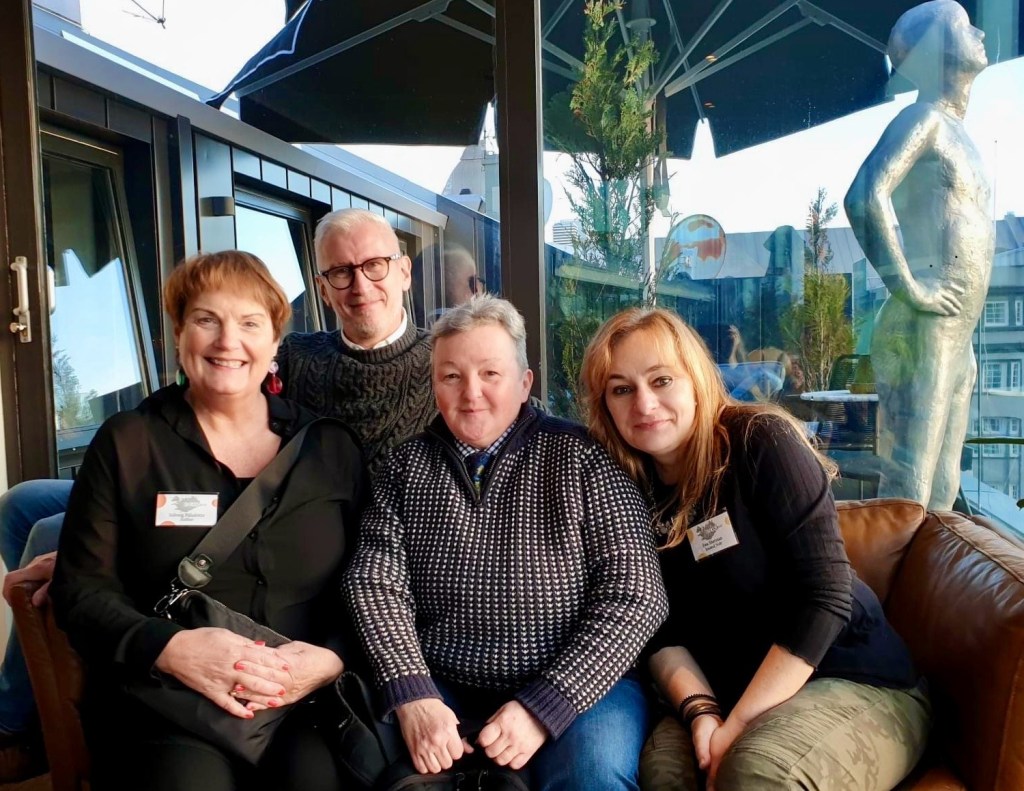
Jackie Farrant – creator of RAVEN CRIME READS and a bookseller/ Area Commercial Support for a major book chain in the UK. Ewa Sherman – translator and writer, and blogger at NORDIC LIGHTHOUSE. The Award administrator is Karen Meek – owner of the EURO CRIME blog and website.
Further information on the history of the Award and the previous winners can be found on the Petrona Award website.
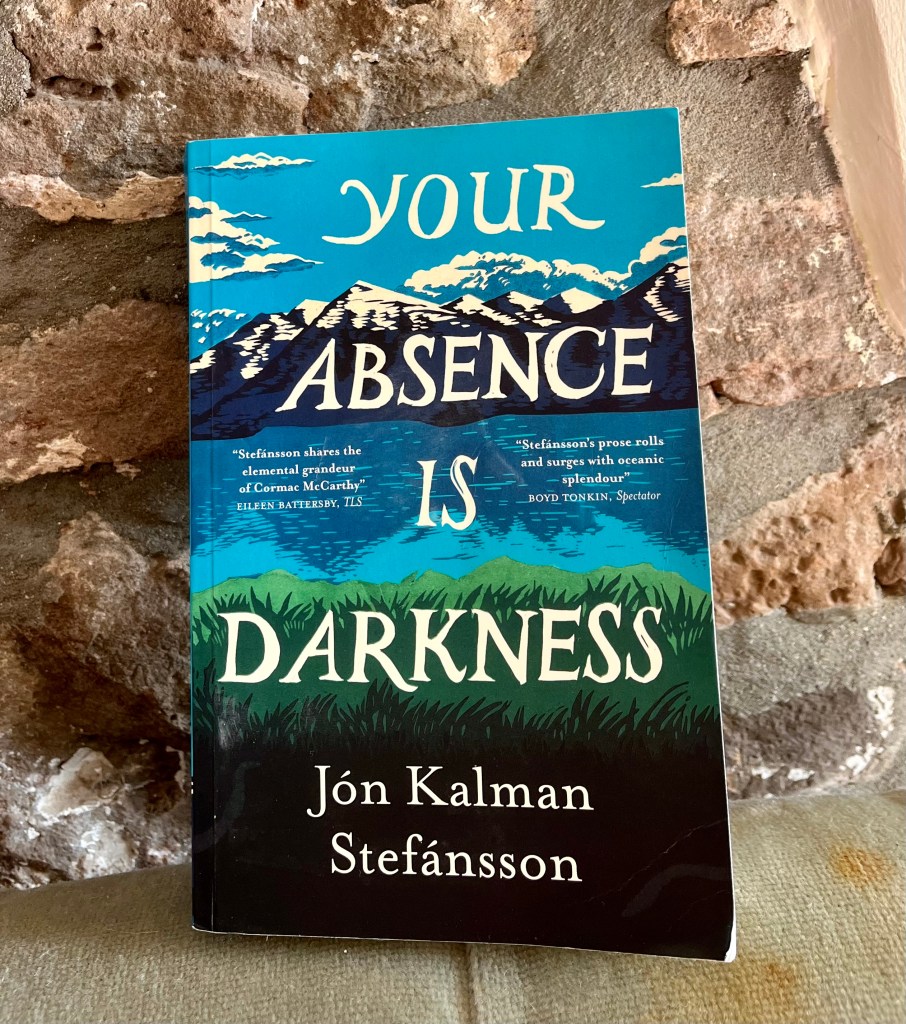
I am very very lucky to have some of my reviews published on the pages of European Literature Network. This particular review is available there as well but I wanted to share it on my blog, too. Here’s the link to Your Absence is Darkness. And I would absolutely recommend that you check other interesting articles written by extraordinary people who contribute #RivetingReviews.
Have you ever seen photographs of rivers and streams meandering through the rugged terrain of Iceland? The way they create their own space, take ownership of obstacles and thrive in the beautiful, unexplored countryside? As I was reading Jón Kalmann Stefánsson’s latest audacious novel Your Absence is Darkness, I was reminded of this Icelandic landscape. I fell under the spell of the storytelling, which meanders through time and locations, taking in life and death, punctuated by raw love of many kinds, and leading the reader to a perfect conclusion.
The powerful narrative, which is both stoic and emotional in equal parts, moves at a pace dictated by both the weather and the speed at which memories come to the surface. An unnamed man finds himself awake in a church in rural Iceland. He remembers nothing – he has completely lost his bearings – but he knows the presence of a stranger makes him feel uncomfortable.
This mysterious shape-shifting figure will accompany him on a journey of discovery. First a local woman helps him reunite with his sister. Then, as he listens to her stories about previous generations, he slowly submerges himself in a history that spans centuries, telling tales of the people who have loved, lost, fought, survived and died in the isolated, windswept farms and small villages on the Snæfellsnes Peninsula in western Iceland, whose stunning, unforgiving landscape has been influencing the ordinary lives of its inhabitants for centuries.
As the narrator begins to question this correlation between the natural environment and the economic situation of the inhabitants of these villages, which have changed very little over the years – ‘Blessed darkness, accursed damp – the history of Iceland?’ – we get to know the fates of the members of one particular family. Eirikur, a musician abandoned as a child by his mother, is running away from his Icelandic past, but suffers from loneliness and cannot connect with his father. A girl, chasing after the memory of one, intense blue-eyed gaze, moves from Reykjavik to the fjords. An uneducated farmer’s wife writes an essay on the earthworm, ‘the blind poet of the soil’ and unwillingly changes the course of two families’ lives. Petur, a pastor, neglects his wife, writes to a dead poet and falls in love with a stranger. An alcoholic father leaves those close to him and follows the starry night sky. We see dramatic events forcing men and women either to abandon their homes or stay firmly put, emigrate to Canada or settle for compromise, moved by love, pride or sense of duty. Just like in Iceland’s ancient sagas, the novel’s characters are bound together in a family history that spans around two hundred years.
Human tragedy links these individual stories, each of which deserves attention and patience from the reader. It seems that these characters cannot escape a brutal, often inexplicable destiny, but even as the natural world around them guides their daily existence, and even their morality, they also crave joy and a sense of belonging. Tenderness appears in the most unexpected places, humour provides some light, while Danish philosopher Søren Kierkegaard reminds the characters that they are loved: ‘Your memory is light, your absence darkness’.
Philip Roughton’s translation is superb, with the novel’s rhythm and tempo beautifully executed, especially when it comes to the way repetitions of words and phrases add to the overall sense of uncontrollable fate and the tensions between faith and biological fact. Stefánsson’s style – complex, intriguing, nuanced – in this translation flows like those Icelandic rivers.
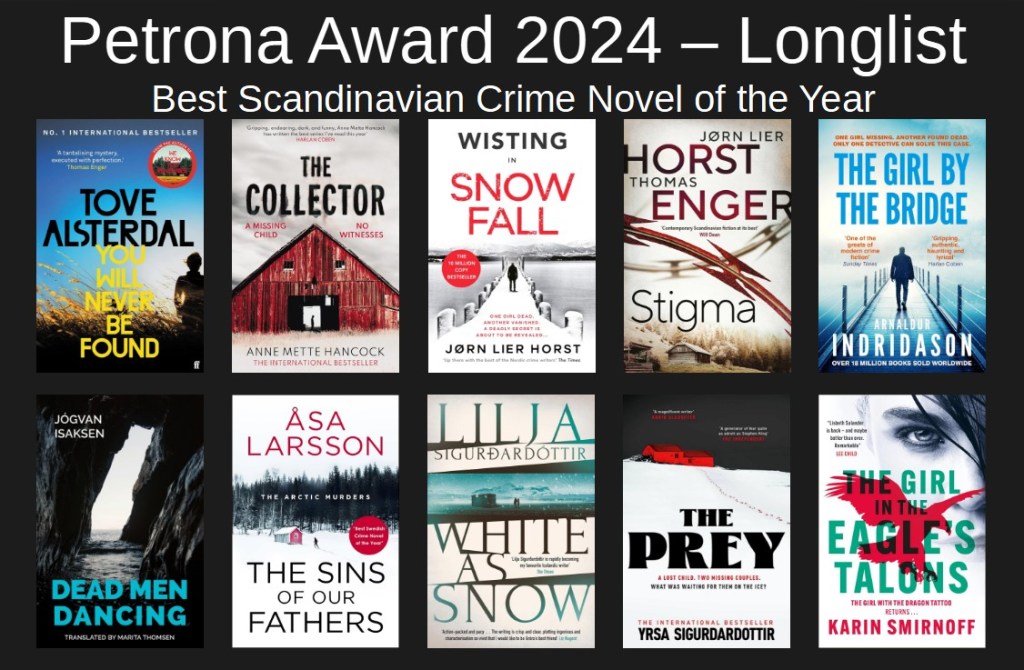
OUTSTANDING CRIME FICTION FROM DENMARK, ICELAND, NORWAY, AND SWEDEN LONGLISTED FOR THE 2024 PETRONA AWARD
Ten crime novels from Denmark, Iceland, Norway and Sweden have made the longlist for the 2024 Petrona Award for the Best Scandinavian Crime Novel of the Year. They are:
o Tove Alsterdal – You Will Never Be Found tr. Alice Menzies (Sweden, Faber & Faber)
o Anne Mette Hancock – The Collector tr. Tara F Chace (Denmark, Swift Press)
o Jørn Lier Horst – Snow Fall tr. Anne Bruce (Norway, Michael Joseph)
o Jørn Lier Horst and Thomas Enger – Stigma tr. Megan E Turney (Norway, Orenda Books)
o Arnaldur Indriðason – The Girl by the Bridge tr. Philip Roughton (Iceland, Harvill Secker)
o Jógvan Isaksen – Dead Men Dancing tr. Marita Thomsen (Faroe Islands (Denmark), Norvik Press)
o Åsa Larsson – The Sins of our Fathers tr. Frank Perry (Sweden, MacLehose Press)
o Lilja Sigurðardottir – White as Snow tr. Quentin Bates (Iceland, Orenda Books)
o Yrsa Sigurðardottir – The Prey tr. Victoria Cribb (Iceland, Hodder & Stoughton)
o Karin Smirnoff – The Girl in the Eagle’s Talons tr. Sarah Death (Sweden, MacLehose Press)
The longlist contains a mix of newer and more established authors, including previous Petrona Award winners Jørn Lier Horst and Yrsa Sigurðardottir. Both large and small publishers are represented on the longlist, with Orenda Books and MacLehose Press both having two entries, and the breakdown by country is Iceland (3), Sweden (3), Denmark (2) and Norway (2).
The shortlist will be announced on 10 October 2024.
The Petrona Award 2024 judging panel comprises Jackie Farrant, the creator of RAVEN CRIME READS and a bookseller / Area Commercial Support for a major book chain in the UK and EwaSherman, translator and writer, and blogger at NORDIC LIGHTHOUSE, with additional help from Sarah Ward, author, former Petrona Award judge and current CWA Crime Fiction in Translation Dagger judge. The Award administrator is Karen Meek, owner of the EURO CRIME blog and website.
The Petrona team would like to thank both our sponsor David Hicks for his continuing support of the Petrona Award and the CWA, in particular MaximJakubowski, for allowing Sarah to step in following the very unexpected death of our much missed judge and friend Miriam Owen.
The Petrona Award was established to celebrate the work of Maxine Clarke, one of the first online crime fiction reviewers and bloggers, who died in December 2012. Maxine, whose online persona and blog was called Petrona, was passionate about translated crime fiction but in particular that from the Scandinavian countries. The award is open to crime fiction in translation, either written by a Scandinavian author or set in Scandinavia and published in the UK in the previous calendar year. More information on the history of the Award and previous winners can be found at the Petrona Award website
A retired, reclusive woman is found on a bitter winter morning, clubbed to death in Reykjavik’s old graveyard. Detectives Guðgeir and Elsa Guðrún face one of their toughest cases yet, as they try to piece together the details of Arnhildur’s austere life in her Red House in the oldest part of the city.Why was this solitary, private woman attending séances, and why was she determined to keep her severe financial difficulties so secret? Could the truth be buried deep in her past and a long history of family enmity, or could there be something more? Now a stranger keeps a watchful eye on the graveyard and Arnhildur’s house.With the detectives running out of leads, could the Medium, blessed and cursed with uncanny abilities, shed any light on Arnhildur’s lonely death?
Sólveig Pálsdóttir and her fellow Icelandic author Óskar Guðmundsson, and two of her biggest fans: Jacky Collins and Ewa Sherman. Iceland Noir 2021.
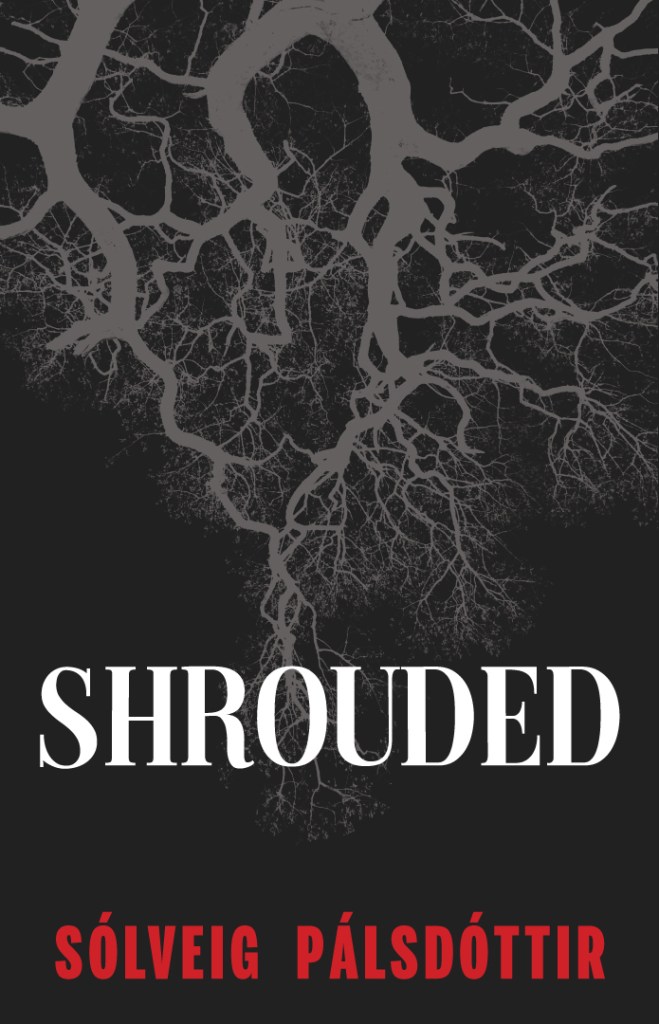
Sólveig Pálsdóttir’s latest gripping intriguing novel Shrouded in Quentin Bates’ translation from Icelandic has been published by Corylus Books last month, and received some excellent reviews from the readers. Here she talks about books that have made impression on her, over the years and quite recently.
‘I have always been a big reader, with an interest in literature of many kinds. My choice of reading depends on how I am feeling, as well as what I’m working on. I was a voracious reader of crime fiction before I started writing it myself. Swedish author Henning Mankell is my absolute favourite, a great stylist with strong social awareness and a highly versatile writer, as in addition to his crime fiction (featuring his most famous creation, Kurt Wallander) he wrote children’s books, plays, novels and powerful works based on his own life. Then I became a strong admirer of Stieg Larsson and his Millennium books. The Icelandic novelist Arnaldur Indriðason’s first books caught me in their grip, and as a student I naturally read Edgar Allan Poe and Umberto Eco, both of whom have been strong influences.
Since writing my own crime fiction, this is a genre I read less and find myself choosing other varieties of literature. I probably read half a dozen crime novels a year, just enough to keep up, and more of other books such as poetry, biographies and other fiction. I’m sure the reason for this is the concern that my work could be influenced by other authors’ crime stories and I want to avoid that happening. So I mustn’t read crime when I’m working on a book of my own.
There are more books than I can count that have been a strong influence on me, and many are by Icelandic authors who are mostly little known elsewhere. I have to include Iceland’s Bell by Nobel Prize winner Halldór Laxness.
I played a part in a dramatisation of Crime andPunishment by Fyodor Dostoevsky which was highly thought-provoking in a way that has stayed with me ever since.
Other authors who moved me deeply in my younger years and shaped my thinking were Margaret Atwood and Doris Lessing. I was captivated by The Grass is Singing and A Diary of a Good Neighbour. I haven’t read this again, but the feeling remains strong of what a curse restraint can be and how important it is to allow oneself fondness for others.
I can’t fail to mention Íslenskar þjóðsögur og dulrænar frásagnir / Icelandic Tolk Tales and Accounts of the Uncanny. I used to devour books like this well into adulthood, and listened carefully to people’s accounts of folk tales, the hidden people and ghosts. This can be clearly seen in The Fox and Shrouded, and probably in other books.
Of the more recent memorable books, I would like to mention The End of Loneliness by Benedict Wells. This seductive, low-key narrative technique has stayed in my mind. I read the book again recently and wasn’t disappointed. Now I mean to track down his latest book Hard Land. I recently read two novellas by Claire Keegan that I would wholeheartedly recommend, Small Things LikeThese and Foster. I have also been reading La Place by French Nobel Prize winner Annie Ernaux, which has recently been translated into Icelandic. This taut, almost cold, text was almost repelling, but it somehow stays with you, and I find myself again and again thinking about this book. Educated by Tara Westover also sticks in the mind. Her parents belonged to an isolated Mormon sect which believes the end of the world is imminent, living completely isolated from the outside world. It is an astonishing autobiography in every way. It’s shot through with the author’s powerful will to live, independence and belief in better things to come.’
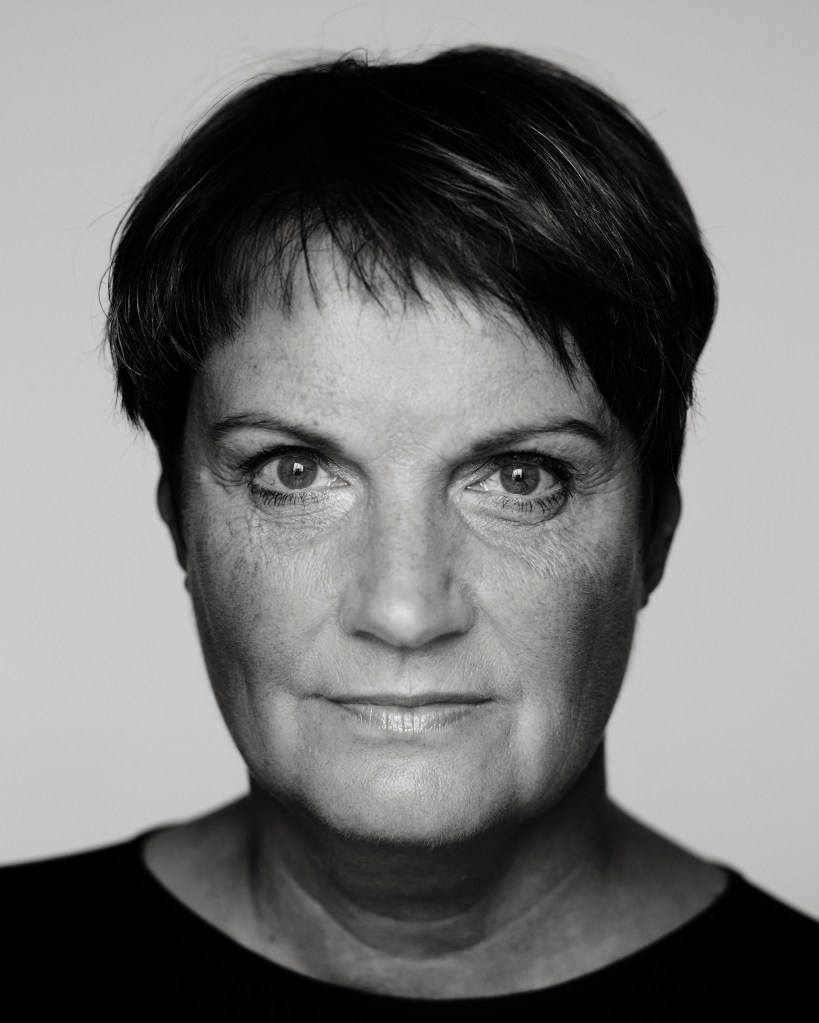
Sólveig Pálsdóttir trained as an actor and has a background in the theatre, television and radio. In a second career she studied for degrees in literature and education, and has taught literature and linguistics, drama and public speaking; she has also produced both radio programmes and managed cultural events. Her first novel appeared in Iceland in 2012 and went straight to the country’s bestseller list. Her memoir Klettaborgin was a 2020 hit in Iceland. Sólveig Pálsdóttir has written seven novels featuring Reykjavík detectives Guðgeir Fransson and Elsa Guðrún in the series called Ice and Crime. Silenced received the 2020 Drop of Blood award for the best Icelandic novel of the year and was Iceland’s nomination for the 2021 Glass key award for the best Nordic crime novel of the year. Shrouded is the series’ fourth book to appear in English. Sólveig lives in Reykjavík.
Quentin Bates has personal and professional roots in Iceland that go very deep. He is an author of series of nine crime novels and novellas featuring the Reykjavik detective Gunnhildur (Gunna) Gísladóttir. In addition to his own fiction, he has translated many works of Iceland’s coolest writers into English, including books by Lilja Sigurðardóttir, Guðlaugur Arason, Einar Kárason, Óskar Guðmundsson, Sólveig Pálsdóttir, Jónína Leosdottir, Ragnar Jónasson and elusive Stella Blomkvist. Quentin was instrumental in launching Iceland Noir in 2013, the crime fiction festival in Reykjavik.
Today it’s Moomin Day… But really it’s one hundred and ten years since Tove Jansson was born in Helsinki and I was thinking of a very special trip which was ten years ago exactly. I wrote about it some time later, and below is the text originally published on Nordic Noir website run by my wonderful friend, late Miriam Owen. So here it is…
More than three years ago, in 2014 I was on a ‘pilgrimage’ in Finland, following in the footsteps of an incredible writer and fine artist Tove Marika Jansson, a woman who has created a completely new universe inhabited by wise philosophical trolls (Moomins), and who hugely influenced my outlook on life. Tove Jansson’s multi-dimensional works overflow with humour and creativity.
In Finland you can see a permanent exhibition of Tove Jansson’s works at Moomin Museum in Tampere, or visit Moomin World created for children in Turku. Moomin Official constantly expands the variety of experiences. My own experience came from the first Polish editions of Muminki, full of humour and warmth, published in the 1970’s, beautifully translated from Swedish and including original drawings by the author. My mother, as a ‘special regular’ customer at the bookshop, had the copies set aside specially for me. I knew all Finn Family Moomintroll, Moominsummer Madness, Moominland Winter and Talesfrom Moominvalley by heart. As well as other children’s books by Scandinavian authors. Astrid Lindgren wrote about practical kids of The Six Bullerby Children, and crazy Pippi Langstrumpf / Longstocking. Over the years I read all these books again in English yet the Polish translation of names and places appeal more to me. At the time Tove Jansson visited Poland when work on adapting her books for the small screen was in full swing. In 1977 Łódź film-based Se-ma-for created the TV series Tales of the Moomins. The cartoon was made with the use of semi-flat animated puppets on glass and it still has quite a surreal feel and quality to it.
The characters from the world of Moomins do not pretend that life is always okay. Yet, despite the storms, turmoil, evil desires and problems there was always a happy ending in these tales. I wanted to be like Moomin Mama, carrying a handbag. She is compassionate, has a sense of humour and, very important, has a sense of her own worth. More visitors: we will make pancake batter in the bathtub because the kitchen is too small. Moomin Papa lacking inspiration: maybe a plate of boiled sweets will help. Forest creatures lost their house: there is always space to sleep. And The Groke whom everyone feared is one of my favourites. Yes, she’s scary and freezes everything she touches but only because she wants love and acceptance. Like all of us.
Later I discovered Tove Jansson’s modest book for adults The Field of Stones which contains a lot of reflections on the writer’s struggle with the word. Searching for more I found books translated into Polish and English. The Summer Book is always available in English but there are no further reprints in Polish. I have Sculptor’s Daughter, an autobiographical novel for adults, The True Deceiver, and Stone Field, adorned with the letter Y on the cover (a symbol of character with whose biography the book’s hero is struggling). A Winter Book and Fair Play show more of Jansson’s talent for writing. Now Sort Of Books published the new collection of short stories originally published in 1991, and translated for the first time by Thomas Teal. Understated, elegant, beautiful simplicity in delicate yet powerful short stories collected in Letters from Klara written when Tove Jansson was in her seventies, at the height of her fame. She has truly mastered the form. Balancing harshness of world and sharpness of the words, the stories also demonstrate love and compassion and a delicate sense of humour. They are philosophical, sarcastic and timeless:
‘…but if you’re odd, you’re odd, and that’s all there is to it.’
‘You’re hurt that I forgot your ancient birthday. You’re being unreasonable. I know you’ve always expected me to make a special fuss, simply because I’m three years younger. But it’s time you realized that the passage of years per se is no feather in anyone’s cap.’
I followed all Tove Jansson-related news and in 2013 I managed to find a hefty tome ToveJansson. Moomin’s Mum, a comprehensive biography by Boel Westin, which had been translated from Swedish into Polish. In the UK, the same biography titled Life, Art, Words:The Authorised Biography was published a year later.
In 2014, the hundredth anniversary of her birth, the summer presented various events which I attended. The Finnish Institute in London opened a photo exhibition at the Institute of Contemporary Arts (ICA) under the title Tove Jansson: Tales from theNordic Archipelago. I loved the beautiful photographs by C-G Hagström, reflecting the simplicity and beauty of the hardships of life, and at the same time the severity of the conditions of existence on the islands, to which Tove and her long-term life companion Tuulikki Pietila responded with joy.
Helsinki’s Ateneum Art Museum, previously the Finnish Art Society’s drawing school which she had attended in Helsinki, organised a brilliant retrospective exhibition of paintings, drawings and sketches, as well as everything related to Moomins before the Japanese machine began to create animations. Next stop for the exhibition is at Dulwich Gallery which opened in October 2017 and runs until28th January 2018 and I cannot wait to see it again.
Moomin troll first appeared as a long snouted ‘Snork’ in 1943 at the time when young Tove drew cartoons for the satirical political anti-Hitler paper Garm. His first formal outing was in The Moomins and the Great Flood published in 1945, and then through further books and comic strips, translations and slowly but steadily growing Moomin emporium. His modest beginnings and frequent cameo appearances in the drawings and paintings eventually demanded proper presence in a book.
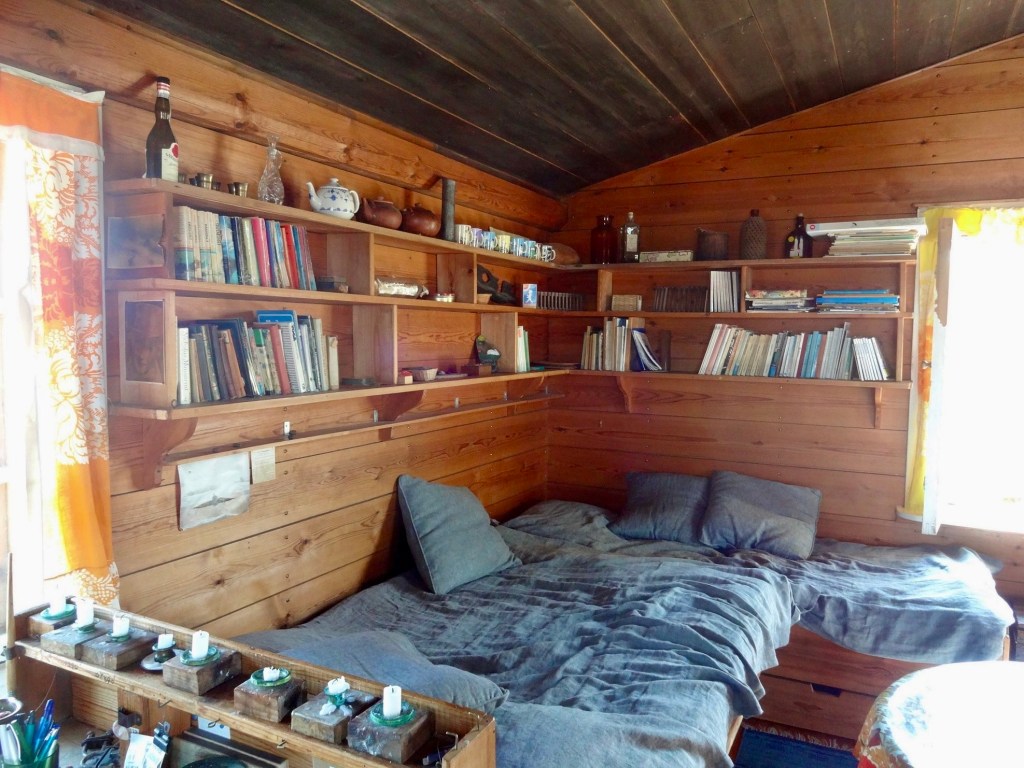
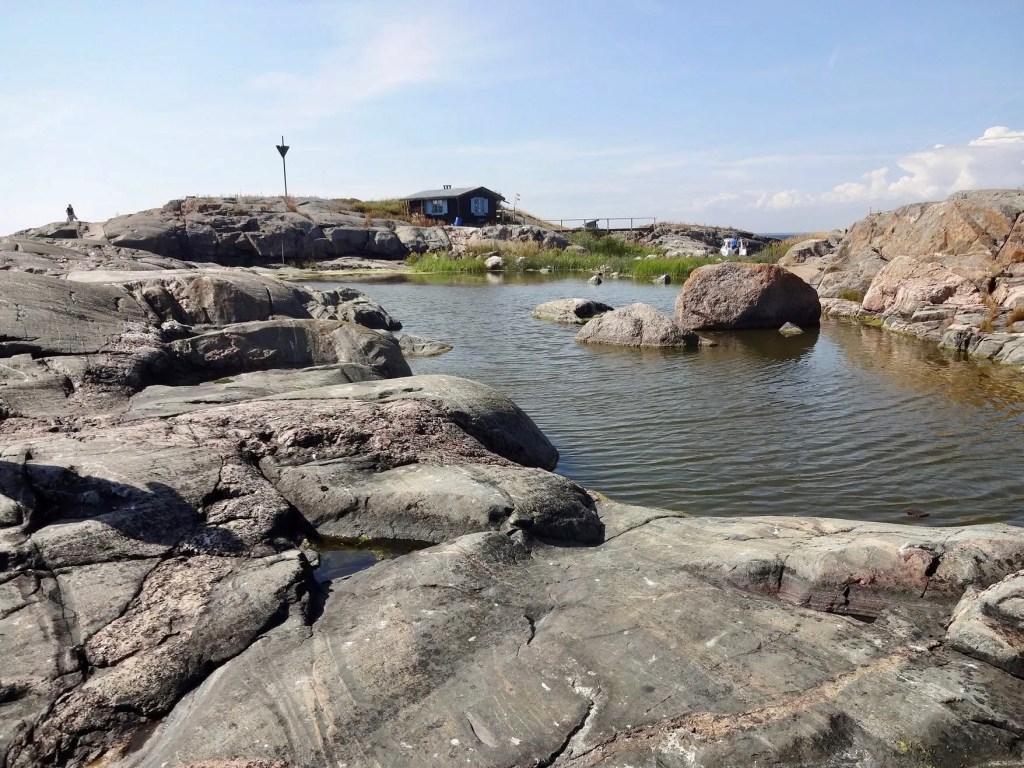
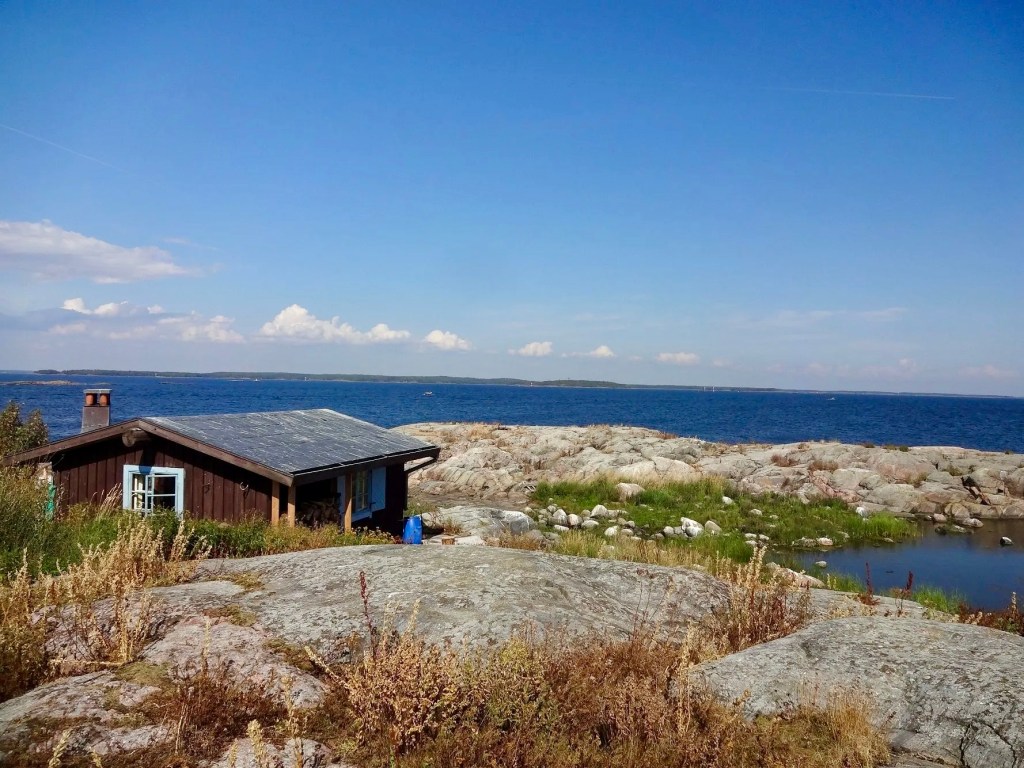
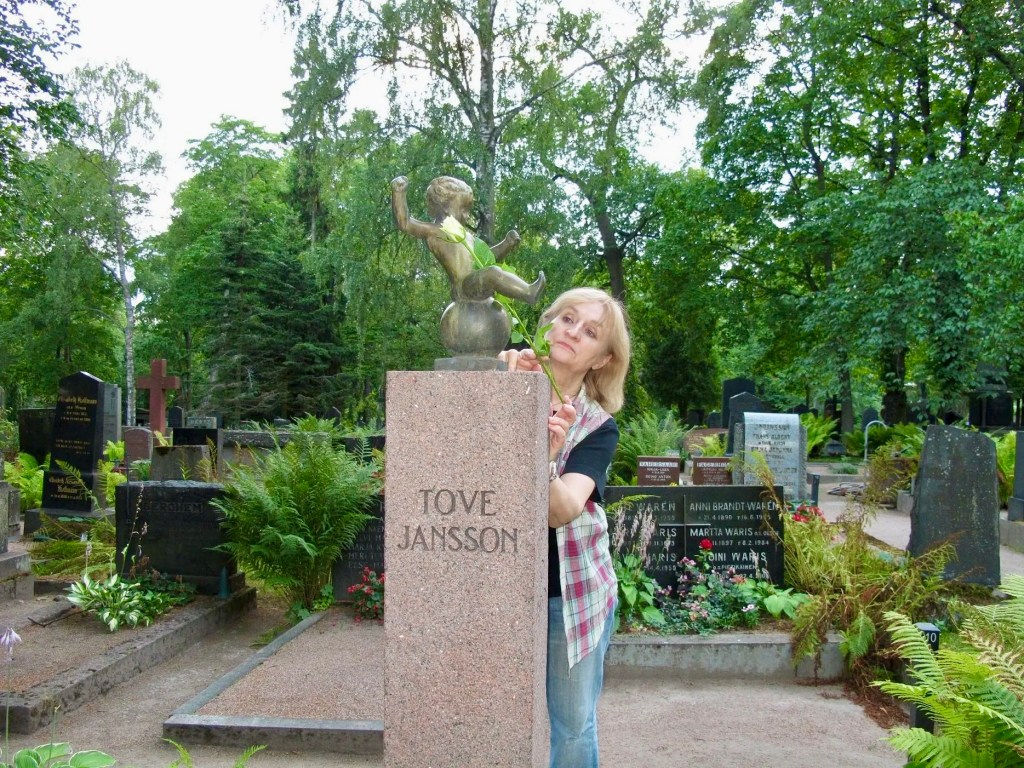
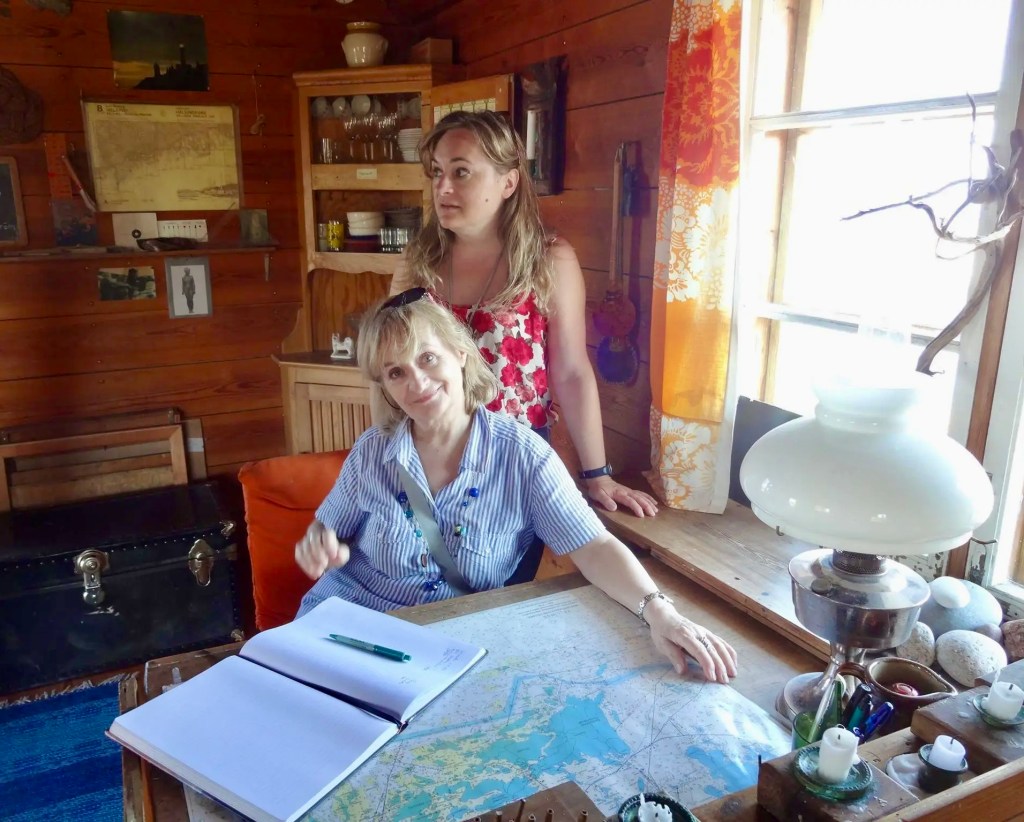
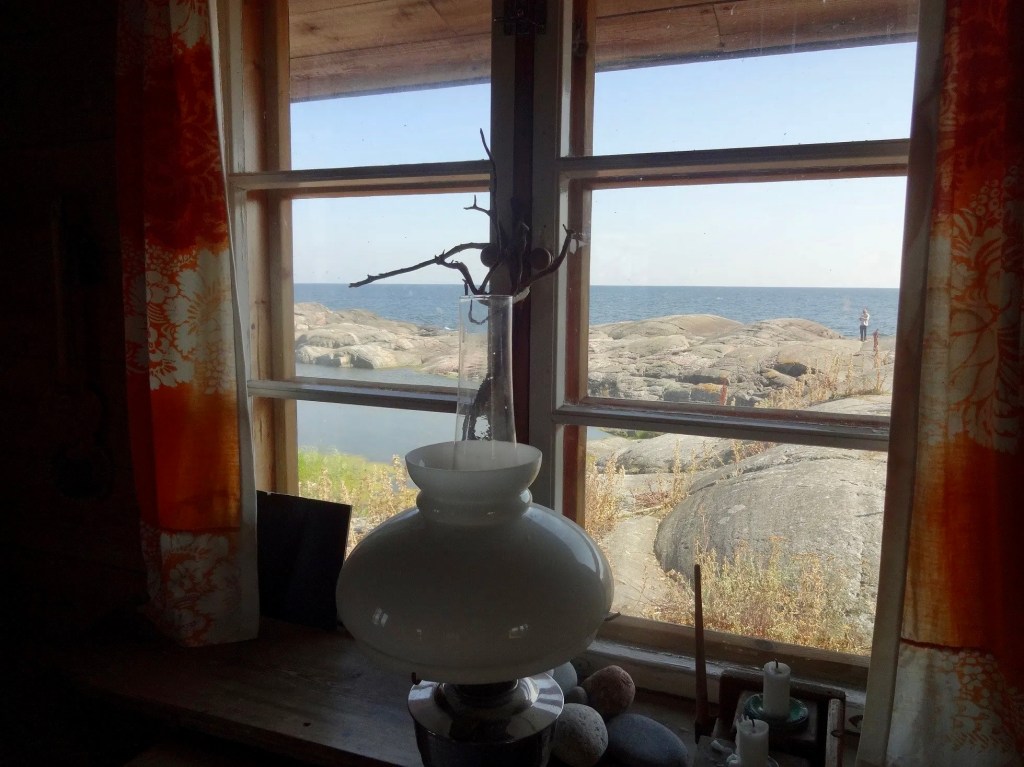
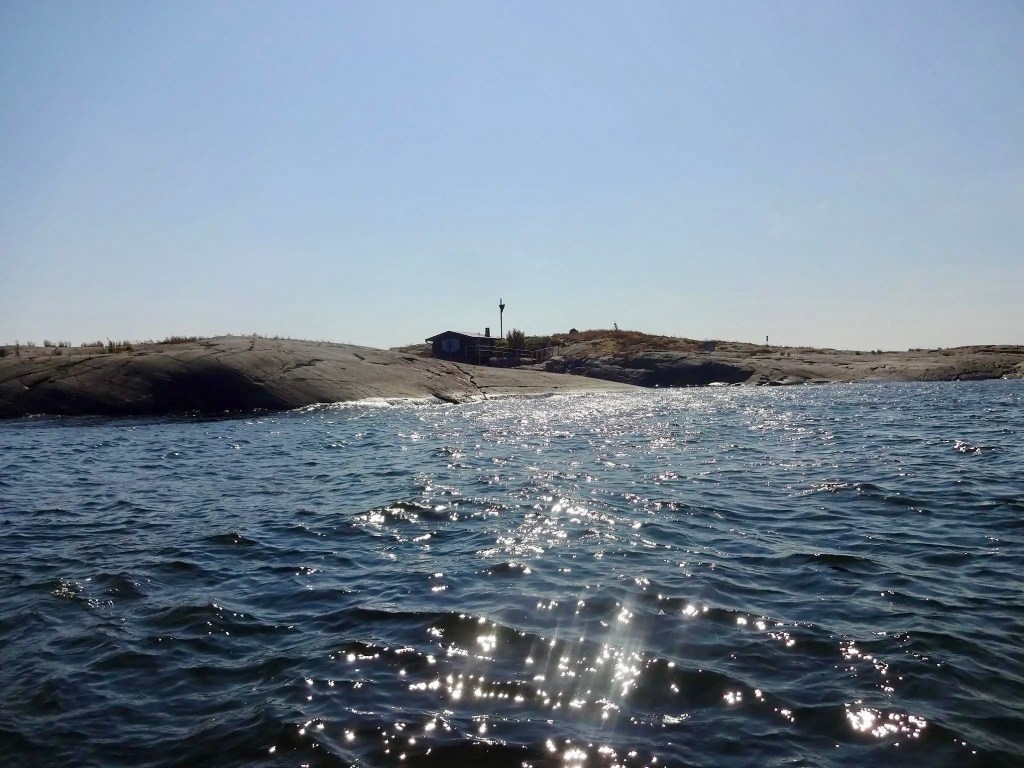
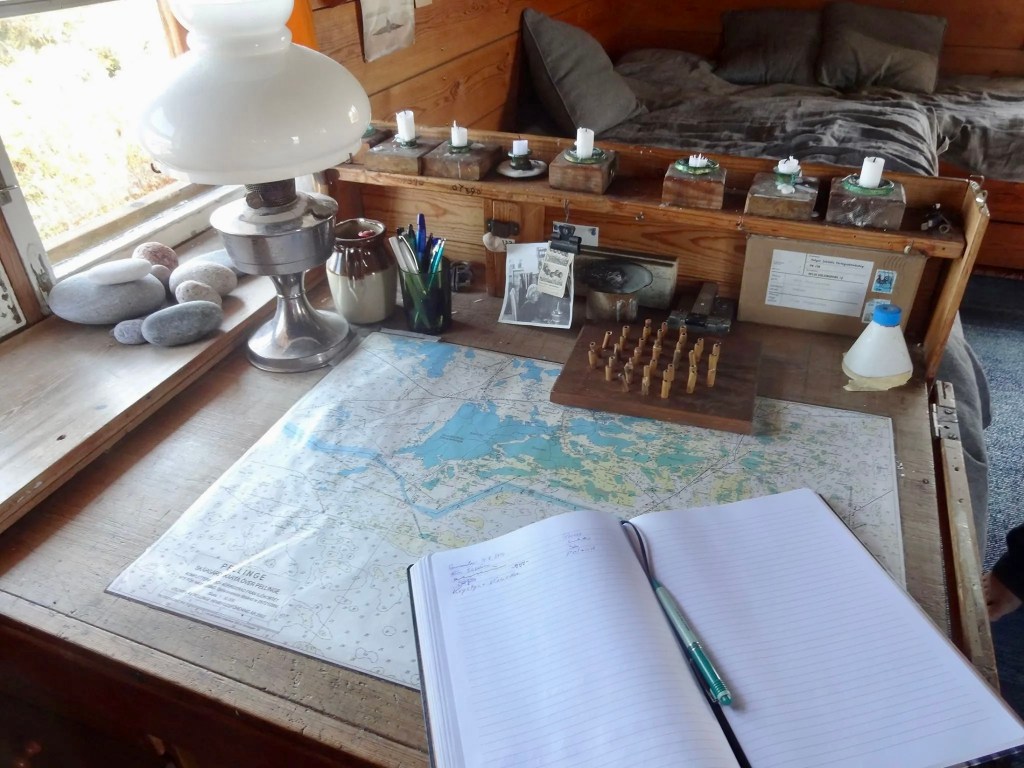
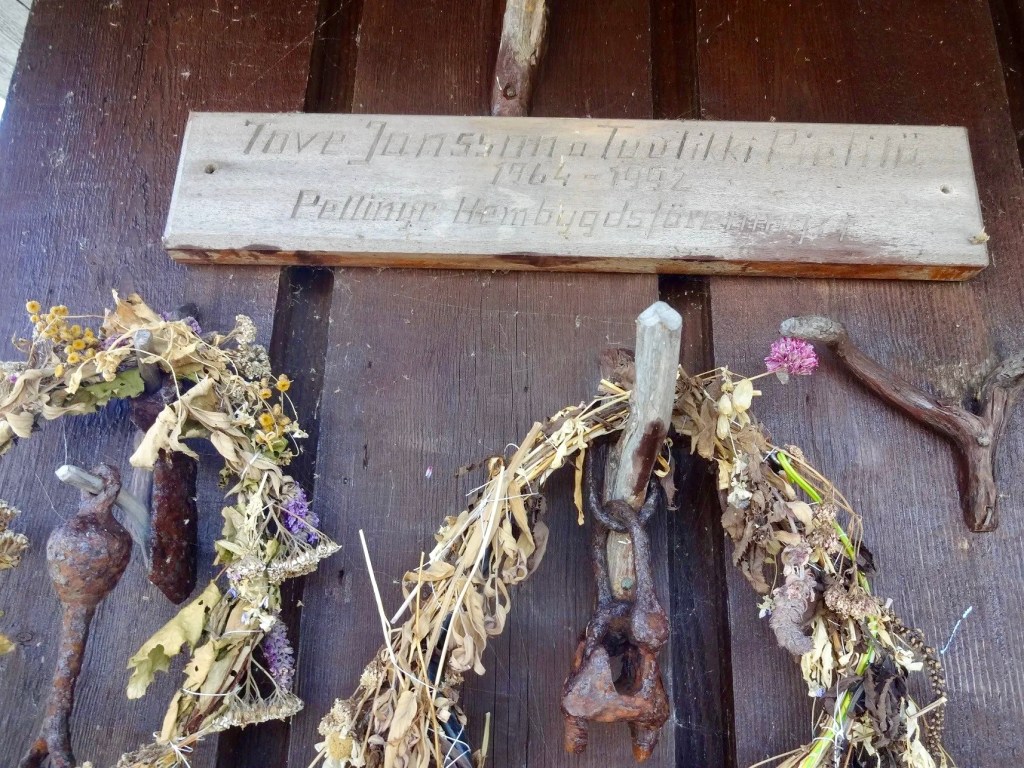
In August 2014 I travelled with my mum Krystyna Konecka, another fan of Tove Jansson, and our adventure started at the Hietaniemi cemetery at the family grave exactly on a day of Tove’s hundredth birthday. Her mother was the Swedish artist and graphic designer Signe Hammarsten, called Ham, and the father was the Finnish sculptor Victor Jansson, known in the family as Faffan. Afterwards we travelled by bus to Porvoo, 50 km east of Helsinki, and then to the island Klovharun in the Gulf of Finland. Even though it was incredibly hot and all arrangements have been confirmed weeks in advance, the trip could have been cancelled because of strong winds. And that’s how it was for Tove and her partner Tuulikki – when they left the bustle of the Capital life and moved to the island for the entire summer for nearly thirty years. Harsh reality of isolated island living, friends, uninvited guests and creativity.
In Porvoo we received a booklet with the Moomin Troll on the cover, made by Polish studio Se-ma-for. This was presented by Liisa Vähäkylä, Managing Director of Finnanimation. She and other members of Tove Jansson Society, along with the head Annikki Vähätalo attended, and we joined them at the opening of the exhibition of photographs of the artist by her friend of many years, artist C-G Hagström, whom I met earlier in London, and Tove’s younger brother Per Olov Jansson who is now 97 years old.
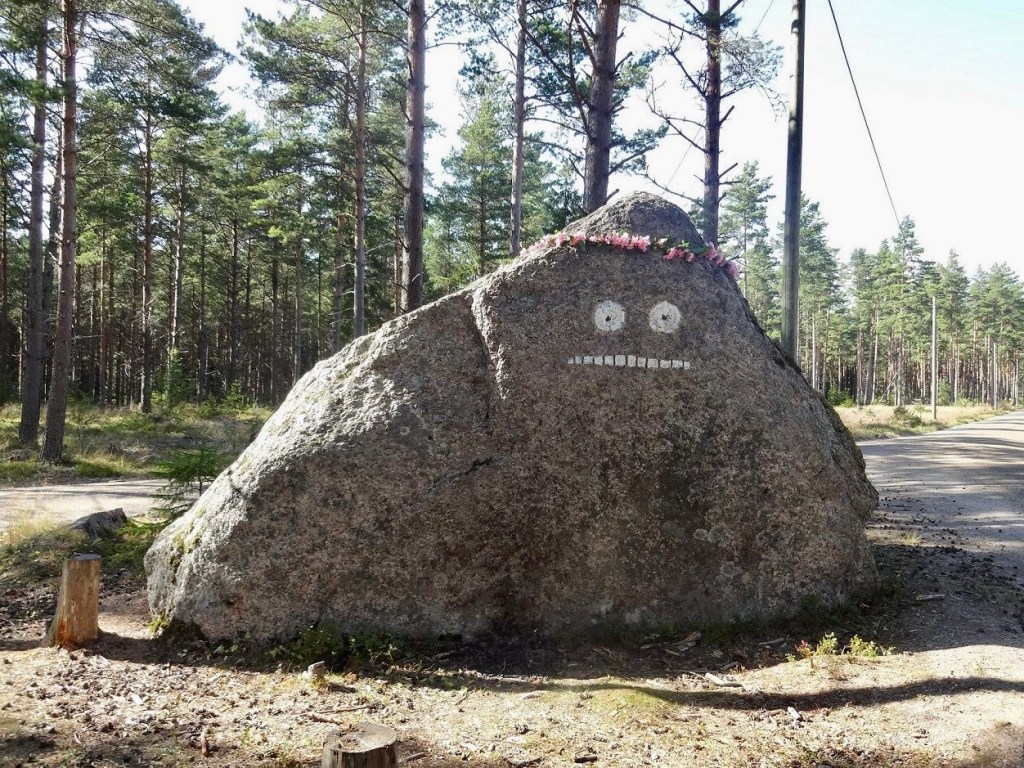
Another adventure awaited in a form of Gerd, wonderful Finnish Swede, living on one of the islands of the archipelago Pellinki, who had arrived in a big taxi to collect us. We made online arrangements for our trip from Porvoo to the small place on the coast. Gerd knew the archipelago, its history, people, roads, landscape. She stopped at the village store where Tove used to do basic shopping, coming by boat from her island Klovharun. On the way back, taking a slightly different route, she suggested stopping for a moment to see ‘Mårran’. And so we drove into the woods and suddenly there was a huge boulder in an unusual shape, a wreath of flowers on its top, with luminous painted eyes and teeth, and it was a happy Groke! A new Finnish word to add to my limited vocabulary.
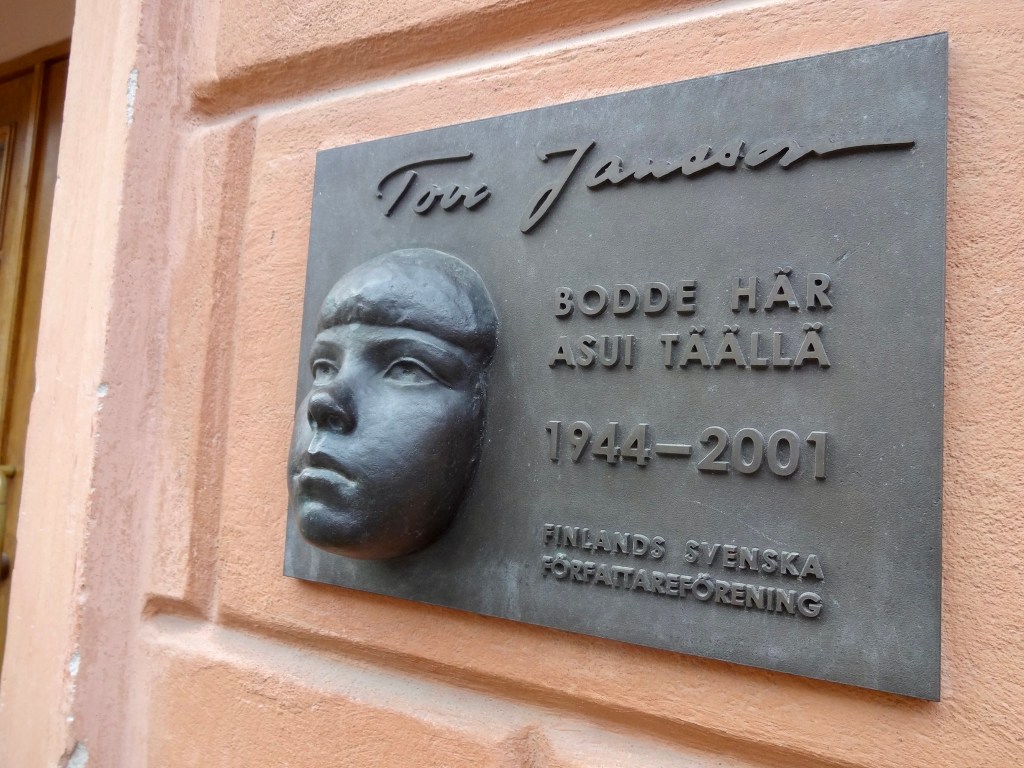
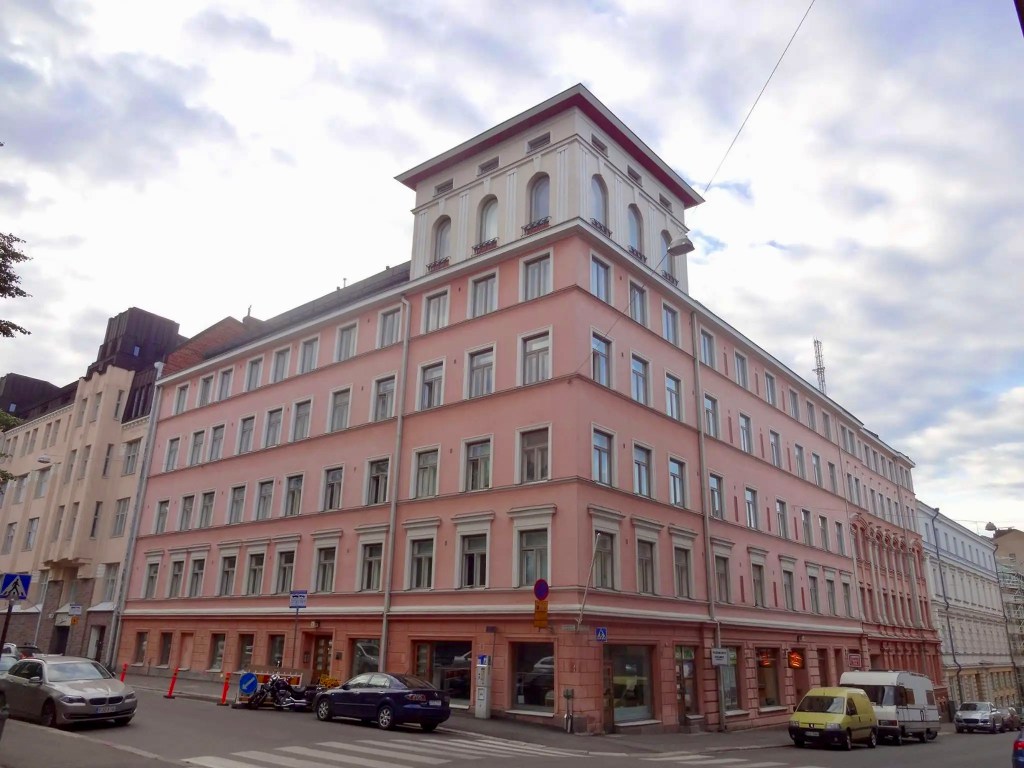
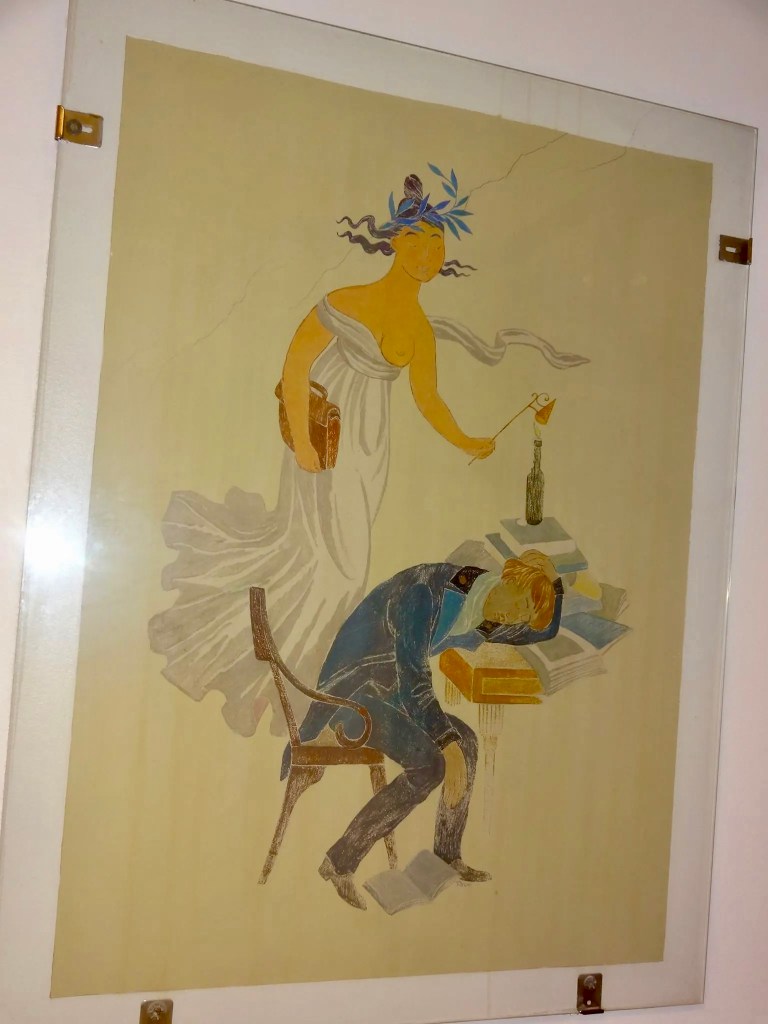
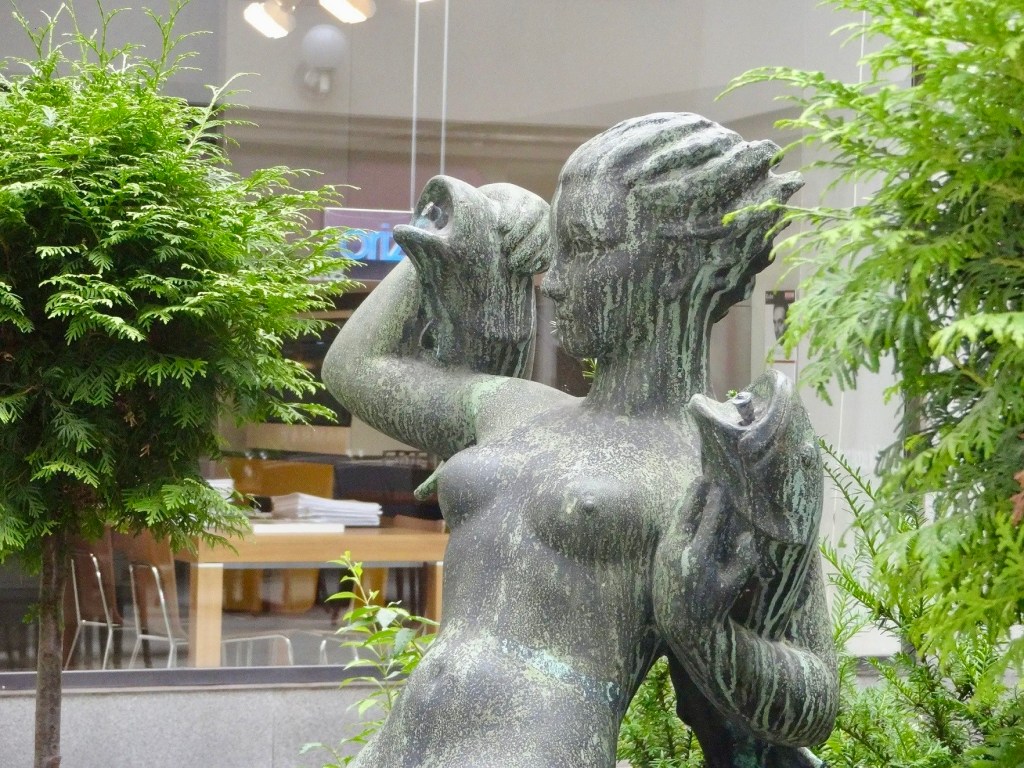
Walking all day in Helsinki added flavour and substance to what I’ve learnt about Tove’s life. The imposing building at Luotsikatu 4 was the childhood home and her parents’ studio. From there she often walked around the corner to buy tobacco for her father to what is now a tiny Café Signora. Then she lived at the House of Artists Lallukka from 1933 until 1942 when she moved to her first studio nearby, and two years later to a tower of a building at Ullanlinnankatu 1. The top floor flat was cold and drafty, the building hit in the bombings but the upper window showed a strip of sea. Tove lived and worked in this oasis until her death. The little gems scattered around the town include Domus Academica (providing student accommodation) which hosts two original murals painted by Tove, or a modest courtyard surrounded by modern office buildings. Hiding amongst the greenery a Viktor Jansson’s sculpture of Mermaid, modelled on young Tove, is standing in an empty fountain.
Various Finnish places have memories of the artist and she has a special place in many hearts, not only those who love Moomins.


 Nordic Lighthouse