Petrona Award 2021 shortlist

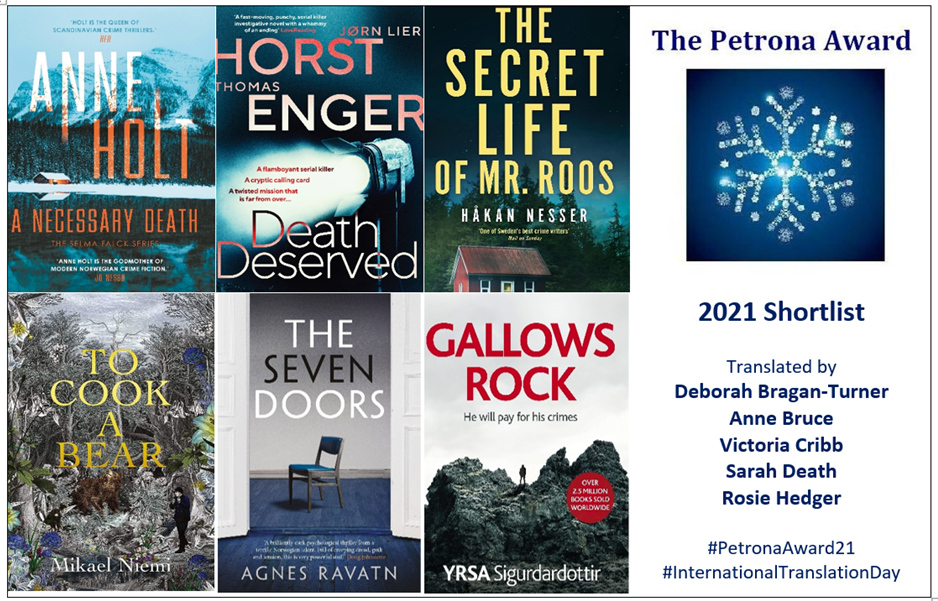
Outstanding crime fiction from Iceland, Norway and Sweden shortlisted for the 2021 Petrona Award. Six outstanding crime novels from Iceland, Norway and Sweden have been shortlisted for the 2021 Petrona Award for the Best Scandinavian Crime Novel of the Year. The shortlist is announced today, Thursday 30 September.

A NECESSARY DEATH by Anne Holt, tr. Anne Bruce (Corvus; Norway)

DEATH DESERVED by Jørn Lier Horst and Thomas Enger, tr. Anne Bruce (Orenda Books; Norway)

THE SECRET LIFE OF MR. ROOS by Håkan Nesser, tr. Sarah Death (Mantle; Sweden)

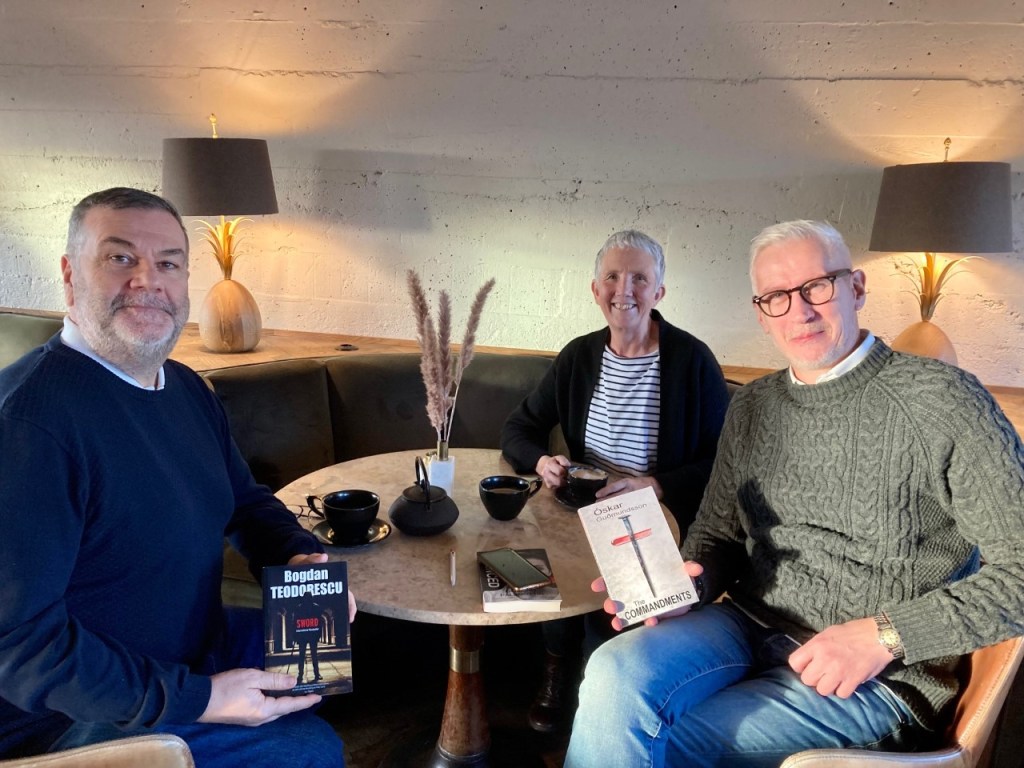
TO COOK A BEAR by Mikael Niemi, tr. Deborah Bragan-Turner (MacLehose Press; Sweden)

THE SEVEN DOORS by Agnes Ravatn, tr. Rosie Hedger (Orenda Books; Norway)

GALLOWS ROCK by Yrsa Sigurðardóttir, tr. Victoria Cribb (Hodder & Stoughton; Iceland)

The winner, usually announced at the international crime fiction convention CrimeFest, will now be announced on Thursday 4 November 2021. The Petrona Award is open to crime fiction in translation, either written by a Scandinavian author or set in Scandinavia, and published in the UK in the previous calendar year.

The judges’ comments on the shortlist:

There were 28 entries for the 2021 Petrona Award from six countries (Denmark, Finland, Germany, Iceland, Norway, Sweden). The novels were translated by 17 translators and submitted by 20 publishers/imprints. There were 10 female, 16 male, one male/male pair and one male/female pair of authors.

This year’s Petrona Award shortlist once again sees Norway strongly represented with three novels; Sweden with two and Iceland with one. The crime genres represented include the police procedural, historical crime, psychological crime, literary crime and thriller.

The Petrona Award judges selected the shortlist from a rich field. The six novels stand out for their writing, characterisation, plotting, and overall quality. They are original and inventive, often pushing the boundaries of genre conventions, and tackle complex subjects such as class and power, the bonds of friendship, and the failure of society to support vulnerable individuals.

Today, very aptly, is International Translation Day. We are extremely grateful to the five translators whose expertise and skill have allowed readers to access these outstanding examples of Scandinavian crime fiction, and to the publishers who continue to champion and support translated fiction.

The judges’ comments on each of the shortlisted titles:

A NECESSARY DEATH by Anne Holt, tr. Anne Bruce (Corvus; Norway)

Anne Holt, according to Jo Nesbø, is the ‘godmother of modern Norwegian crime fiction’. Best known for her ‘Hanne Wilhelmsen’ and ‘Vik/Stubø’ series (the inspiration for TV drama Modus), she also served as Norway’s Minister for Justice in the 1990s. A Necessary Death is the second in Holt’s ‘Selma Falck’ series, whose eponymous protagonist is a high-flying lawyer brought low by her gambling addiction. The novel shows Falck resisting an attempt to kill her: on waking in a burning cabin in a remote, sub-zero wilderness, she has to figure out how to survive, while desperately trying to remember how she got there. A pacy, absorbing thriller with a gutsy, complex main character.

DEATH DESERVED by Jørn Lier Horst and Thomas Enger, tr. Anne Bruce (Orenda Books; Norway)

Death Deserved marks the beginning of an exciting collaboration between two of Norway’s most successful crime authors. Thomas Enger and Jørn Lier Horst are both already well known for their long-running ‘Henning Juul’ ­and ‘William Wisting’ series. Death Deserved, in which a serial killer targets well-known personalities, mines each writer’s area of expertise: the portrayal of detective Alexander Blix draws on Horst’s former career as a policeman, while Enger brings his professional knowledge of the media to the depiction of journalist Emma Ramm. The novel expertly fuses the writers’ individual styles, while showcasing their joint talent for writing credible and engaging characters, and creating a fast-paced, exciting plot.

THE SECRET LIFE OF MR. ROOS by Håkan Nesser, tr. Sarah Death (Mantle; Sweden)

Håkan Nesser, one of Sweden’s most popular crime writers, is internationally known for his ‘Van Veeteren’ and ‘Inspector Barbarotti’ series. The Secret Life of Mr. Roos is the third in a quintet featuring Gunnar Barbarotti, a Swedish policeman of Italian descent, who is a complex yet ethically grounded figure. His relatively late appearance in the novel creates space for the portrayal of an unlikely friendship between Mr. Roos, a jaded, middle-aged man who has unexpectedly won the lottery, and Anna, a young, recovering drug addict of Polish origin, who is on the run. Slow-burning literary suspense is leavened with a dry sense of humour, philosophical musings, and compassion for individuals in difficult circumstances.

TO COOK A BEAR by Mikael Niemi, tr. Deborah Bragan-Turner (MacLehose Press; Sweden)

Mikael Niemi grew up in the northernmost part of Sweden, and this forms the setting for his historical crime novel To Cook a Bear. It’s 1852: Revivalist preacher Lars Levi Læstadius and Jussi, a young Sami boy he has rescued from destitution, go on long botanical treks that hone their observational skills. When a milkmaid goes missing deep in the forest, the locals suspect a predatory bear, but Læstadius and Jussi find clues using early forensic techniques that point to a far worse killer. Niemi’s eloquent depiction of this unforgiving but beautiful landscape, and the metaphysical musings of Læstadius on art, literature and education truly set this novel apart.

THE SEVEN DOORS by Agnes Ravatn, tr. Rosie Hedger (Orenda Books; Norway)

Agnes Ravatn’s The Seven Doors has shades of Patricia Highsmith about it: a deliciously dark psychological thriller that lifts the lid on middle-class hypocrisy. When Ingeborg, the daughter of university professor Nina and hospital consultant Mads, insists on viewing a house that her parents rent out, she unwittingly sets off a grim chain of events. Within a few days, tenant Mari Nilson has gone missing, and when Nina starts to investigate her disappearance and past life as a musician, worrying truths begin to emerge. A novel about gender, power and self-deception, expertly spiced with Freud and Bluebeard, The Seven Doors delivers an ending that lingers in the mind.

GALLOWS ROCK by Yrsa Sigurðardóttir, tr. Victoria Cribb (Hodder & Stoughton; Iceland)

Gallows Rock is the fourth in Yrsa Sigurðardóttir’s ‘Children’s House’ series, featuring child psychologist Freyja and police detective Huldar as a reluctant investigative duo. Their relationship provides readers with some lighter moments and occasional black humour, along with a frisson of mutual attraction. The novel’s intricate plot focuses on skewed morals and revenge: what begins as a ritualistic murder at an ancient execution site in the lava fields – the Gallows Rock of the title – leads to the unearthing of a case of long-term abuse, whose devastating impact is sensitively explored. The author won the 2015 Petrona Award for The Silence of the Sea.

The judges

Jackie Farrant – Crime fiction expert and creator of Raven Crime Reads; bookseller for twenty years and a Regional Commercial Manager for a major book chain in the UK.

Dr. Kat Hall – Translator and editor; Honorary Research Associate at Swansea University; international crime fiction reviewer at Mrs. Peabody Investigates.

Ewa Sherman (me!) – Translator and writer; blogger at NORDIC LIGHTHOUSE; regular contributor to Crime Review; volunteer at crime fiction festivals in Reykjavik, Bristol and Newcastle.

Award administrator
Karen Meek
– owner of the Euro Crime website; reviewer, former CWA judge for the International Dagger, and Library Assistant.


Further information can be found on the Petrona Award website

Add Cyanide to Taste by Karmen Špiljak

Kurt Wallander’s visits to his favourite cafe Fridolf’s Konditori in Ystad. Martin Beck’s meetings with his daughter Inger at the dimly lit restaurants in Stockholm. Harry Hole’s frequent trips to the old-school Restaurant Schrøder in Oslo though he does not care much for what’s on offer. Solemn Erlendur tucking into the classic Icelandic dish of boiled sheep’s head and potatoes. Salvo Montalbano enjoying delicious dinners and gorgeous sunsets on the terrace of his local eatery.

‘Food and stories aren’t that different; they nurture in different ways.’

The food examples in the crime fiction are endless, and so often allow for some breathing space when the plots become too intense and crimes are too gruesome. They also reflect protagonists’ state of mind, giving detectives and inspectors a moment of normality and distraction from a complex case, or become the quite opposite when opening a fridge represents looking at a sad lonely onion and a dry piece of cheese thus signifying the personal life’s emptiness. However, good food, or lack of it, is always present.

Karmen Špiljak, a Slovenian-Belgian writer currently living in Brazil, loves food AND crime fiction. In her carefully assembled menu of international culinary noir with some unexpected notes, food is the pièce de résistance although it does not overpower the main ideas. Themes are interesting and surprising: a cursed recipe, a suspicious cook, friends turning against each other, or a mysterious disappearing pub.

I was convinced that the number thirteen is the one that fills many people with trepidation. Superstition can be a powerful emotion. However, in Špiljak’s latest piece of creative fiction it is the fourteen that brings some truly deadly thoughts. That specific number of short stories delivers both sinister and delicious twists and reactions as the author combines passion for words and cuisine, offers food for the soul and recipes to be followed should anyone wanted to recreate the mood of the perfectly formed and narrated descriptions from the collection. What I found especially enjoyable is the lightness of touch of her writing style, and the flow of narration with which she concocts her mouth-watering noir dishes. There are cooked to perfection thrillers, ghost stories and mysteries. And even a slightly futuristic take on the pact with the Devil that feeds on people’s desire to pay with their lives for the most sensational feast. Although the food is the muse, sustenance, invitation or joy, it nevertheless can turn into the expression of deeply hidden emotions, unforgotten secrets, and become a catalyst for change or closure. 

None of the recipes proposed in the second part of the book contain or advise the use cyanide. Far from it. There’s no need to transfer anger or hurt into the readers’ reality. Yet it’s fascinating to read about a mother who had always expressed her love for the family and unspoken trauma through cooking delicious cakes, pies and biscuits. She also discovered a bitter-sweet formula for practical revenge. Which means that from now on I will think of fruit in a different way. Fruit is wonderful but can lead to a sinister demise if people are not careful. Or if a crime has been committed already. 

As the author focuses so much on various aspects of food, and how we relate to cooking, eating, enjoying, or not, a variety of easy and complicated dishes, she asks the reader what they were eating while reading Add Cyanide to Taste. Well, I was lucky to enjoy the Norwegian waffles with strawberry jam and soured cream which makes the perfect combination for this particular easy dish. The soured cream is a worthy ingredient in my kitchen but that’s another story. Not murderous. 

You can get to know Karmen Špiljak and order this collection of short stories Add Cyanide To Taste

To Cook a Bear by Mikael Niemi

It is 1852, and in Sweden’s far north, deep in the Arctic Circle, charismatic preacher and Revivalist Lars Levi Læstadius impassions a poverty-stricken congregation with visions of salvation. But local leaders have reason to resist a shift to temperance over alcohol.

Jussi, the young Sami boy Læstadius has rescued from destitution and abuse, becomes the preacher’s faithful disciple on long botanical treks to explore the flora and fauna. Læstadius also teaches him to read and write – and to love and fear God.

When a milkmaid goes missing deep in the forest, the locals suspect a predatory bear is at large. A second girl is attacked, and the sheriff is quick to offer a reward for the bear’s capture. Using early forensics and daguerreotype, Læstadius and Jussi find clues that point to a far worse killer on the loose, even as they are unaware of the evil closing in around them.

Mikael Niemi’s historical crime novel To Cook a Bear, in superb flowing translation from Swedish by Deborah Bragan-Turner, is a masterpiece, and an absolute literary revelation for me. The author grew up near the old parsonage in Pajala where the real-life leader and keen botanist lived with wife Brita Kajsa and his family until his death in 1861. The inspiration and the proximity to the location so significant at the time, sparked Niemi’s interest and propelled his imagination to create a gripping semi-detective tale of communities turning inwards when panic and the incomprehensible happen. The meandering path from superstition and fear can quickly turn into injustice and violence, and nothing can prevent unfair treatment of those who are different or not belonging. The book becomes more than just a fascinating engaging and breath-taking search for the killer where Læstadius follows logic, calm reasoning and all scientific methods available to him while the those in power become his enemies. The main players: foundry owner, merchant, bailiff and sheriff want quick results (yes, let’s catch and kill the beastly animal!) and no ‘meddling’ in their business. To Cook a Bear takes various religious thoughts and dismantles them into both lyrical and brutal philosophical journey.   

The story is set in a distant location at Kengis in the parish of Pajala in northern Sweden, close to the Finnish border, and we follow Jussi, a wanderer, observing life from the sidelines and being an outcast narrator: Although he wants to fit in, he is fully aware of his strange fate: ‘Clothes on my back, knife in my belt, fire striker and cup, horn spoon, pouch of salt.’ His life is harsh, yet thanks to the pastor he has a chance to encounter gentler facets of nature and humanity and to learn to read and write, while trying to understand God. Faced with the difficult question ‘What are you doing to combat the world’s evil’ he’s not quite ready to come up with ideas but the process of thinking and experiencing knowledge helps him to feel some hope. Damaged by the abuse, hunger and poverty, he’s convinced (wrongly) of own unlovable character: ‘No-one looking at me breaks into a smile or feels the easy joy I have seen in others. No woman meets my eye with a grin but instead she will tense and turn away.’ Yet he is in love and prepared to sacrifice everything to help a woman of his dreams, of his physical and emotional desires which are so complex they might be derived straight from Satan. That’s the only possible interpretation… Given the chance Jussi would have become a wise educated man; alas, his story was not so happy.


‘The greatest sin people can commit is not to love their children.’

Together with the pastor he glimpsed into the possibility of improving lives of the local neighbourhoods and people whose existence was particularly tough: Sami people, Swedes and Finns, and occasional Norwegians who had ventured into the area. Jussi discovered the joy of reading, of creating sounds in own head and trying to speak eloquently: ‘If you owned books, you would never be alone.’ And the religious revival seemed like an opportunity: ‘It is an inner revolution. Instead of overthrowing those in power, the battle is within the inner tyrants. With self-righteousness, arrogance, pride, with desire for ostentation and carnal pleasures. Only when inner demons are brought down and slain, can society undergo a lasting change.’

And I will leave you with the quote that carries simplicity taken from the close bond with the nature, into the universal contemporary themes:   

‘Most people behave like reindeer. They want to walk with others, move forward in a herd. If a female grunts, the others will start to grunt too. If a male gives out a warning signal, they all run, even if they haven’t seen the danger themselves. The reindeer navigates by fear, its enemies are the wolverine, the wolf, the bear and the lynx. A human being is also afraid, created that way by our Lord. Luther’s call was to love and fear God. But we love and fear each other with the same intensity. And most of all we fear losing one another. Being alone, being separated from the protection of our herd.’

To Cook a Bear – Amazon

To Cook a Bear – Bookshop.org

Eva Björg Ægisdóttir: Girl who questions lies

During Iceland Noir festival in November 2018 Eva Björg Ægisdóttir was one of the new authors introduced by Quentin Bates at the New Icelandic Noir panel, together with Robert Marvin, Kristján Atli Ragnarsson and Simon Cox. Apologies for the quality of my photo but it was dark and mysterious, and the shadowy atmosphere mirrored the themes perfectly.

Fast forward to 2021 and Eva Björg Ægisdóttir’s Forbidden Iceland series is in full swing, and by that I mean the first two books have been translated into English by Victoria Cribb and published by Orenda Books. Her debut The Creak on the Stairs won the Crime Writers’ Association John Creasey (New Blood) Dagger, strengthening her position as brilliant and exciting new voice in the Icelandic crime fiction. The second book, Girls Who Lie, followed as a much more confident sophisticated story of murder and assumptions, perceptions and expectations within tight communities. Both novels are cleverly constructed slow-burning police procedurals which take on the concepts of truth and existence in small towns. And locations that leave traces for ever and remain in people’s bloodstream.

What Ægisdóttir does so elegantly is the subtle understated yet extremely powerful psychological analysis of the main and secondary characters, while at the same time she fills the narration with unsettling details, creating absorbing and chilling stories, reflecting some ordinary yet universal truths. Elma, the emotionally wounded core character in the novels, becomes fully alive and vividly present in the moral dilemmas of people she comes in contact with. The contrast between doggedly mundane yet tenacious police work and the superb twists which are so reluctant to come to the surface, makes a huge impression. And thus, increases the level of tension. Another element of her writing that captures the imagination and resonates with the readers is the landscape of and around Akranes on the west coast of Iceland, a place that is close enough to the big noise of the capital Reykjavik, yet distant enough for its inhabitants to feel isolated or disconnected, or hidden if they want.

Here are some photos of Akranes’ old and new lighthouses with the appropriate background of wind, rain and dark moody wintery clouds.

The Creak on the Stairs

When a body of a woman is discovered at a lighthouse in the Icelandic town of Akranes, it soon becomes clear that she’s no stranger to the area. Chief Investigating Officer Elma, who has returned to Akranes following a failed relationship, and her colleagues Sævar and Hörður, commence an uneasy investigation, which uncovers a shocking secret in the dead woman’s past that continues to reverberate in the present day. But as Elma and her team make a series of discoveries, they bring to light a host of long-hidden crimes that shake the entire community. Sifting through the rubble of the townspeople’s shattered memories, they have to dodge increasingly serious threats, and find justice… before it’s too late.

Girls Who Lie

When single mother Maríanna disappears from her home, leaving an apologetic note on the kitchen table, everyone assumes that she’s taken her own life… until her body is found on the Grábrók lava fields seven months later, clearly the victim of murder. Her neglected fifteen-year-old daughter Hekla has been placed in foster care, but is her perfect new life hiding something sinister? Fifteen years earlier, a desperate new mother lies in a maternity ward, unable to look at her own child, the start of an odd and broken relationship that leads to a shocking tragedy.

Police officer Elma and her colleagues take on the case, which becomes increasingly complex, as the number of suspects grows and new light is shed on Maríanna’s past – and the childhood of a girl who never was like the others.

Iceland Noir (Iceland Noir on twitter) crime fiction festival in Reykjavik is being planned and organised right now. Tickets are on sale, and let’s hope it can happen this year Iceland Noir 2021 – tickets

Utøya, Oslo, Norway

Today marks the tenth anniversary of the terrorist attacks by a white supremacist in Oslo’s government district and on the island of Utøya. In the last week the Norwegian media have been full of memories, evaluations, recollections. Sadness and anger. Most of all: the desire not to have experience anything like that again. 77 people lost their lives, 69 of them were left-ish teenagers at the summer camp.

Today Oslo sparkled with sunshine and noises of everyday life; however, the national events to remember the dead and not forgotten young people have been solemn and thoughtful.

It is not my place to provide own analysis of this tragedy. Instead, I would like to republish my review (originally on Crime Review pages) of the novel which shook me, and made a huge impression on my understanding of consequences of the killing spree and reactions by ordinary people.

Scottish Cal and Norwegian Elsa left their home in Washington DC to stay for six months in Norway, with their two teenage daughters and a baby son. The change of scene brought also a devastating change to their lives: fifteen-year-old Licia vanished from a summer camp on a tranquil island where two men shot tens of youngsters. Desperate and destroyed family falls apart, doubting one another, mistrusting the police, losing faith and hope to ever survive this mental ordeal.

The Island hits you hard from the very first paragraphs. An idyllic image of a fifteen-year-old girl ‘sleeping alone on a grassy bank at the side of a glistening fjord.’ Distant voices of more girls attending International Future Female holiday camp; visions of empowering the youngsters, respect for the others and the environment. True Norwegian dream… But the tranquillity of such a serene moment becomes ruined as soon she feels shockwaves of a bomb explosion coming from a capital city nearby. Two police officers arrive at the island and round up all teenagers in one place, and start shooting. The girl realises that the men cannot be the real police, tries to warn others, and help a younger boy, tries in vain to escape from the site of the massacre. Then she vanishes.

The nation is in shock. Devastated parents of ninety-one murdered victims cannot comprehend what had happened in their safe country, ‘practical, elegant and egalitarian’ encapsulating the best Scandinavian values, as someone has pointed out half-ironically, half-desperately. A year later a trial is held of two brothers, representing Tactical Brigades of the Knights Templar.

Licia’s parents Cal and Elsa Curtis cannot move on after the massacre, delve into their missing daughter’s secrets and discover strange activities of their younger girl Vee. Their personal microcosmos shattered, doubts and suspicions of one another appear. Elsa seems to be more mysterious and aloof. Cal reaches out to charismatic Father Bror of the Patriotic Order of the Temple Knights, who had known Elsa in the past and who offers advice. Because now the couple distrust the police even if Cal and the Chief of Police form an uneasy friendship.

Ben McPherson weaves the chilling unsettling story of grief and despair into the modern take on the Norwegian reality. His detailed razor-sharp perception of differences between cultural and social aspects of different societies gives drama and depth to the vividly authentic main characters who struggle to process their trauma. Elsa, an uncompromising photographer and quintessential Nordic goddess, lives by the principle of absolute honesty in her approach to life. Cal, a Scottish satirist, remains a foreigner, an observer, slightly adrift in Norway where the family moved for a while after living in the USA for many years. As a spectator to the national tragedy he feels that his own family falls apart as a result of not knowing if Licia is dead or alive, whether she somehow managed to survived the massacre, and at the same time hearing of his little girl hailed as a hero. That last element makes him equally proud and concerned: a video footage shot by a TV crew in a helicopter shows a girl wearing a distinct dress and saving lives of other youths. But an old photo of Licia holding a gun during a shooting practice in the USA emerges and appeals to those blinded by white power.

The aftermath of the terrorist attack in July 2011 in Oslo and on Utøya echoes throughout this gripping intense novel, and occasionally makes for disconcerting reading as The Island is inspired by true events. However, the author meticulously analyses the aftershock experienced by all members of the society and the emotional consequences impacting Curtis’ family perspectives and that process of change, of attempting to rationalise their responses, of processing all contradictory feelings, is told with sensitivity and understanding. This psychological thriller is deftly penned by an author who sees even the smallest differences in the changing society, and through this prism he delivers an outstanding study in personal heartbreak.

Ben McPherson’s The Island was published by Harper Collins (hardback 2020, paperback 2021)

Fragile by Sarah Hilary

Everything she touches breaks… Nell Ballard is a runaway. A former foster child with a dark secret she is desperately trying to keep, all Nell wants is to find a place she can belong. So when a job comes up at Starling Villas, home to the enigmatic Robin Wilder, she seizes the opportunity with both hands. But her new lodgings may not be the safe haven that she was hoping for. Her employer lives by a set of rigid rules and she soon sees he is hiding secrets of his own. But is Nell’s arrival at the Villas really the coincidence it seems? After all, she knows more than most how fragile people can be – and how easy they can be to break…


Connections are important and valuable, and my Nordic / Scandi connections often appear in completely unexpected places… I could have searched for them in Sarah Hilary’s standalone stunning novel; however, there is no need for big explorations. What matters is that relationships and interactions, and lack of the real deep meaningful links between people, are universal. Human condition in all its shades. In Fragile Hilary created a hypnotic and claustrophobic world into which we are invited via the front door of the Starling Villas. Reluctantly we follow a runaway foster girl, or rather a young woman, Nell on the brink of discovering how her own upbringing and life experience might, or not, fit in the real world. Of course, the realism of the new life contrasts with the skewed authenticity of what she had known. Nell escaped with her best friend Joe from the home in Wales, a place run by Megan, a woman not necessarily evil and malicious, but lacking empathy and understanding. Yet we are not quite sure whether we truly are within the realistic environment of an old London house, wedged between two modern buildings, and steeped in darkness and mystery, and owned by the enigmatic Dr Robin Wilder. Or is it all imagination? The cinematic quality of the writing, the gothic atmosphere of the location hiding many mysteries and uncomfortable rules, and the growing drama of creepiness make the novel so intense and gut-wrenching. Nell wants to belong, to be loved, to forget guilt of a terrible deed done by mistake, and feeling responsible for death of a little Rosie in Megan’s care, and at the same time she is not able to consciously express her emotions. And did she cause the tragic death? Did she use her body to survive the first weeks in London, to avoid tough existence on the streets? Will she be saved? And can she save Joe?

Fragile indeed presents fragility in many forms and brings this delicate state of feelings and reactions into our attention. It balances aspects of the real-life abuse and impacts on the young people in care who are not completely aware of their own paths in life, and struggle to process experiences that they have had, while subconsciously learning what love in many guises might mean, and whom to trust. Clashes between harsh brutal truth and Nell’s inner world take this story into the Victorian spectre of the difficult social issues such as homelessness, neglect, violence. Problems that have not vanished in spite of development of modern technology and apparent advances of social care. The intensity of feelings and the lingering sense of impending doom, beautifully and sensitively written plot, and weaving delicate Japanese motives into the quiet tragedy of shame, guilt and passion are outstanding. A dark psychological thriller to be savoured, with a nod to Rebecca and to Dickensian traditions.

Here you can listen to Sarah Hilary discussing the book with Dr Noir – Dr Jacky Collins in the series of interviews The Doctor will see you now https://www.youtube.com/watch?v=mOnbA3hDsFo

Katla: writing process by Lilja Sigurðardóttir

The catastrophic eruption of subglacial volcano Katla turns a nearby community’s world upside down as mysteries begin to emerge from the ice.

(c) Netflix

I could say that Katla, streamed on Netflix, is currently making waves worldwide, yet this expression might not be quite correct… It’s more about darkness and dust, unsettling wind and ash clouds. The series certainly creates a significant impression on fans of Iceland and all aspects to do with this fascinating land, on readers of crime fiction books by Lilja Sigurðardóttir, one of the series’ writers, and all those who enjoy elements of science fiction mixed with the apparently ordinary life… I have watched all eight episodes in two sittings and then could not get the characters and the intriguing story out of my head. So I am absolutely delighted to share Lilja Sigurðardóttir’s thoughts on writing Katla:

‘Writing a screenplay differs quite a lot from writing a novel, mostly in the sense that novel writing is solitary while a screenplay for TV is most often a joint venture of a team of writers. This was the case with Katla. The original idea came from a team of RVK Studios http://rvkstudios.is/about/ guys, Baltasar Kormákur, Ólafur Egilsson and Sigurjón Kjartansson. They even had a pilot episode written many years ago. When the idea was revived in 2019 we set on it, a team of three writers along with producer, director and creator Baltasar Kormákur. The writers were Sigurjón Kjartansson, Iceland’s most experienced TV writer, Davíð Már Stefánsson, a newly graduated screenwriter from Columbia and myself. I am a crime writer and mostly write novels but I have also written stage plays and screenplays before.

So we had an idea to build on, a good idea indeed, and we had a premise for the series which was the question: ‘Do we dare face ourselves?‘ We began our work by setting up a Writers Room, which is not exactly a room, as we mostly holed down in Sigurjón´s office at the RVK Studio headquarters, but a method of working. We decided on the characters and took the time to discuss each one thoroughly until we felt we knew her or him. And then we set out with the storyline and discussed the story for approximately three episodes at the time. After about four or five days of the Writers Room we went our separate ways to write for a few weeks. And then we met again, reading each other’s work, getting notes and feedback from the team etc. and then we re-wrote and then started another Writer´s Room.

We also did things to inspire ourselves while writing Katla. We watched films and TV series we felt might be helpful and of course we rewatched Solaris by Andrei Tarkovsky, a film many viewers have noted was a big inspiration for Katla, both in the story and atmosphere. The writer´s team also traveled to South Iceland, to the small village of Vik sitting right underneath the volcano Katla and the glacier covering it. That´s where the series takes place.

The geography of the place is inspiring to say the least. The black beaches, the barren landscape around with magnificent cliffs and the constant danger from the volcano. As Katla has erupted approximately every 100 years throughout Iceland’s history she is overdue for an eruption. And that is Icelanders‘ biggest nightmare. Do you remember the Eyjafjallajökull eruption in 2010 that halted air traffic around the world for days? Well Katla is much, much bigger than that.

Besides the geography of South Iceland we were greatly inspired by the old Icelandic myths of the Hidden People, who are our kind of elves. They do not resemble what other Europeans envision as elves as our hidden people are full size and can easily be confused with regular people. And also there are many strange folk tales from the area, many of them connected to the rumblings of the volcanoes. During the writing we were probably drawn more and more towards that as we set out to write a Sci-Fi series but ended up with a wonderful hybrid of a show that does not quite fit into the genres of psychological drama, Sci-Fi or Nordic Noir.

We are very proud of Katla and hope many, many people enjoy the show.’

Knock Knock by Anders Roslund

He thought she was safe. Then the past came knocking.

Seventeen years ago Inspector Ewert Grens was called to the scene of a brutal crime. A family had been executed, with only their five-year-old daughter left alive. The girl was placed under witness protection and adopted but the case went cold – a fact that haunts Grens. When he learns that the apartment where the crime took place is now the scene of a mysterious break-in, Grens realises that someone is intent on silencing the only witness. He must find her… before they do.

Meanwhile, Piet Hoffman has put his life of crime and infiltrating the most dangerous criminal gangs behind him to live a peaceful life with his wife and three children. But one day, he returns home to find that someone has found him – and has the power to share his identity with some of the sadistic criminals that he has helped put away over the years. With the strong possibility that the police have been compromised, there is only one man he can trust to help him, and save his family.

Perfect for fans of Jo Nesbø, Samuel Bjørk and Stieg Larsson.

Anders Roslund (c) Emil Eiman-Roslund

I am delighted to join the #blogtour for #KnockKock by Anders Roslund.

It is amazing how the authors can create compulsive heart-pounding stories that have huge impact on the readers, particularly when it comes to the genre widely known as crime fiction which encompasses so many varieties. I believe that a fool proof way to find out more about some social issues is to read certain excellent crime novels which follow long-established tradition. In Sweden this has definitely come a long way since Sjöwall & Wahlöö’s partnership. Anders Roslund never loses the sight of brilliant storytelling, detailed characterisation and logical systematic construction in his writing while he continues to be a well-informed journalist. His collaboration with late Börge Hellström brought seven critically acclaimed books, including 3 Minutes and 3 Hours. In another venture and writing under the pseudonym Anton Svensson, duo Anders Roslund and Stefan Thunberg published Father and The Sons, focusing on familiar issues of violence, guilt and retribution.

In Knock Knock Roslund again takes on the grey area of law where the protagonists must operate, and created fully-developed main and secondary characters, each with own past, present and uncertain future, an array of emotions and experiences, and ways to deal with conflict. The familiar faces appear: Grens’ immediate boss Erik Wilson and detective Mariana Hermansson, and also a couple of bright new recruits, Each interaction is important and drives the plot towards explosive finale. Ex-criminal Piet Hoffman, with his overwhelming love for his family and still struggling with his past which shows its ugly head, and Inspector Ewert Grens, on the brink of retirement and haunted by the unsolved case, both deeply suspicious begin to trust each other and become unlikely partners for three days. Relationship between these two on the opposing sides of the law is complex, difficult, yet ultimately enriching. They both experienced and fear loneliness, and they find it difficult to open and show vulnerability. ‘Emotions are a liability. You don’t have to be a criminal to understand that. A quick glance at the emptiest, most desolate home Piet Hoffmann had ever visited. And right there, at that moment, they understood each other and were in complete agreement. That the ugliest, most dangerous enemy would always be loneliness.

Distinction between law and justice, ambiguous boundaries between classic bad guys and good guys, the law enforcers and criminals aren’t obvious just in the western world. The Albanian policeman is painfully aware of that: ‘Because in some cases justice and the law are two different things’

What I really enjoyed in this vast dramatic picture of power struggle was the journey into the criminal world of people who either found themselves as pawns in the big game or travelled specifically to Sweden to continue the arm trade and to spread violence. History of immigration from the Balkan countries, especially of the ex-Yugoslavian ethnic groups and establishing of new states in the region means that the Scandinavian dream often pulsates with the undercurrent of rage and anger. In this context decision that Hoffman, originally from Poland, must travel to Albania and so it becomes essential and urgent as it not only helps to deal with some of the huge problems facing the police but also demonstrates how the local people get drawn into the underground of socially accepted norms, some of them becoming major international players. Looking at the issues or problems of violence from inside, discovering the inner core, the engine room of the universe much bigger than the legal system in Sweden, adds grit, understanding and a degree of authenticity. In a similar vein Kati Hiekkapelto, the Finnish author of Anna Fekete series sends her heroine in The Exiled back to the Romanian / Hungarian place in northern Serbia from which she arrived in Finland to start a new life. Relativity within the legal system and the actual reality are shown with detailed perception.

Three days that Hoffman is given to save his family and solve an astonishing number of issues considering he has to rely on his own wits, previous experience, extensive yet invisible contacts while not contacting them at all. In a meantime Grens discovers superbly-executed clever revenge plan. Specific tasks within specified timeframe seem far fetched; however, in this excellent piece of fiction anything could be possible. And is. Novel’s narration is flawless, and so is the translation by Elizabeth Clark Wessel, making dark and unsettling Knock Knock one of the best books I’ve read this year.     

Roslund and Hellström: 3 Hours

3 Hours moves effortlessly between two continents and completely different locations, the civilised Sweden and the less so Niger and Libya, but even though the perception of these countries is of contrasting morals, what really ties them together in this context is basically the harsh criminal barbaric trade in human beings.

It all starts in Stockholm. Nearing his professional journey DCI Ewert Grens receives an emergency call to a morgue whose inventory is showing one corpse too many. This impossible situation leads him to Värta Harbour, one of the largest port areas, and centre of international ferry traffic where he discovers a horrendous cargo: dead bodies of seventy-three refugees, suffocated in a container. The initial investigation directs Grens and his excellent team of main players Sven and Mariana to another mortuary where more unidentified bodies are found, and then to the complicated tunnels underneath the city. This was the route to transport the dead. The shocking discovery means that people responsible for the mass killing know the underground area well and might be within police’s reach.

Next stop is Niamey in Niger, a West African city unheard of by many people. Grens decides to search for a man he had hoped to never see again after the last escapade to Colombia. Yet now he needs to find Piet Hoffmann whose fingertip was lifted from a phone by one of the victims. The ex-convict, former-government informer and Gren’s nemesis-turned-ally is forced to infiltrate the brutal ring responsible for the container corpses; the organisation known for brutality and greed, and treating the refugees worse than animals, even worse than any cargo weight. Hoffmann really has no choice but to agree to a two-week period in order to unmask the top figures so he could return to his wife and two young sons. His family supposed to be safe in a quiet Stockholm suburb yet is also connected to the vicious operators and hence in grave danger. Two weeks become three hours, and the tension goes through every roof imaginable.

Hoffmann’s life consists mostly of being on the run ‘from a life sentence in a Swedish prison, from a death sentence from the Polish mafia, then another one from the White House, and then one more from a South American drug cartel.’ Lying became his second nature and a powerful tool to infiltrate dangerous criminal organisations, and in this particular case the corporation specialising in human smuggling of desperate African refugees to Sweden and Germany. Violence is a by-product, yet we still root for him.

Anders Roslund and Börge Hellström excel in creating intense compelling plots encompassing huge international matters and ordinary human existence, including major social issues without lecturing or judging, even if their stance is absolutely clear. Occasionally the duo leaves more questions than answers as how the moral compasses should work. And these compasses of course swing in various directions depending on personal circumstances. In 3 Hours, translated by Elizabeth Clark Wessel, as the narration unfolds levels of connections between good and evil, the complexity of characters shines throughout and keeps you on the edge of the seat.

The novel was published by Quercus’ imprint Riverrun in August 2019 (hardback) and October 2020 (paperback).

Our man in Malmö

With a new Skåne County Police commissioner wanting to make his mark in Malmö, the Criminal Investigation Squad is under pressure when they are called in to solve the killing of a private investigator. The nature of the victim’s work throws up some obvious suspects, yet not all is what it seems. When another murder takes place, there seems to be a politically sensitive connection.
Anita Sundström, out of the force for a year after her resignation, is approached by a dying woman to track down a collection of paintings stolen from her family. The paintings were looted by the Nazis in Budapest in 1944. But needing the money, Anita takes on this seemingly impossible task. As she heads off to Hungary, she has no idea of the dangers ahead. This is the eighth mystery in the best-selling Anita Sundström crime series.

Ahead of the publication day for Mammon in Malmö on 6th June 2021, I asked its author Torquil MacLeod to share reflections about his various Swedish connections.

‘It was on a storm-tossed ferry from Newcastle in the middle of December in the year 2000 that we made our visit to Sweden. On arrival in Gothenburg, we took a very slow train down the coast and ended up at a desolate Malmö Central Station at midnight. We were virtually the only people left on the train when we were met by our elder son who had recently moved to Skåne. We drove through deserted streets and the only bright spots were the electric Christmas lights in nearly every window. It wasn’t the most promising of starts, yet it turned out to be the beginning of a great adventure. 

During that first wintry visit, I was captivated by the landscape of Skåne https://visitskane.com/cities-locations/malmo, the southernmost region of Sweden. For part of our sojourn, we stayed in the attractive coastal town of Ystad with a police detective who has become a firm friend and has proved a useful source of information over the years. She worked out of the station, which I discovered some years later was the home of Henning Mankell’s fictional detective, Kurt Wallander.

At the time of our visit, I was interested in writing film scripts and was working on a number of projects with a producer friend. Among the script ideas I came up with were two crime-based dramas set in southern Sweden; one specifically in Malmö. With my screenwriting career going nowhere fast, I decided to dust off an old film treatment, and it morphed into my first novel, Meet me in Malmö.    

Though the central figure, Anita Sundström, was to be a Swedish police inspector, I wanted to give British readers an outsider’s view of the country – my view. The novel was a basic introduction to Sweden, as home-grown Swedish writing – just as crime writing from any other country – assumes a certain degree of local knowledge and cultural understanding in its readers.  In my subsequent Malmö Mysteries, I have attempted to fill in some of the gaps. In doing so, I appear to have become a member of the Scandi-Brit sub-genre of Nordic crime along with Quentin Bates, Michael Ridpath and Will Dean.

I also wanted Anita to be different from many other fictional detectives. Unlike Kurt Wallander, Harry Hole, Morse, Rebus and even Jane Tennyson, she is only one of a team. She’s not running the investigations. She’s only a cog in the machine and has to work within those restrictions. She can’t be the clichéd maverick figure. It’s her role within the team that leads to tensions. 

The other main character in the story is Malmö itself. My son called it home for several years. It’s a pleasant city – particularly in the summer with all its beautiful parks. Much as I enjoyed The Bridge, I was disappointed that the producers deliberately ignored many of the city’s obvious attractions. Malmö is also a cultural melting pot with a large immigrant population. Thanks to the opening of the Öresund Bridge in 2000 linking it to Copenhagen, it has transformed itself from backwater town into cosmopolitan city. This is Anita Sundström’s beat.

I also like to weave aspects of Swedish history into the modern crime mix. In Midnight there was Lenin’s visit to Malmö on his way to Russia and its earth-shattering revolution. Menace featured the eighteenth-century orientalist, linguist and traveller, Jakob Jonas Björnstahl; while Malice covered the large number of child refugees that Sweden took in from Finland during the Second World War. Mourning dealt with the Estonia ferry disaster while my latest book, Mammon in Malmö, looks at Sweden’s contrasting roles in the last war.

My Swedish adventure may have had a rough start but the country now plays a huge role in my life. And the journey has come full circle as I have two wonderful Swedish grandchildren living in Ystad, where it all began.’ 

More information about all eight books can be found here: Torquil MacLeod – McNidder & Grace