
Writing reviews for European Literature Network is a joy and a wonderful opportunity to discover new books that otherwise I might have not noticed on my reading horizon. One of such literary gems is Slanting Towards the Sea by Lidija Hilje, reviewed on that website. Somehow the novel takes me back to the places where I have never been. But my parents have, and their stories, memories and photographs created this lovely sense of familiarity with the countries that used to be Yugoslavia. My dad studied Serbo-Croatian language at the university, my mum just learnt it, and both had many friends in that part of Europe.
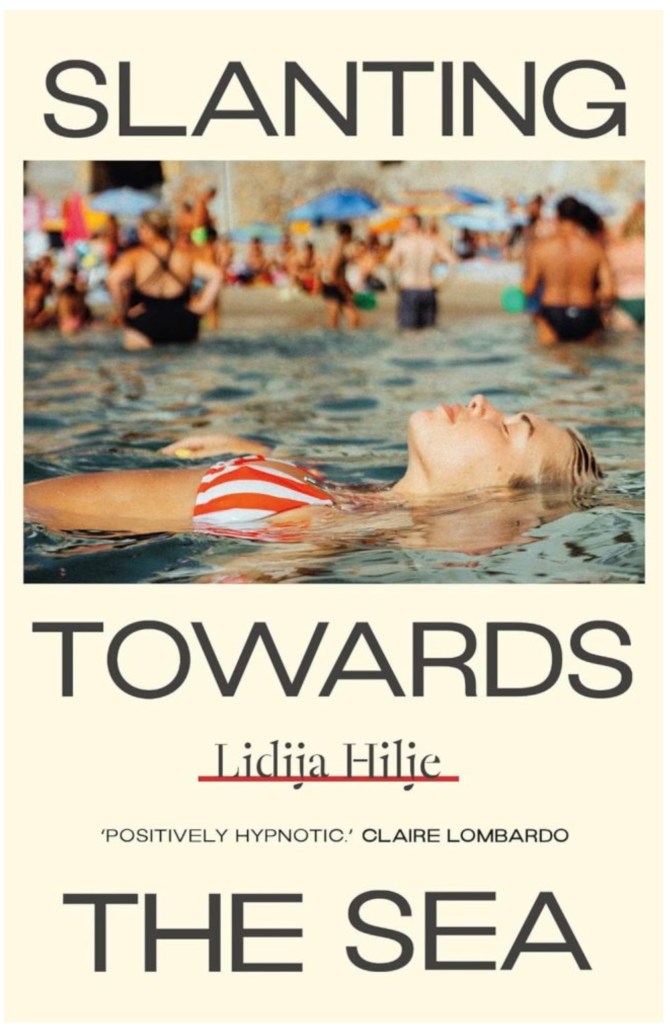
Writing a novel in a language that is not your mother tongue demands clarity, precision and flair on your part and deserves to be applauded, especially when it relates to emotions, shared and individual history, and yearning for things that could have been. In Slanting Towards the Sea this is exactly what Lidija Hilje has achieved: a moving and evocative story of buried feelings in the changing social and economic landscape of her country. Hilje, the Croatian writer and former lawyer, wrote her debut novel in English and I am so impressed by her nuanced style and vivid evocative film-like painting of real and emotional landscapes.
Set in the sun-drenched beautiful city of Zadar, it follows Ivona who has returned to her childhood home to care for her sick father, manage his business affairs and consider selling a place dear to her. Nearly twenty years earlier, she was a biology student in the capital Zagreb where she met fellow student Vlaho Oberan. Their love and passion were deep and all-consuming but unfortunately not future-proof in the long term, mostly down to the social context, as well as the perceptions of other people. After several years the couple had to divorce yet never stopped loving each other. Vlaho’s new wife Marina and children welcomed Ivona into their life and as a result this unusual trio of adults managed to maintain a close friendship. Of course, when eventually a man, Asier Henry, appeared on the scene and ignited some forgotten and unspoken longing in Ivona, the new situation created tumultuous change for them all. Additionally it also forced Vlaho and Marina to see themselves from a different perspective, and it was not easy, as Ivona says: ‘The thing about feeling too much is that sometimes you have to force yourself to feel less. That in order to preserve your heart, you have to close it off, deliberately deny it its main function, and reduce it to a mere pump.’
Structurally Slanting Towards the Sea embraces two intertwining timelines allowing the main character to contemplate her current situation and analyse her life and feelings towards her ex-husband and people close to her. Is she a failure? A coward? The picture of her emotional world is both complex and simple, shaped by al expectations: ‘The path of life had long been instilled in me: elementary school, high school, university, job, marriage, kids.’ She questions own personal and professional choices living in a young country, emerging from the post-Yugoslavian legacy: ‘It’s a special blend that works here, the bureaucratic smarts, paired with a talent for wielding connections and bending rules. Better yet if it comes with a penis.’ A woman’s traditional role is also one of the issues that seriously troubles her, as well as living in the shade of two strong personalities: ‘My parents operating between their three standard settings: togetherness, indifference, and vile fighting.’ Her brutal realisation is that many of her, as well as Vlaho’s, decisions were influenced by staying in ’parent-pleasing’ mode – which leads to them acknowledging their otherwise hidden resentments.
Ultimately though Lidija Hilje’s story is about love and all its aspects, and these two quotes from Ivona are particularly poignant: ’If people want to love you, they do, no matter how flawed you are. But if they aren’t inclined to love you, nothing you say or do, no amount of your own goodness, can make them change their mind.’ And: ‘I nod, thinking about it, about age. About my mum who is now gone. And about that bottomless need inside me, still present now, at thirty-eight, for her and Dad to like me, love me, acknowledge me, take pride in me.’ I would encourage you to step into this sensual, deeply personal and honest space.
 Nordic Lighthouse