
Leo Kall, a research chemist and a very obedient citizen, has been working on a revolutionary new drug that will force everyone to share the most private and innermost personal thoughts. Police are keen to use Kallocain as a new interrogation technique to crush citizens of the totalitarian ‘World State’. Leo begins to feel alienated and terrified.
Let me start with mentioning the translator David McDuff who did an incredible job bringing this pioneering work of dystopian fiction from a Swedish author into emotive and taut precise English. He also wrote an introduction to the novel, and I would like to quote some of his words to get a better understanding of the poet, novelist and essayist Karin Boye. Her science fiction novel, written in 1940, presented a ‘vision of enslaved humanity, an allegory dream- like and grotesque, yet instantly recognizable to anyone then living through the international crisis.’ It is a novel from one of Sweden’s most acclaimed writers that we know nothing or very little of.
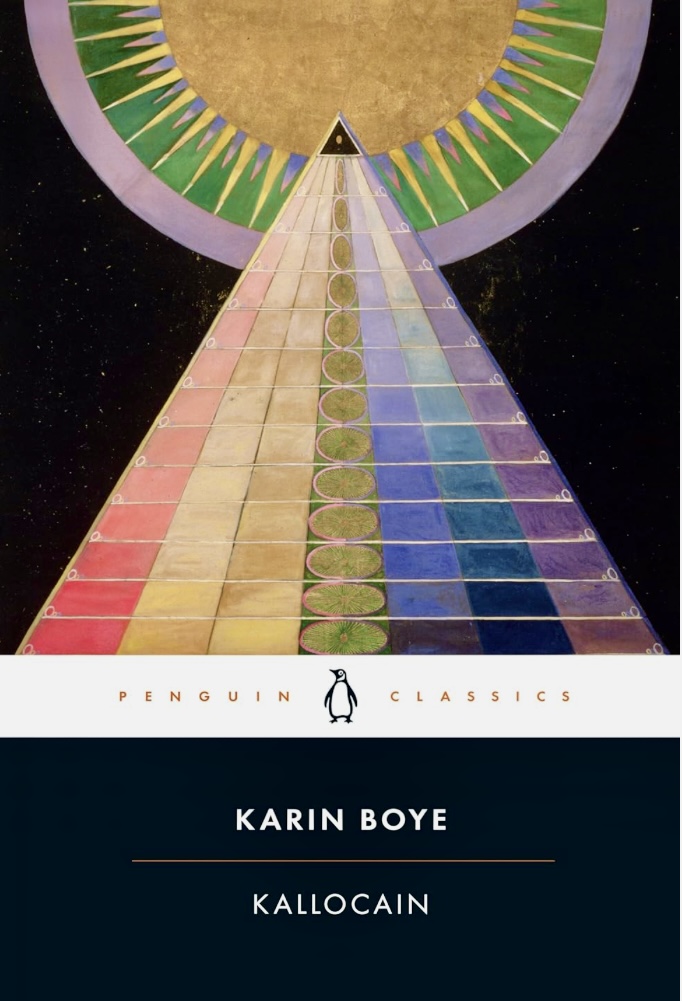
I was reading Kallocain with trepidation, shocked by the incredible clarity of literary vision of its author Karin Boye. It depicts a totalitarian ‘World State’ designed to crush and obliterate the individual and all private thoughts. It is also pure Nineteen Eighty-Four even though it was written eight years before George Orwell’s dystopian classic, with touches of The Handmaid’s Tale which I just couldn’t handle. Boye’s fictionalised futuristic world was influenced by the contemporary unfolding events of the Second World War and two apparently opposing systems: ‘ice-cold reasoning’ of Hitler and the ‘merciless dialectics’ of Stalin’. This chilling and totally absorbing tale follows the research chemist Leo Kall, a very obedient citizen and middle-ranking scientist. He is a Fellow Solider, just as his wife is, and as his three children will be. Their life is rigorously compartmentalised in the society divided by basic skills and needs. Leo has been working on ‘truth drug’ Kallocain which will force truth of anyone when the liquid is injected straight into the bloodstream, making people fall into a sleep-like state and saying what’s on their minds, even the most personal opinions, hidden deep down in subconsciousness. When the drug stops working, everyone is aware and often intensely ashamed of sharing everything. The authorities are excited: ‘Kallocain gives us the possibility of controlling what goes on in people’s minds’ and will replace all other methods of interrogation.
Leo and his superior start initial tests on ‘five subjects from the Voluntary Sacrifice Service’ which proved satisfactory and more ‘human material’ gets brought in to experiment on. Soon the top police get involved, production of Kallocain goes ahead, other Fellow Soldiers are trained to administer it – and Leo begins to fear for his own life. Surrounded by ‘police eyes’ and ‘police ears’ – cameras and microphones – which are in the walls of apartments and houses, and lacking any sense of security at home as Linda often vanishes without a word, he, like everyone else, is terrified of being denounced and found guilty of not denouncing others. Because this is happening as more injections are given to anyone who dares to think differently, more arrests and deaths. However, he realises that there is a seed of opposition in the society, and equally scared of being own person.
Karin Boye paints a bleak desolate landscape of underground buildings and corridors; with a need for surface permissions; dehumanised and alien, lacking colours and smells. Grim. Leo tells his story from the prison where he’s been for over twenty years, not sure how long because of the isolation and induced timelessness, and still continues as a chemist, his existence being still terrified but also a little bit brave and resigned that he must not be completely silent. Whatever happens to him afterwards is unclear; however, I believe that any reader of Kallocain by Karin Boye will be shaken to the core.
Karin Boye (1900–41) was born in Gothenburg, Sweden and studied in Stockholm and Uppsala. As a young woman she joined the international socialist and pacifist organization Clarté and published her first volume of poetry while still in her early twenties. She translated T. S. Eliot’s The Waste Land into Swedish in 1931, and wrote several novels throughout the decade. She married a fellow writer but left her husband after undergoing psychoanalysis in Berlin and formed a lifelong relationship with a German woman, Margot Hanel. Boye’s most famous book, Kallocain (1940), was partly inspired by eye-opening trips to Nazi Germany and Soviet Russia. She died from an overdose of sleeping pills the year after writing the novel.
David McDuff’s translations for Penguin Classics include Dostoyevsky’s Crime and Punishment, The Brothers Karamazov and The Idiot, and Babel’s short stories.
 Nordic Lighthouse