
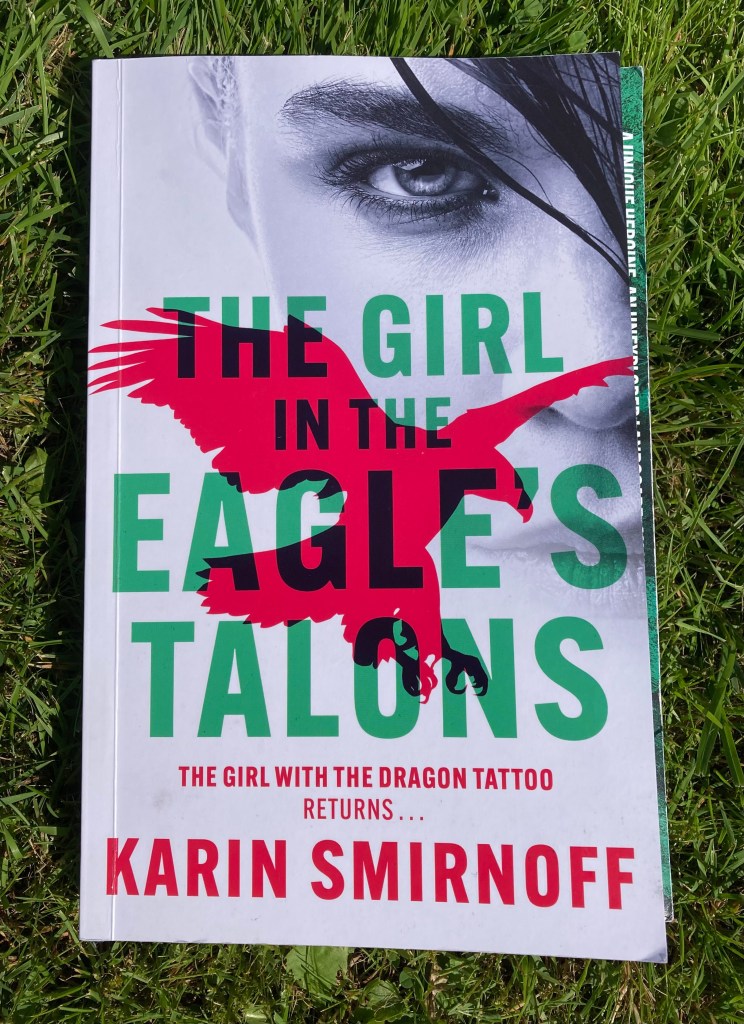
The Girl with the dragon tattoo returns as a grownup woman, independent, running own business and living own life as she wants, in The Girl in the Eagle’s Talons / Havsörnens Skrik. Ferocious, brave and uncompromising as always, this time Lisbeth Salander is thrown into tricky familial situation when asked to look after her thirteen-year-old niece Svala Hirak. Following recent death of the girl’s grandmother and a disappearance of her mother, she travels to the small town of Gasskas in the north of Sweden, and reluctantly takes on a role of her legal guardian. Initially Lisbeth and Svala are like the opposite poles of two magnets: distrustful, sceptical and cynical until they begin to connect, which of course is a very slow gradual process with many dangerous hammers thrown in the works. The gifted teenager, ‘a loner who fights when she has to’, was often ‘used’ by the local gangsters to crack open safes, and threatened to pay for her mother’s debts, whatever they might be.
Mikael Blomkvist heads off to the same place to visit his daughter Pernille soon to be married to a local politician Henry Salo. He’s reflecting on his forthcomings as a father and contemplating own professional future as the Millennium magazine ceased to exist in print and now will be a podcast. The new medium does not appeal to Mikael at all. However, his journalistic instincts awake as soon as he smells an investigation search forming in his head after getting to know his soon-to-be son-in-law. It’s clear the head of council has his fingers in many dubious enterprises and hides shameful past.
Hovering over these two semi-personal plots is the modern problem of the climate change and the fight for control of the natural resources in that part of the country, with the criminal underworld leading the conquest. Several main parties are interested in investing and developing a huge wind turbine project, apparently for the community’s benefit. It seems though that the ambitious venture will bring profits for the international and home-grown baddies only. The main abominable villain wheelchair-bound Marcus Branco kills and rapes for pleasure, while his team kidnaps and terrorizes anyone who might stand in the way. Children are not immune.
Characters from previous Millennium novels make an appearance in the form of references or as actual players. Brutal Ronald Niedermann, Lisbeth’s half-brother and Svala’s father, remains in the memories and in the lingering questions about his murder, and as donor of the genetic gift passed to his daughter, also impervious to pain. Luckily she is also incredibly intelligent and kind. Erika Berger, Millennium’s editor-in-chief and Mikael’s on-and-off lover, is on the outskirts of thoughts. Others are not welcome in the lives of Lisbeth, Svala and Mikael yet have no intention to disappear as they mark new grounds. Svavelsjö MC, or ‘Sea of sulphur’ motorcycle gang that spreads its nasty tentacles into the Northern Sweden, gets involved in shady ‘protection’ business, and follows anyone that throws money and scraps of power in their direction.
With the nods to the previous iconic books by the legendary Stieg Larsson, published posthumously after his sudden death in 2004, and then by his continuator David Lagercrantz (The Girl in the Spider’s Web), and the solid background, Karin Smirnoff maintains the tradition of the Millennium series devised to consist of ten books. She builds on ‘Larsson’s core themes, such as violence, abuse of power, and contemporary political currents.’ Her strong vivid style carries the story of greed, conspiracy and betrayal in the cold snowy wilderness with the old enemies and the new fears. The thriller’s focus on environmental exploitation and underlaying social problems is told from different perspectives, from the invisible ‘cleaner’ to the people in power, both in the official capacity to make laws and from those on the illegal side of the fence. It is not a comfortable read but engaging and intense, nevertheless. Lisbeth and Mikael are recognisable and well portrayed in the new circumstances, though the investigative journalist has lost some of his daring spark. More reflection takes place in their minds, and getting close into their families’ issues makes them uneasy but I feel that the old ‘chemistry’ is still there, behind the screen. Svala comes to the fore with her reasoning, logic and vulnerability and I would hope that her future is lighter than that of her antisocial hacker aunt’s.
Special kudos to Sarah Death who translated The Girl in the Eagle’s Talons making this book the first, in series of seven, with two female creators. Excellent smooth translation of the work that is difficult and full of brutality yet flowing and engaging at the same time. The wild sea eagles, although not directly involved in making of human drama, suffer consequences, left a long-lasting memory for me.
 Nordic Lighthouse
Pingback: Fatal Gambit by David Lagercrantz – Nordic Lighthouse